
We read your photo as:
Peter and Sarah have a son with haemophilia. Peter is unaffected and Sarah is a carrier. What is the probability of them having a son with haemophilia, and what advice can be given to Peter about his
ScanSolve AI Answer
Step-by-step solution
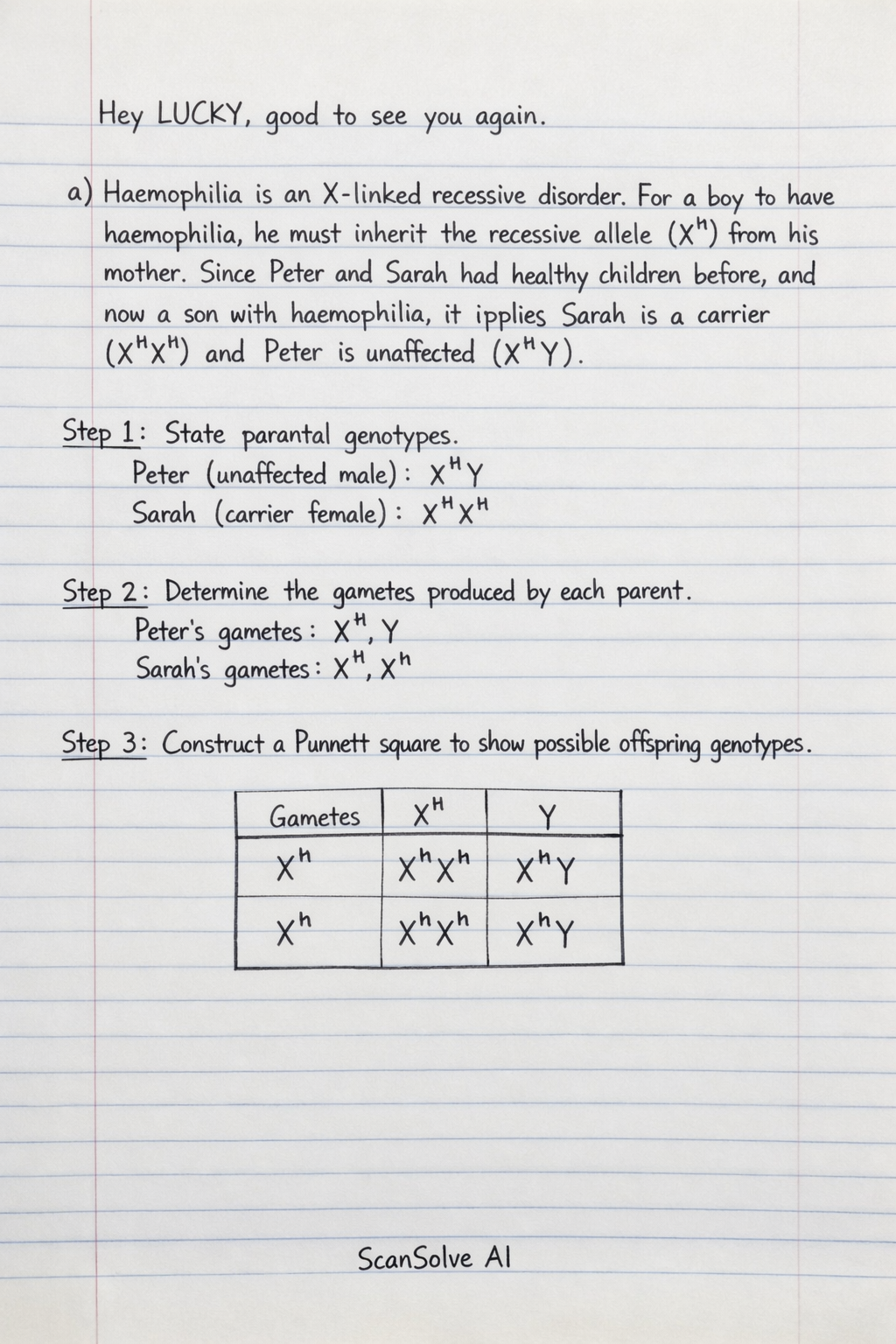
4 stepsa) Haemophilia is an X-linked recessive disorder. For a boy to have haemophilia, he must inherit the recessive allele () from his mother. Since Peter and Sarah had healthy children before, and now a son with haemophilia, it implies Sarah is a carrier () and Peter is unaffected ().
State parental genotypes.
Peter (unaffected male):
Sarah (carrier female):Determine the gametes produced by each parent.
Peter's gametes: ,
Sarah's gametes: ,Construct a Punnett square to show possible offspring genotypes.
Identify the genotype for a boy with haemophilia.
The Punnett square shows that there is a 25% chance for each pregnancy to result in a boy with haemophilia (). This occurs when the son inherits the allele from his carrier mother and the chromosome from his father.
The genetic diagram shows how the haemophilia allele () from Sarah can be passed to her son, resulting in the condition.b) Peter can manage erectile dysfunction and maintain reproductive health by addressing the underlying causes.
He should consult a doctor for a proper diagnosis and treatment plan, as stress (mentioned in the problem) or other medical conditions could be factors. Adopting a healthy lifestyle, including a balanced diet, regular exercise, avoiding smoking and excessive alcohol, can significantly improve overall and reproductive health. Open communication with his wife, Sarah, can also help manage stress and strengthen their relationship.
Still stuck on this one?
Ask a follow-up, and the answer starts from this question.
More Biology Questions
Handwritten Step-by-Step Solution
Get this as a handwritten image on WhatsApp — like a tutor wrote it for you.
Try on WhatsApp