

This business/management problem is solved step by step below, with detailed explanations to help you understand the method and arrive at the correct answer.
ScanSolve AI Answer
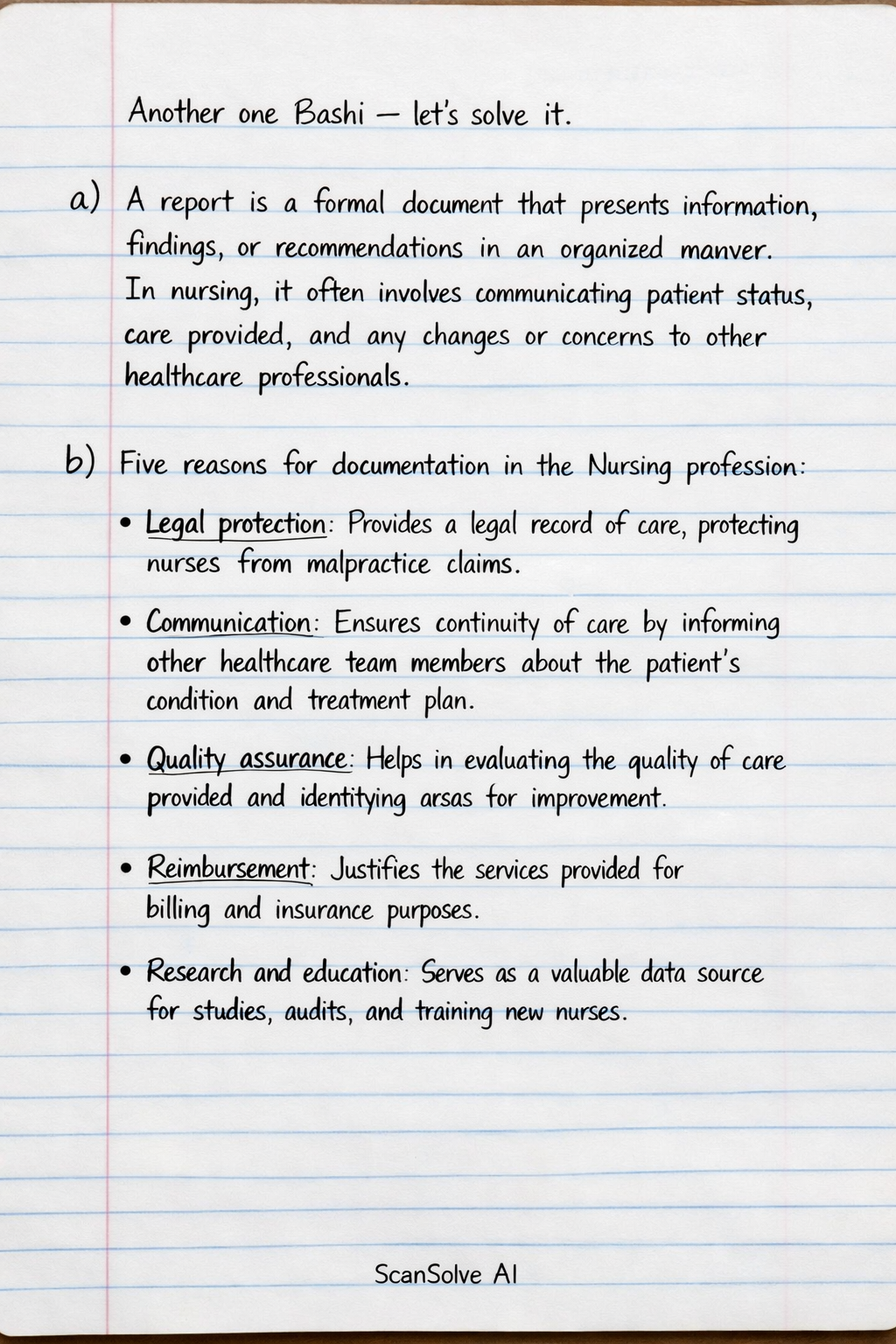
Another one Bashi — let's solve it. a) A report is a formal document that presents information, findings, or recommendations in an organized manner. In nursing, it often involves communicating patient status, care provided, and any changes or concerns to other healthcare professionals. b) Five reasons for documentation in the Nursing profession: • Legal protection: Provides a legal record of care, protecting nurses from malpractice claims. • Communication: Ensures continuity of care by informing other healthcare team members about the patient's condition and treatment plan. • Quality assurance: Helps in evaluating the quality of care provided and identifying areas for improvement. • Reimbursement: Justifies the services provided for billing and insurance purposes. • Research and education: Serves as a valuable data source for studies, audits, and training new nurses. c) Five logistics management information system (LMIS) forms and their purpose used in supply chain management and logistics system: • Stock Card/Bin Card: Used to track the quantity of each item in stock, showing receipts, issues, and balances. • Requisition and Issue Voucher (RIV): Used to request items from a central store and to record their issuance. • Report and Requisition (R&R) Form: Combines reporting of stock status with a request for resupply, often used for periodic ordering. • Delivery Note/Waybill: Accompanies goods during transport, confirming items shipped and received. • Physical Inventory Count Sheet: Used to record actual counts of items during a physical inventory, comparing them to recorded stock levels. d) Five key components of the ARV, EMLIP, and HIV test commodity logistics system: • Selection: Deciding which specific ARVs, EMLIP items, and HIV tests to procure based on national guidelines and disease burden. • Procurement: The process of acquiring these commodities from suppliers, including tendering, contracting, and purchasing. • Storage: Safely housing commodities in appropriate conditions (e.g., temperature control) to maintain their quality and efficacy. • Distribution: Transporting commodities from central warehouses to various health facilities where they are needed. • Information Management: Collecting, analyzing, and using data on stock levels, consumption, and patient needs to make informed logistics decisions. Send me the next one 📸