
We read your photo as:
(i) Determine the overall order of the reaction 2NO(g) + Cl₂(g) 2NOCl(g) showing all the steps.
ScanSolve AI Answer
This answer stops before the end.
It was cut off when it was first written. Ask ScanSolve this question again for the full working.
Here are the solutions to the questions:
1. (d) (i) Determine the overall order of the reaction showing all the steps.
The general rate law for this reaction can be written as:
where is the order with respect to , is the order with respect to , and is the rate constant.
Step 1: Determine the order with respect to ().
Compare Experiment 1 and Experiment 2, where is kept constant.
From Experiment 1:
From Experiment 2:
Divide by :
Therefore, . The reaction is first order with respect to .
Step 2: Determine the order with respect to ().
Compare Experiment 2 and Experiment 3, where is kept constant.
From Experiment 2:
From Experiment 3:
Divide by :
Still stuck on this one?
Ask a follow-up, and the answer starts from this question.
More Chemistry Questions
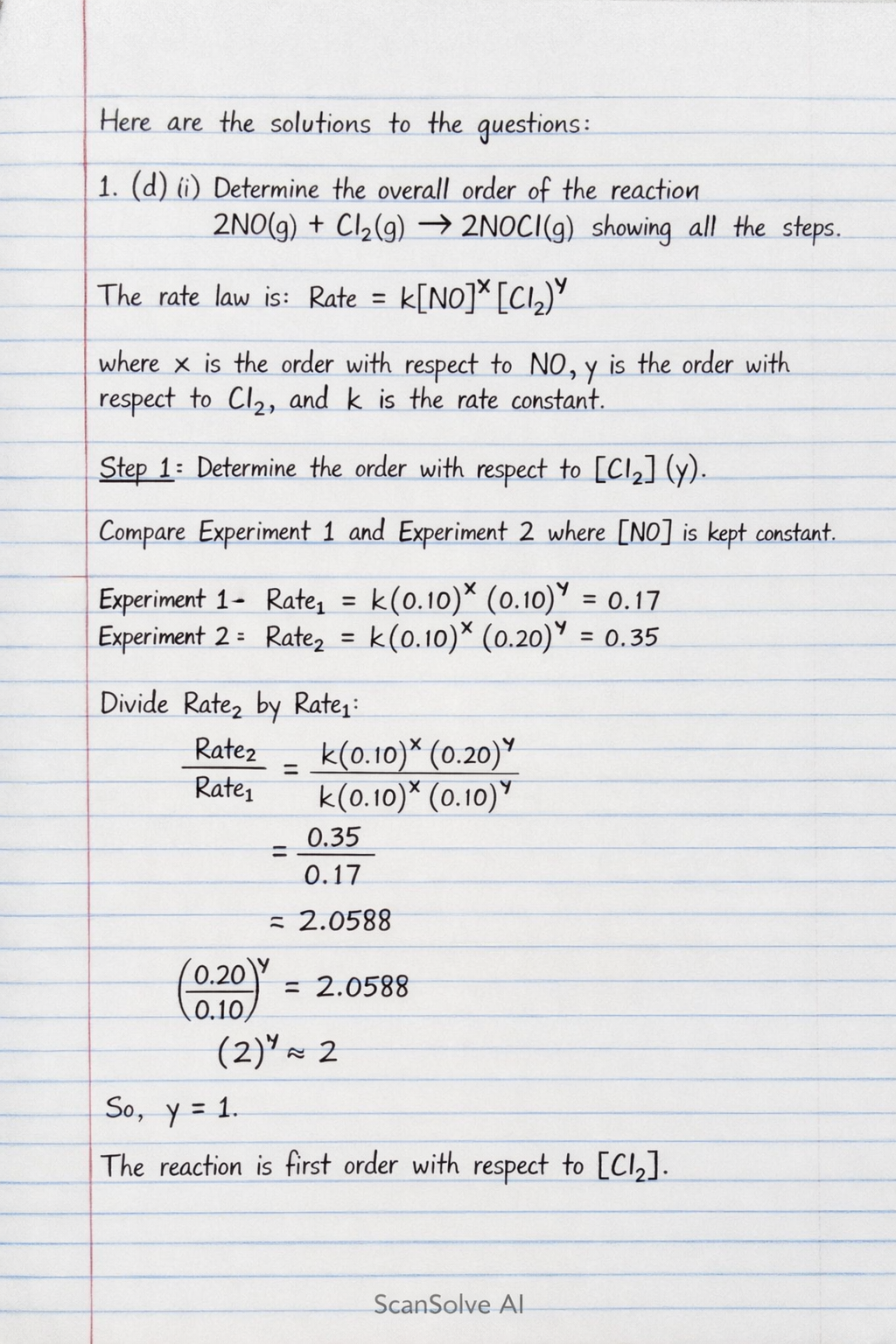
Handwritten Step-by-Step Solution
Get this as a handwritten image on WhatsApp — like a tutor wrote it for you.
Try on WhatsApp