
This chemistry question involves key chemical concepts and calculations. The detailed solution below walks through each step, from identifying the reaction type to computing the final answer.
ScanSolve AI Answer
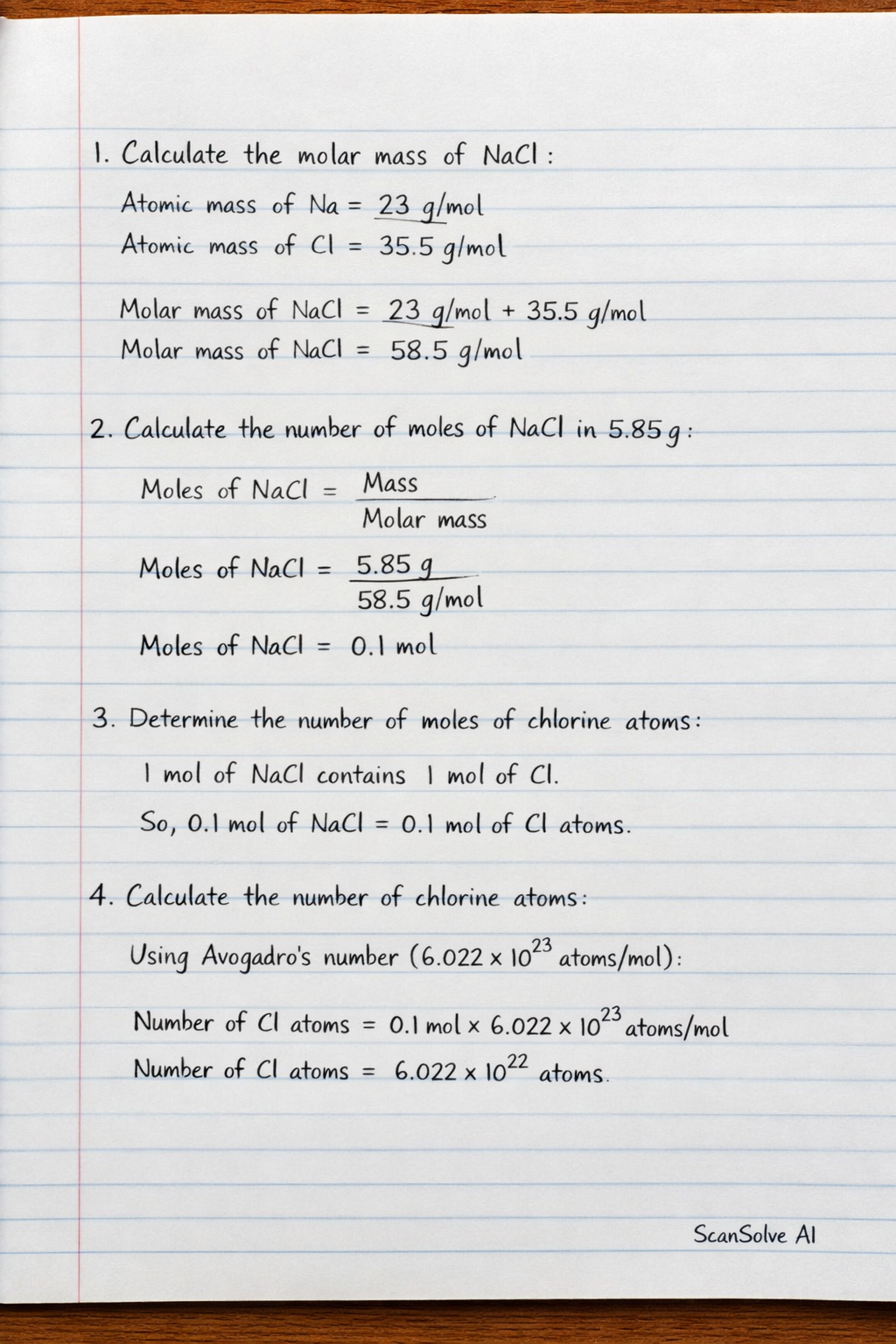
1. Step 1: Calculate the molar mass of NaCl. The atomic mass of Na is 23 g/mol. The atomic mass of Cl is 35.5 g/mol. Molar mass of NaCl = atomic mass of Na + atomic mass of Cl Molar mass of NaCl = 23 g/mol + 35.5 g/mol Molar mass of NaCl = 58.5 g/mol Step 2: Calculate the number of moles of NaCl in 5.85 g. Moles of NaCl = MassMolar mass Moles of NaCl = 5.85 g58.5 g/mol Moles of NaCl = 0.1 mol Step 3: Determine the number of moles of chlorine atoms. In one molecule of NaCl, there is one atom of Cl. Therefore, 0.1 mol of NaCl contains 0.1 mol of Cl atoms. Step 4: Calculate the number of chlorine atoms. Using Avogadro's number (6.022 × 10^23 atoms/mol): Number of Cl atoms = Moles of Cl atoms × Avogadro's number Number of Cl atoms = 0.1 mol × 6.022 × 10^23 atoms/mol Number of Cl atoms = 6.022 × 10^22 atoms The number of atoms of chlorine present in 5.85g of NaCl is 6.022 × 10^22 atoms. 2. Step 1: Analyze the first oxide of copper. Mass of oxide = 2.25 g Mass of copper = 2.00 g Mass of oxygen = Mass of oxide - Mass of copper Mass of oxygen = 2.25 g - 2.00 g = 0.25 g Ratio of copper to oxygen in the first oxide: Mass of copperMass of oxygen = 2.00 g0.25 g = 8 Step 2: Analyze the second oxide of copper. Mass of oxide = 2.50 g Mass of copper = 2.00 g Mass of oxygen = Mass of oxide - Mass of copper Mass of oxygen = 2.50 g - 2.00 g = 0.50 g Ratio of copper to oxygen in the second oxide: Mass of copperMass of oxygen = 2.00 g0.50 g = 4 Step 3: Compare the ratios of copper to oxygen. For a fixed mass of copper (2.00 g), the masses of oxygen that combine with it are 0.25 g (in the first oxide) and 0.50 g (in the second oxide). The ratio of these masses of oxygen is: Mass of oxygen (second oxide)Mass of oxygen (first oxide) = 0.50 g0.25 g = 2 This ratio (2:1) is a simple whole number. Step 4: Identify the law. This observation illustrates the Law of Multiple Proportions. This law states that if two elements can combine to form more than one compound, then the ratios of the masses of the second element that combine with a fixed mass of the first element are ratios of small whole numbers. These results illustrate the law of: Multiple Proportions.