
We read your photo as:
Explain three roles of chemistry in ensuring safety of such herbal products.
ScanSolve AI Answer
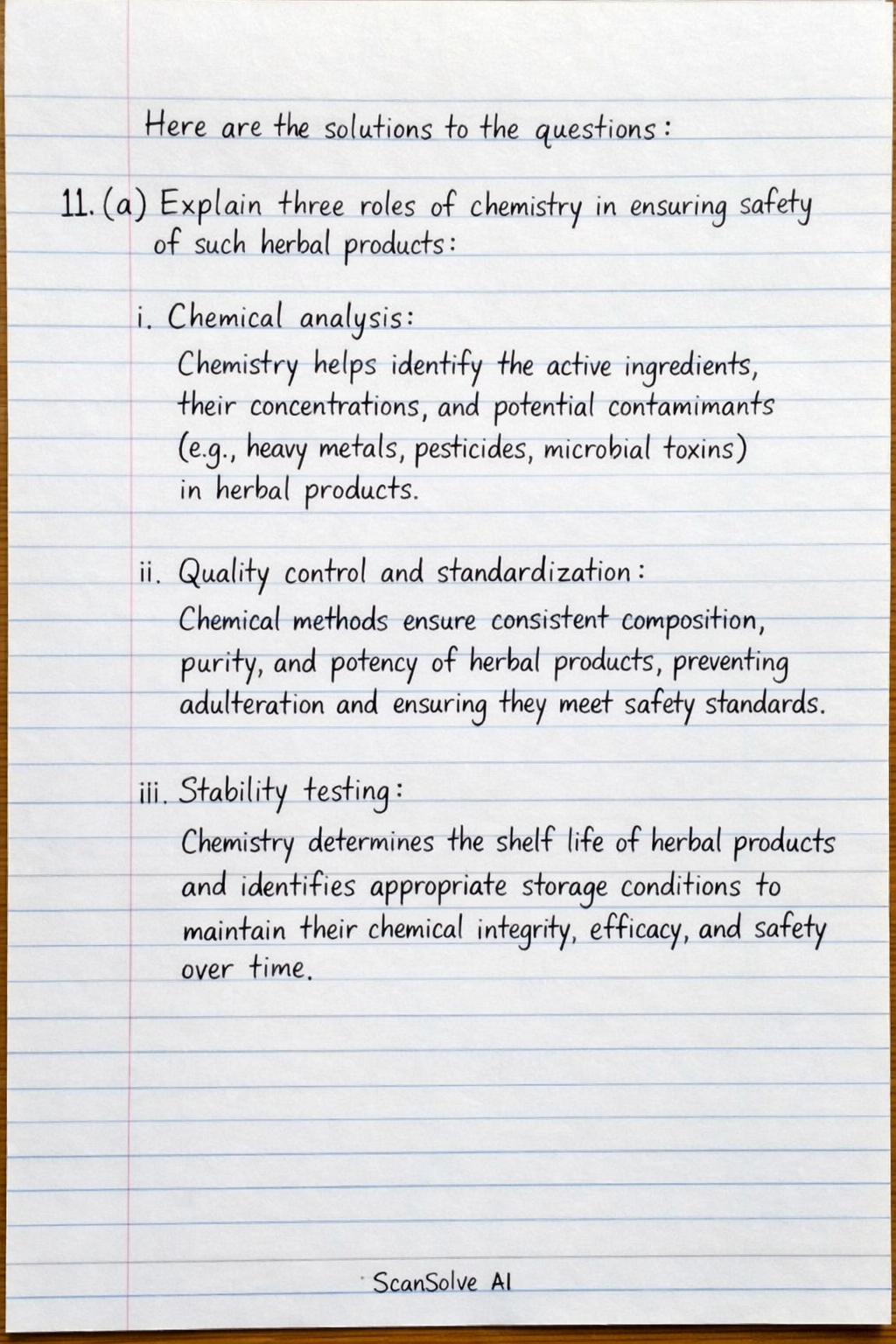
Here are the solutions to the questions:
11. (a) Explain three roles of chemistry in ensuring safety of such herbal products.
i. Chemical analysis: Chemistry helps identify the active ingredients, their concentrations, and potential contaminants (e.g., heavy metals, pesticides, microbial toxins) in herbal products.
ii. Quality control and standardization: Chemical methods ensure consistent composition, purity, and potency of herbal products, preventing adulteration and ensuring they meet safety standards.
iii. Stability testing: Chemistry determines the shelf life of herbal products and identifies appropriate storage conditions to maintain their chemical integrity, efficacy, and safety over time.
11. (b) Describe two responsibilities of consumers when buying herbal substances.
i. Consumers should read and understand product labels carefully, checking for ingredients, dosage instructions, expiry dates, and any warnings or contraindications.
ii. Consumers should purchase herbal products from reputable sources to ensure they are buying genuine, quality-controlled products and to avoid counterfeit or contaminated substances.
11. (c) State two qualities of a safe learning/working environment in a chemistry lab.
i. A chemistry lab should have proper ventilation (e.g., fume hoods) to remove hazardous fumes and maintain air quality.
ii. A safe lab environment must have readily available and functional safety equipment, such as fire extinguishers, eye wash stations, safety showers, and first aid kits.
12. (a) Explain two reasons why young people abuse drugs such as glue/cobbler's blue.
i. Peer pressure and social influence: Young people may succumb to pressure from friends or social groups to experiment with drugs to fit in or gain acceptance.
ii. Coping mechanism: Some teenagers use drugs like inhalants to escape from stress, anxiety, depression, or difficult home environments, seeking a temporary sense of euphoria or detachment.
12. (b) For each of the drugs below, describe one mode of intake and one health effect:
i) Cocaine
- Mode of intake: Snorting (inhaling through the nose)
- Health effect: Increased heart rate and blood pressure, leading to risk of heart attack or stroke.
ii) Illicit brew (chang'aa)
- Mode of intake: Drinking
- Health effect: Severe liver damage (e.g., cirrhosis) or kidney failure, and potential blindness if contaminated with methanol.
iii) Cannabis (bhang)
- Mode of intake: Smoking
- Health effect: Impaired memory and concentration, and potential respiratory problems with prolonged use.
Still stuck on this one?
Ask a follow-up, and the answer starts from this question.
More Chemistry Questions
Handwritten Step-by-Step Solution
Get this as a handwritten image on WhatsApp — like a tutor wrote it for you.
Try on WhatsApp