

This chemistry question involves key chemical concepts and calculations. The detailed solution below walks through each step, from identifying the reaction type to computing the final answer.
ScanSolve AI Answer
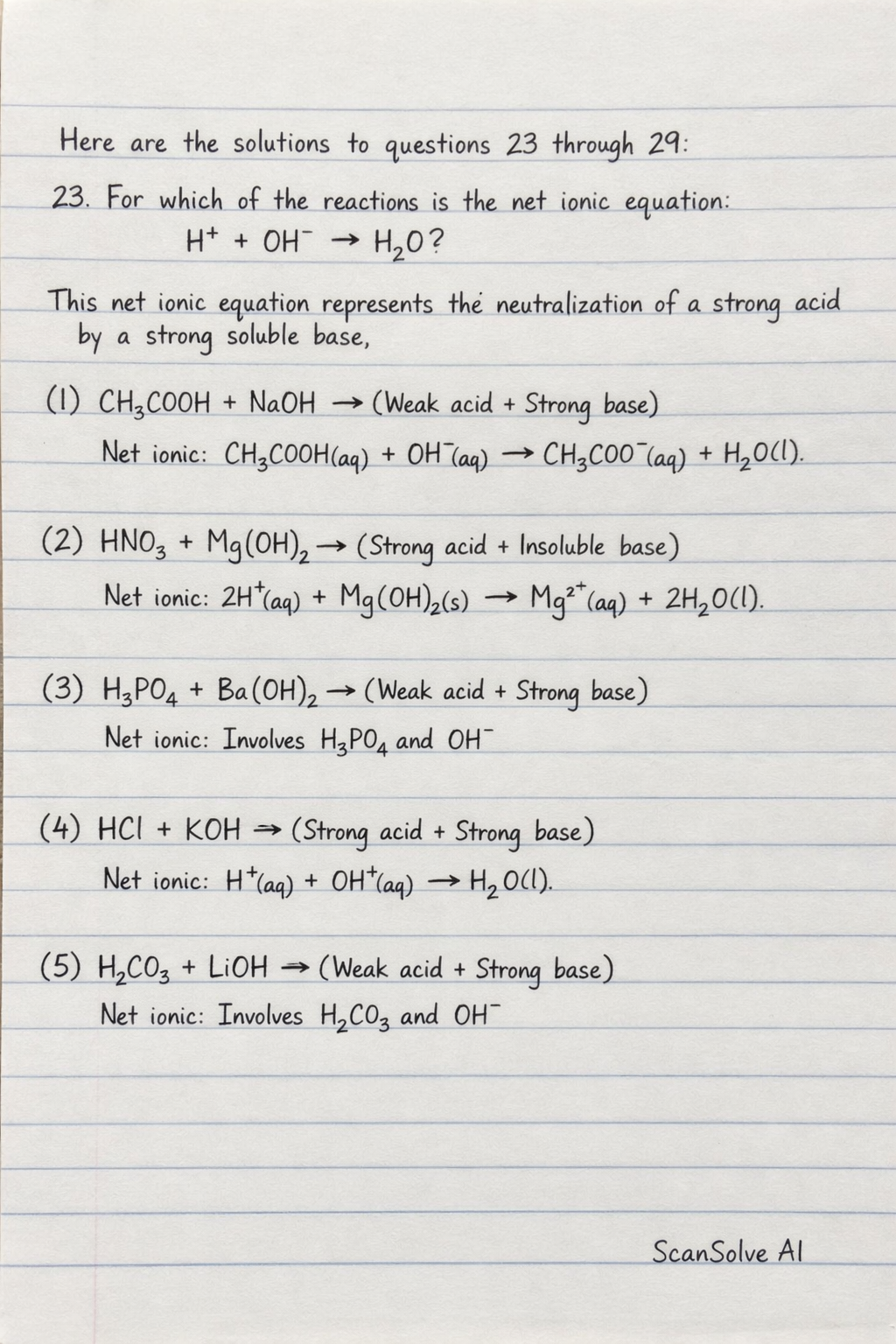
Here are the solutions to questions 23 through 29: 23. For which of the reactions is the net ionic equation: H^+ + OH^- → H_2O? This net ionic equation represents the neutralization of a strong acid by a strong soluble base. (1) CH_3COOH + NaOH → (Weak acid + Strong base) - Net ionic equation: CH_3COOH(aq) + OH^-(aq) → CH_3COO^-(aq) + H_2O(l). (2) HNO_3 + Mg(OH)_2 → (Strong acid + Insoluble/sparingly soluble strong base) - Net ionic equation: 2H^+(aq) + Mg(OH)_2(s) → Mg^2+(aq) + 2H_2O(l). (3) H_3PO_4 + Ba(OH)_2 → (Weak acid + Strong base) - Net ionic equation involves H_3PO_4 and OH^-. (4) HCl + KOH → (Strong acid + Strong soluble base) - Net ionic equation: H^+(aq) + OH^-(aq) → H_2O(l). (5) H_2CO_3 + LiOH → (Weak acid + Strong base) - Net ionic equation involves H_2CO_3 and OH^-. Only reaction (4) involves a strong acid and a strong soluble base that fully dissociates, resulting in the net ionic equation H^+ + OH^- → H_2O. The correct answer is C. 4. 24. Which one of the following represents the net ionic equation for the reaction of nitric acid with aluminum hydroxide? Step 1: Write the balanced molecular equation. Nitric acid (HNO_3) is a strong acid. Aluminum hydroxide (Al(OH)_3) is an insoluble base. 3HNO_3(aq) + Al(OH)_3(s) → Al(NO_3)_3(aq) + 3H_2O(l) Step 2: Write the complete ionic equation. Strong acids and soluble ionic compounds are written as dissociated ions. Insoluble compounds remain as solids. 3H^+(aq) + 3NO_3^-(aq) + Al(OH)_3(s) → Al^3+(aq) + 3NO_3^-(aq) + 3H_2O(l) Step 3: Identify and cancel spectator ions. The spectator ion is NO_3^-. 3H^+(aq) + Al(OH)_3(s) → Al^3+(aq) + 3H_2O(l) The correct answer is A. 3H^+ + Al(OH)_3 → Al^3+ + 3H_2O. 25. Which one of the following is an amphoteric metal hydroxide? An amphoteric substance can react as both an acid and a base. A. KOH (Potassium hydroxide) is a strong base. B. Ba(OH)_2 (Barium hydroxide) is a strong base. C. Pb(OH)_2 (Lead(II) hydroxide) is known to be amphoteric, reacting with strong acids and strong bases. D. LiOH (Lithium hydroxide) is a strong base. The correct answer is C. Pb(OH)_2. 26. According to the Lewis theory, a base ______. A. is a proton acceptor. (Bronsted-Lowry base) B. is a proton donor. (Bronsted-Lowry acid) C. makes available a share in a pair of electrons. (This is the definition of a Lewis base, an electron-pair donor.) D