

This chemistry question involves key chemical concepts and calculations. The detailed solution below walks through each step, from identifying the reaction type to computing the final answer.
ScanSolve AI Answer
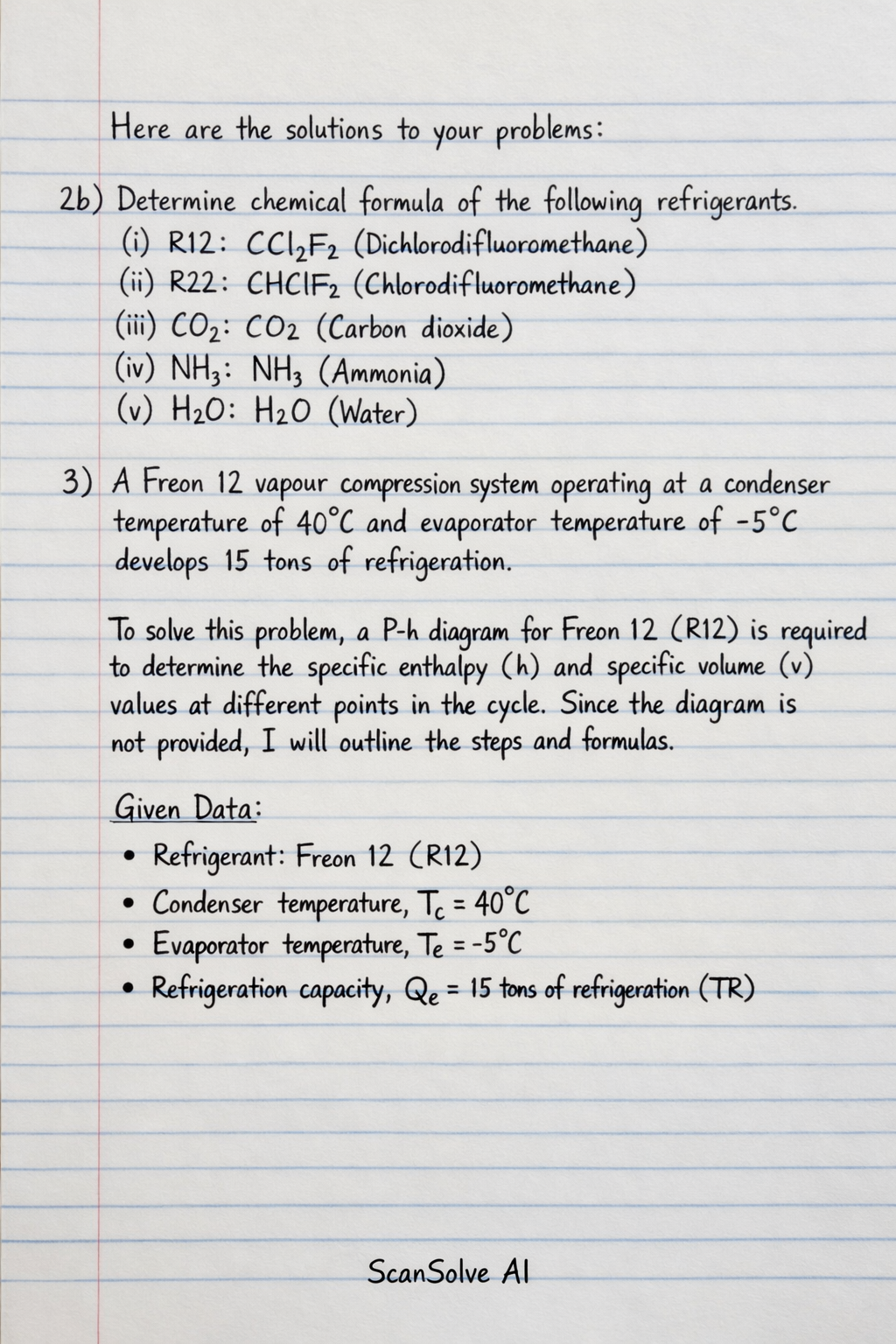
Here are the solutions to your problems: 2b) Determine chemical formula of the following refrigerants (i) R12: CCl_2F_2 (Dichlorodifluoromethane) (ii) R22: CHClF_2 (Chlorodifluoromethane) (iii) CO_2: CO_2 (Carbon dioxide) (iv) NH_3: NH_3 (Ammonia) (v) H_2O: H_2O (Water) 3) A Freon 12 vapour compression system operating at a condenser temperature of 40^ and evaporator temperature of -5^ develops 15 tons of refrigeration. To solve this problem, a P-h diagram for Freon 12 (R12) is required to determine the specific enthalpy (h) and specific volume (v) values at different points in the cycle. Since the diagram is not provided, I will outline the steps and formulas. Given Data: Refrigerant: Freon 12 (R12) Condenser temperature, T_c = 40^ Evaporator temperature, T_e = -5^ Refrigeration capacity, Q_e = 15 tons of refrigeration (TR) Conversion: 1 ton of refrigeration (TR) = 3.517 kW Q_e = 15 TR × 3.517 kWTR = 52.755 kW Cycle Points (from P-h diagram): State 1 (Evaporator outlet, compressor inlet): Saturated vapor at T_e = -5^. Read h_1 (enthalpy), v_1 (specific volume), s_1 (entropy) from the diagram. State 2 (Compressor outlet, condenser inlet): Superheated vapor after isentropic compression from State 1 to the condenser pressure (corresponding to T_c = 40^). Follow an isentropic line (s_2 = s_1) from State 1 to the condenser pressure. Read h_2. State 3 (Condenser outlet, expansion valve inlet): Saturated liquid at T_c = 40^. Read h_3 from the diagram. State 4 (Expansion valve outlet, evaporator inlet): Liquid-vapor mixture after isenthalpic expansion from State 3. h_4 = h_3. Calculations: i) Mass flow rate of refrigerant circulated (m): The refrigeration capacity is given by: Q_e = m(h_1 - h_4) m = (Q_e)/(h_1 - h_4) Numerical value cannot be determined without h_1 and h_4 from the P-h diagram. ii) Theoretical piston displacement of the compressor (V) and piston displacement per ton of refrigeration: The theoretical piston displacement is: V = m · v_1 Piston displacement per ton of refrigeration: VTR = m · v_1Q_e/TR Numerical values cannot be determined without m and v_1 from the P-h diagram. iii) Theoretical horse power of the compressor (W_c) and horse power per ton of refrigeration: The theoretical compressor work is: W_c = m(h_2 - h_1) To convert to horsepower (HP), use 1 HP = 0.7457 kW: W_c (HP) = m(h_2 - h_1)0.7457 Horse power per ton of refrigeration: W_c (HP)TR = W_c (HP)Q_e/TR Numerical values cannot be determined without m, h_1, and h_2 from the P-h diagram. iv) Heat rejected in the condenser (Q_c): The heat rejected in the condenser is: Q_c = m(h_2 - h_3) Numerical value cannot be determined without m, h_2, and h_3 from the P-h diagram. v) Carnot COP and actual COP of the cycle: Carnot COP (COP_Carnot): Convert temperatures to Kelvin: T_e = -5^ + 273.15 = 268.15 K T_c = 40^ + 273.15 = 313.15 K COP_Carnot = (T_e)/(T_c - T_e) = 268.15 K313.15 K - 268.15 K = (268.15)/(45) ≈ 5.959 Actual COP (COP_actual): COP_actual = (Q_e)/(W_c) = m(h_1 - h_4)m(h_2 - h_1) = (h_1 - h_4)/(h_2 - h_1) Numerical value cannot be determined without h_1, h_2, and h_4 from the P-h diagram.