

This chemistry question involves key chemical concepts and calculations. The detailed solution below walks through each step, from identifying the reaction type to computing the final answer.
ScanSolve AI Answer
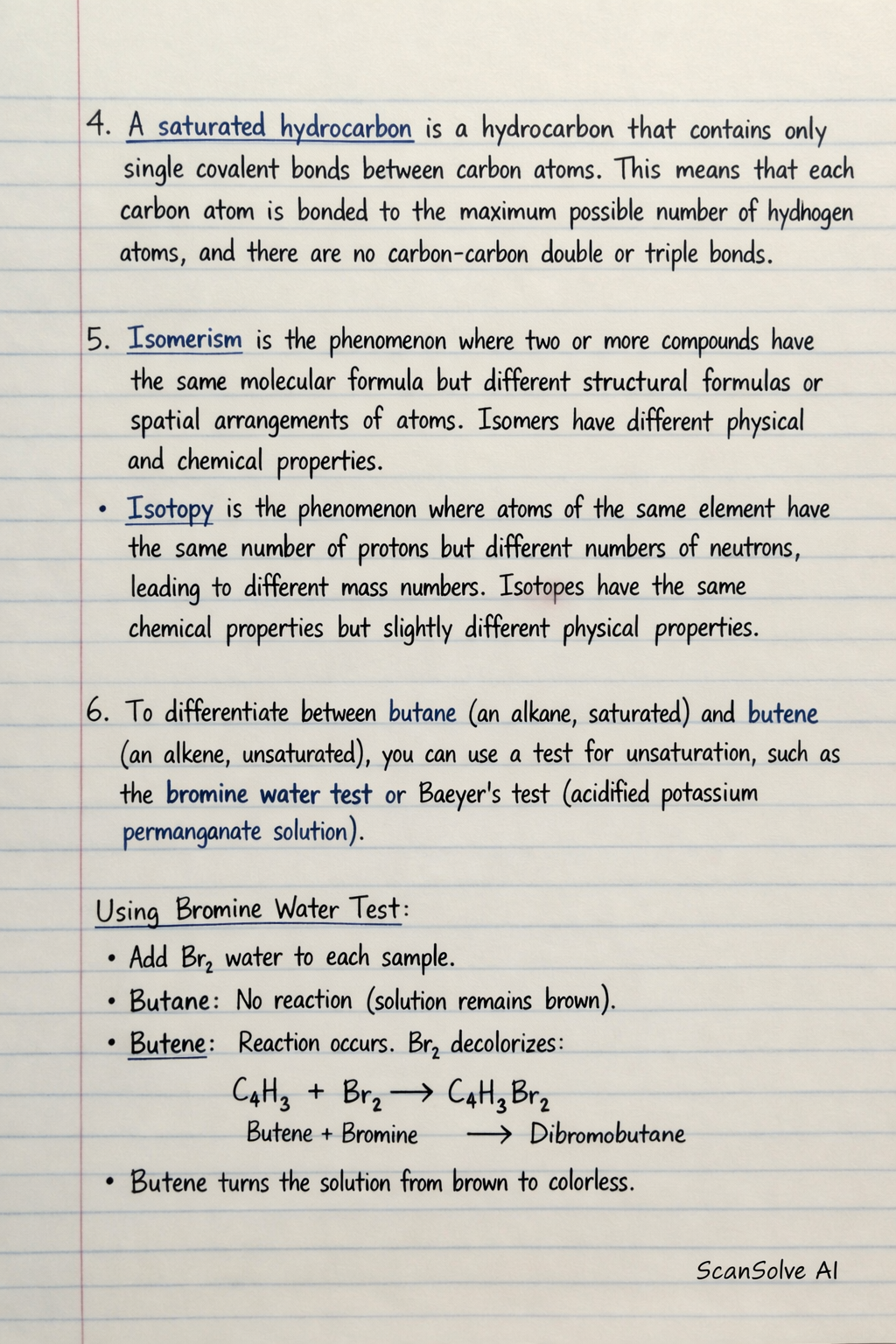
4. A saturated hydrocarbon is a hydrocarbon that contains only single covalent bonds between carbon atoms. This means that each carbon atom is bonded to the maximum possible number of hydrogen atoms, and there are no carbon-carbon double or triple bonds. 5. • Isomerism is the phenomenon where two or more compounds have the same molecular formula but different structural formulas or spatial arrangements of atoms. Isomers have different physical and chemical properties. • Isotopy is the phenomenon where atoms of the same element have the same number of protons but different numbers of neutrons, leading to different mass numbers. Isotopes have the same chemical properties but slightly different physical properties. 6. To differentiate between butane (an alkane, saturated) and butene (an alkene, unsaturated), you can use a test for unsaturation, such as the bromine water test or Baeyer's test (acidified potassium permanganate solution). Using Bromine Water Test: Step 1: Place a small sample of butane in one test tube and a small sample of butene in another test tube. Step 2: Add a few drops of bromine water (orange-brown solution) to each test tube. Step 3: Shake both test tubes and observe the changes. Observations: • In the test tube containing butene, the orange-brown color of the bromine water will disappear (decolorize) rapidly. This is because butene, being an alkene, undergoes an addition reaction with bromine. CH_3CH_2CH=CH_2(g) + Br_2(aq) CH_3CH_2CHBr-CH_2Br(l) • In the test tube containing butane, the orange-brown color of the bromine water will remain unchanged. Butane, being a saturated alkane, does not readily react with bromine water under normal conditions. Conclusion: The hydrocarbon that decolorizes bromine water is butene, while the one that does not is butane.