

This chemistry question involves key chemical concepts and calculations. The detailed solution below walks through each step, from identifying the reaction type to computing the final answer.
ScanSolve AI Answer
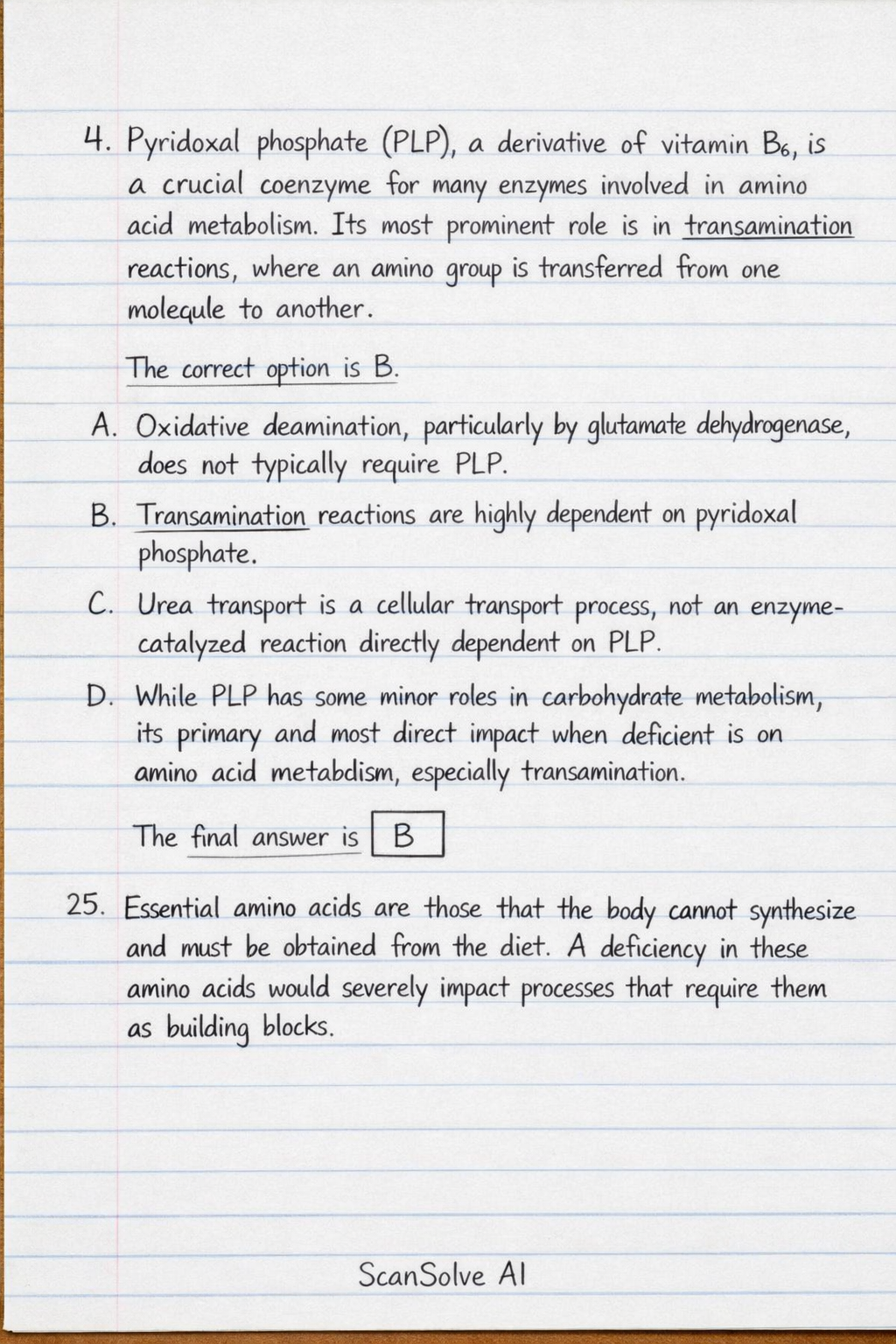
4. Pyridoxal phosphate (PLP), a derivative of vitamin B6, is a crucial coenzyme for many enzymes involved in amino acid metabolism. Its most prominent role is in transamination reactions, where an amino group is transferred from one molecule to another. The correct option is B. A. Oxidative deamination, particularly by glutamate dehydrogenase, does not typically require PLP. B. Transamination reactions* are highly dependent on pyridoxal phosphate. C. Urea transport is a cellular transport process, not an enzyme-catalyzed reaction directly dependent on PLP. D. While PLP has some minor roles in carbohydrate metabolism, its primary and most direct impact when deficient is on amino acid metabolism, especially transamination. The final answer is B 25. Essential amino acids are those that the body cannot synthesize and must be obtained from the diet. A deficiency in these amino acids would severely impact processes that require them as building blocks. The correct option is C. A. Protein synthesis* directly requires all necessary amino acids, including essential ones, to build new proteins. A deficiency would severely impair this. B. Tissue repair* involves synthesizing new proteins and cells, which is dependent on the availability of essential amino acids. A deficiency would hinder this. C. Nitrogen excretion is the process of removing nitrogenous waste (primarily urea) from the body, which is a consequence of amino acid breakdown. While the nitrogen comes from amino acids, the process of excretion itself (e.g., the urea cycle) is not directly dependent on the availability of essential amino acids* for its function. In fact, if essential amino acids are deficient, the body might break down existing proteins, leading to an increase in nitrogenous waste that still needs to be excreted. Therefore, the process of nitrogen excretion would be least affected in terms of its ability to occur, compared to processes that directly require essential amino acids as building blocks. D. Growth* involves the synthesis of new tissues and proteins, which requires a sufficient supply of all amino acids, including essential ones. A deficiency would impair growth. The final answer is C