
We read your photo as:
A) Explain which of the above are isotopes of Neon. b) A student states "If two atoms have different numbers of neutrons, they must be different elements". Is this statement true or false? Explain you
ScanSolve AI Answer
Step-by-step solution
13 steps1) Examine the information provided below.
a) Explain which of the above are isotopes of Neon.
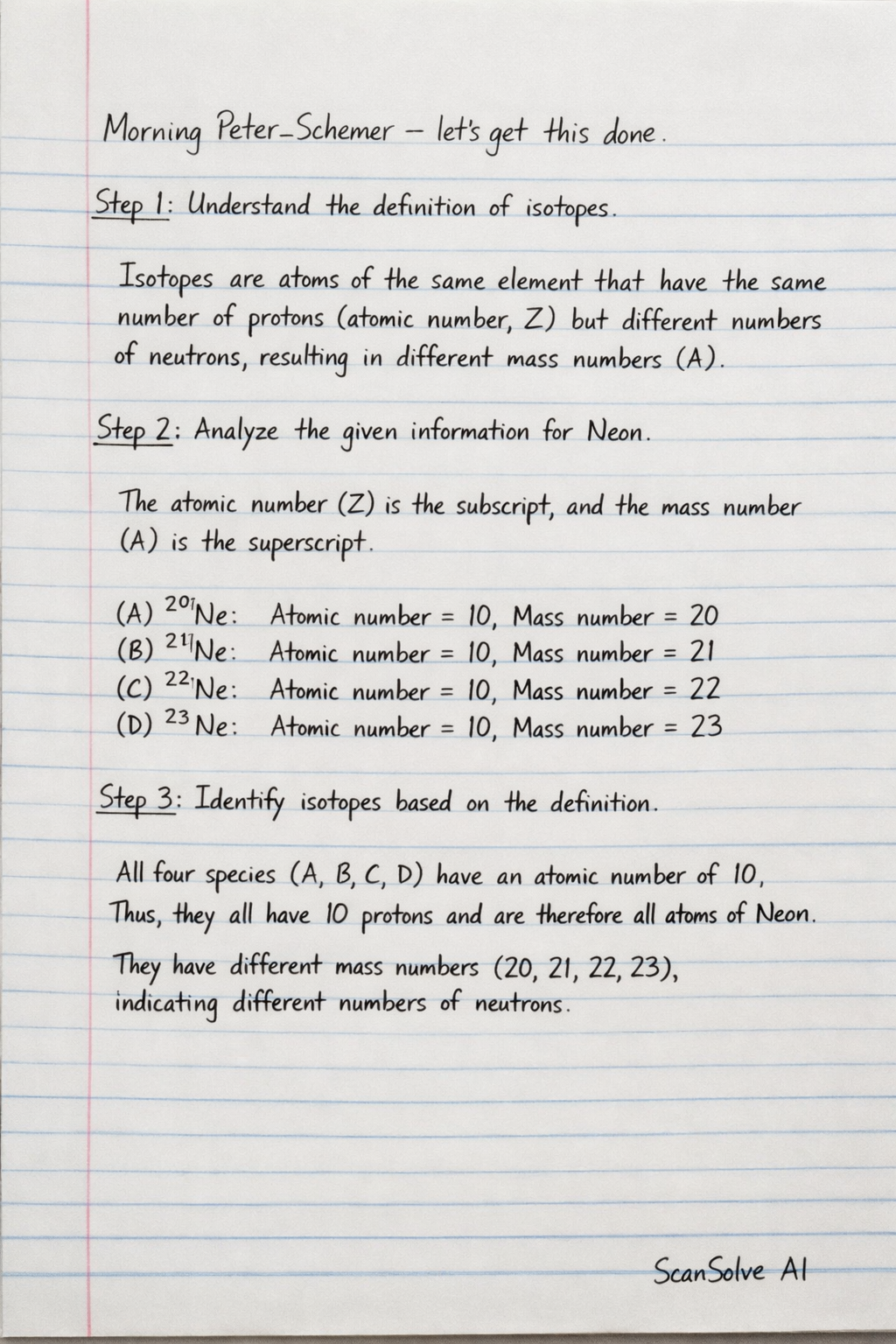
Understand the definition of isotopes.
Isotopes are atoms of the same element that have the same number of protons (atomic number, Z) but different numbers of neutrons, resulting in different mass numbers (A).
Analyze the given information for Neon.
The atomic number (Z) is the subscript, and the mass number (A) is the superscript.
- (A) : Atomic number = 10, Mass number = 20
- (B) : Atomic number = 10, Mass number = 21
- (C) : Atomic number = 10, Mass number = 22
- (D) : Atomic number = 10, Mass number = 23
Identify isotopes based on the definition.
All four species (A, B, C, D) have an atomic number of 10, which means they all have 10 protons and are therefore all atoms of Neon. They have different mass numbers (20, 21, 22, 23), indicating different numbers of neutrons.
- Therefore, all of the given species (, , , and ) are isotopes of Neon.
2) A student states "If two atoms have different numbers of neutrons, they must be different elements". Is this statement true or false? Explain your answer using a suitable example.
Evaluate the statement.
The statement claims that a difference in neutron count must mean different elements. This is incorrect because isotopes of the same element have different numbers of neutrons. The identity of an element is determined by its number of protons (atomic number), not its number of neutrons.
Provide an example.
Consider the element Carbon (C), which always has 6 protons.
- Carbon-12 () has neutrons.
- Carbon-14 () has neutrons.
Conclude based on the example.
Carbon-12 and Carbon-14 have different numbers of neutrons (6 vs. 8), but they are both the same element, Carbon. This demonstrates that the student's statement is false.
3) Determine the percentage abundance of the two isotopes of lithium-7 and lithium-6, given that the Relative Atomic Mass of the element is 6.941.
Define variables for the abundances.
Let be the fractional abundance of Lithium-7 ().
Then, the fractional abundance of Lithium-6 () will be .Set up the equation for relative atomic mass.
The relative atomic mass is the weighted average of the masses of its isotopes.
Using the mass numbers as approximate isotope masses:
Solve the equation for .
Calculate the percentage abundances.
Percentage abundance of Lithium-7:
Percentage abundance of Lithium-6:
The percentage abundance of Lithium-7 is
\boxed{\text{94.1%}}and Lithium-6 is\boxed{\text{5.9%}}.4) Determine Group and Period of Boron of atomic no 5 using S & P notation.
Write the electron configuration for Boron (atomic number 5).
Boron has 5 electrons. Following the Aufbau principle:
Determine the Period.
The period number corresponds to the highest principal quantum number () in the electron configuration. In this case, the highest is 2.
- Period: 2
Determine the Group.
For main group elements (s-block and p-block), the group number is determined by the number of valence electrons. Valence electrons are those in the outermost shell (highest ).
The outermost shell is , which contains .
Number of valence electrons = .
For p-block elements, the modern IUPAC group number is .- Group:
The Group of Boron is and the Period is .
Still stuck on this one?
Ask a follow-up, and the answer starts from this question.
More Chemistry Questions
Handwritten Step-by-Step Solution
Get this as a handwritten image on WhatsApp — like a tutor wrote it for you.
Try on WhatsApp