A mixture of CO(g) and H2O(g) at equilibrium contains 0.6 mol CO, 0.6 mol H2O, 0.1 mol CO2, and 0.1 mol H2 in a 2 dm3 flask. Kc = 4. Calculate the mass of CO at equilibrium.
|Chemistry
A mixture of CO(g) and H2O(g) at equilibrium contains 0.6 mol CO, 0.6 mol H2O, 0.1 mol CO2, and 0.1 mol H2 in a 2 dm3 flask. Kc = 4. Calculate the mass of CO at equilibrium.
ScanSolve AI Answer
Answer
6.54 g
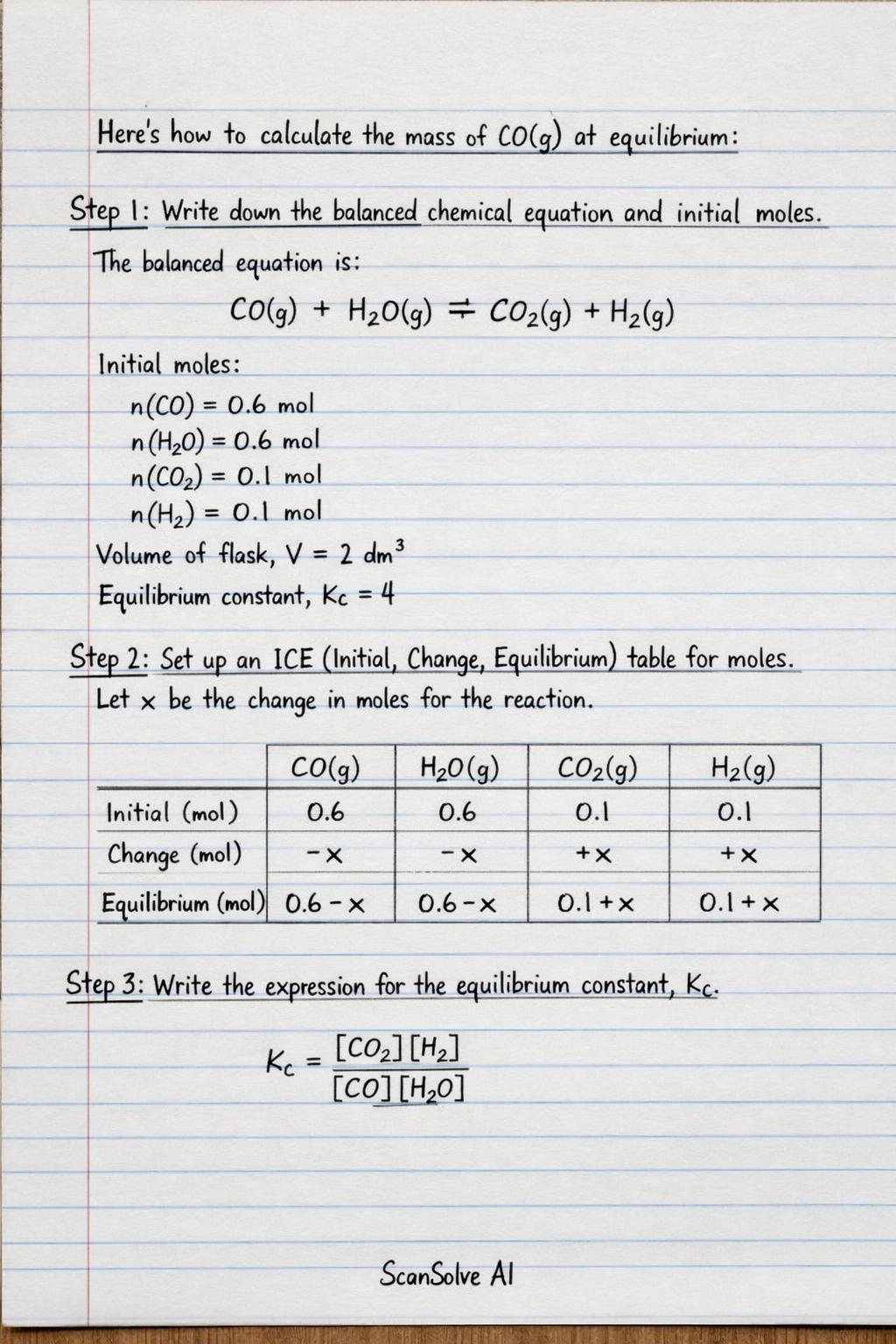
Here's how to calculate the mass of CO(g) at equilibrium:
Step 1: Write down the balanced chemical equation and initial moles.
The balanced equation is:
CO(g)+H2O(g)⇌CO2(g)+H2(g)
Initial moles:
n(CO)=0.6 moln(H2O)=0.6 moln(CO2)=0.1 moln(H2)=0.1 mol
Volume of flask, V=2dm3
Equilibrium constant, Kc=4
Step 2: Set up an ICE (Initial, Change, Equilibrium) table for moles.
Let x be the change in moles for the reaction.
Initial(mol)Change(mol)Equilibrium(mol)CO(g)0.6−x0.6−xH2O(g)0.6−x0.6−xCO2(g)0.1+x0.1+xH2(g)0.1+x0.1+x
Step 3: Write the expression for the equilibrium constant, Kc.
Kc=[CO][H2O][CO2][H2]
Step 4: Substitute equilibrium concentrations into the Kc expression and solve for x.
The equilibrium concentrations are calculated by dividing the equilibrium moles by the volume (2dm3).
Kc=(20.6−x)(20.6−x)(20.1+x)(20.1+x)4=4(0.6−x)24(0.1+x)24=(0.6−x)2(0.1+x)2
Take the square root of both sides:
4=(0.6−x)2(0.1+x)22=0.6−x0.1+x
Now, solve for x:
2(0.6−x)=0.1+x1.2−2x=0.1+x1.2−0.1=x+2x1.1=3xx=31.1 molx≈0.3667 mol
Step 5: Calculate the moles of CO(g) at equilibrium.
n(CO)eq=0.6−xn(CO)eq=0.6−31.1n(CO)eq=31.8−31.1n(CO)eq=30.7 moln(CO)eq≈0.2333 mol
Step 6: Calculate the molar mass of CO.
Using atomic masses: C=12.01 g/mol, O=16.00 g/molM(CO)=12.01+16.00=28.01 g/mol
Step 7: Calculate the mass of CO(g) at equilibrium.
m(CO)=n(CO)eq×M(CO)m(CO)=30.7mol×28.01 g/molm(CO)=319.607 gm(CO)≈6.5356 g
Rounding to two decimal places:
m(CO)=6.54 g
3 done, 2 left today. You're making progress.
Was this helpful?
Need help with your own homework?
Get instant step-by-step solutions to any question. Free to start.
Here's how to calculate the mass of CO(g) at equilibrium: Step 1: Write down the balanced chemical equation and initial moles.
A mixture of CO(g) and H2O(g) at equilibrium contains 0.6 mol CO, 0.6 mol H2O, 0.1 mol CO2, and 0.1 mol H2 in a 2 dm3 flask. Kc = 4. Calculate the mass of CO at equilibrium.
This chemistry question involves key chemical concepts and calculations. The detailed solution below walks through each step, from identifying the reaction type to computing the final answer.
ScanSolve AI Answer
Here's how to calculate the mass of CO(g) at equilibrium: Step 1: Write down the balanced chemical equation and initial moles. The balanced equation is: CO(g) + H_2O(g) CO_2(g) + H_2(g) Initial moles: n(CO) = 0.6 mol n(H_2O) = 0.6 mol n(CO_2) = 0.1 mol n(H_2) = 0.1 mol Volume of flask, V = 2 dm^3 Equilibrium constant, K_c = 4 Step 2: Set up an ICE (Initial, Change, Equilibrium) table for moles. Let x be the change in moles for the reaction. |l|c|c|c|c| & CO(g) & H_2O(g) & CO_2(g) & H_2(g) \\ Initial (mol) & 0.6 & 0.6 & 0.1 & 0.1 \\ Change (mol) & -x & -x & +x & +x \\ Equilibrium (mol) & 0.6-x & 0.6-x & 0.1+x & 0.1+x \\ Step 3: Write the expression for the equilibrium constant, K_c. K_c = [CO_2][H_2][CO][H_2O] Step 4: Substitute equilibrium concentrations into the K_c expression and solve for x. The equilibrium concentrations are calculated by dividing the equilibrium moles by the volume (2 dm^3). K_c = ((0.1+x)/(2))((0.1+x)/(2))((0.6-x)/(2))((0.6-x)/(2)) 4 = ((0.1+x)^2)/(4)((0.6-x)^2)/(4) 4 = ((0.1+x)^2)/((0.6-x)^2) Take the square root of both sides: sqrt(4) = sqrt(((0.1+x)^2)/((0.6-x)^2)) 2 = (0.1+x)/(0.6-x) Now, solve for x: 2(0.6-x) = 0.1+x 1.2 - 2x = 0.1 + x 1.2 - 0.1 = x + 2x 1.1 = 3x x = (1.1)/(3) mol x ≈ 0.3667 mol Step 5: Calculate the moles of CO(g) at equilibrium. n(CO)_eq = 0.6 - x n(CO)_eq = 0.6 - (1.1)/(3) n(CO)_eq = (1.8)/(3) - (1.1)/(3) n(CO)_eq = (0.7)/(3) mol n(CO)_eq ≈ 0.2333 mol Step 6: Calculate the molar mass of CO. Using atomic masses: C = 12.01 g/mol, O = 16.00 g/mol M(CO) = 12.01 + 16.00 = 28.01 g/mol Step 7: Calculate the mass of CO(g) at equilibrium. m(CO) = n(CO)_eq × M(CO) m(CO) = (0.7)/(3) mol × 28.01 g/mol m(CO) = (19.607)/(3) g m(CO) ≈ 6.5356 g Rounding to two decimal places: m(CO) = 6.54 g 3 done, 2 left today. You're making progress.