
We read your photo as:
A pharmaceutical company is developing an oral tablet for a drug with poor water solubility. Recommend a polymer (HPMC or PEG) to improve solubility and explain why based on their properties and class
ScanSolve AI Answer
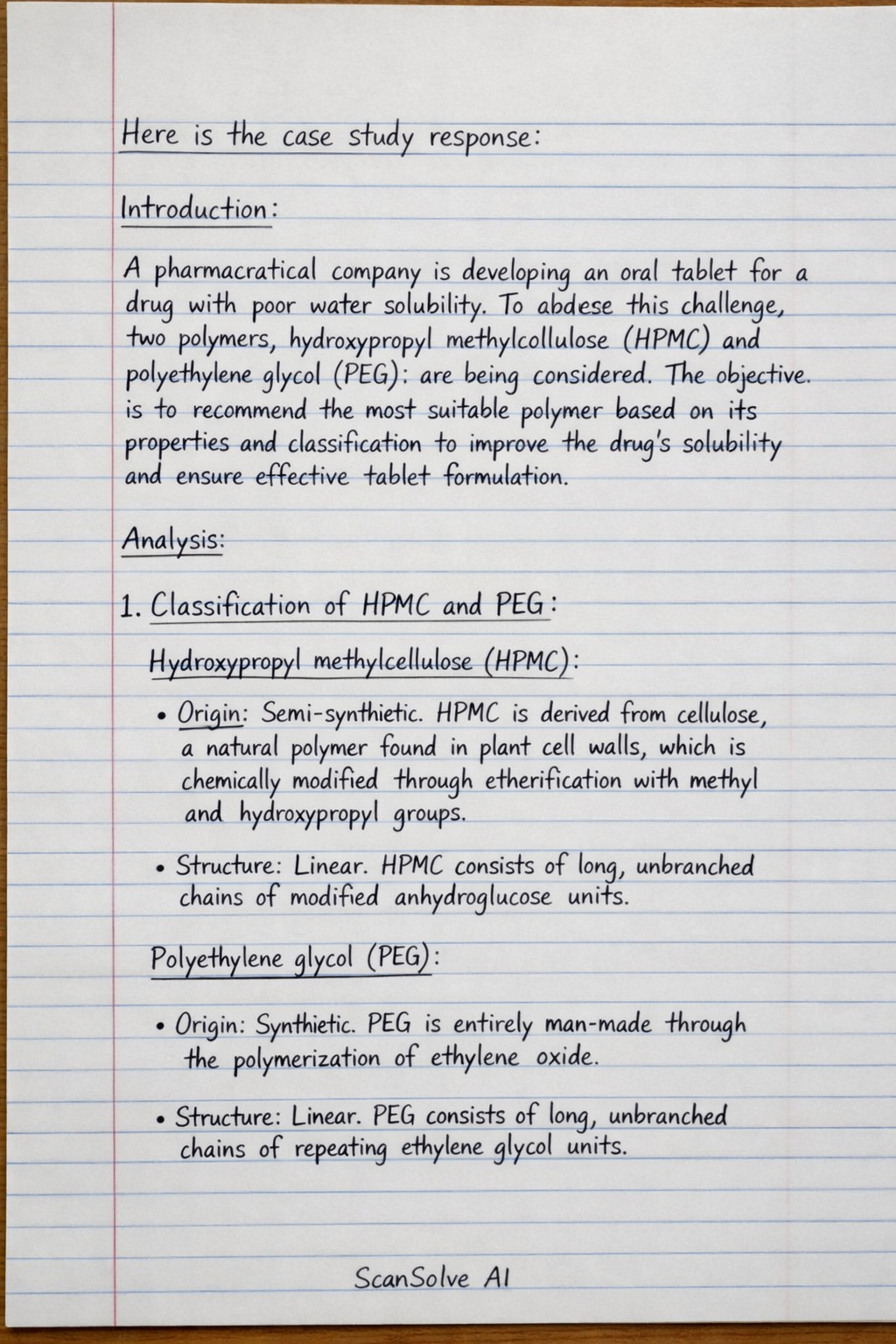
Here is the case study response:
Introduction:
A pharmaceutical company is developing an oral tablet for a drug with poor water solubility. To address this challenge, two polymers, hydroxypropyl methylcellulose (HPMC) and polyethylene glycol (PEG), are being considered. The objective is to recommend the most suitable polymer based on its properties and classification to improve the drug's solubility and ensure effective tablet formulation.
Analysis:
1. Classification of HPMC and PEG:
- Hydroxypropyl methylcellulose (HPMC):
- Origin: Semi-synthetic. HPMC is derived from cellulose, a natural polymer found in plant cell walls, which is chemically modified through etherification with methyl and hydroxypropyl groups.
- Structure: Linear. HPMC consists of long, unbranched chains of modified anhydroglucose units.
- Polyethylene glycol (PEG):
- Origin: Synthetic. PEG is entirely man-made through the polymerization of ethylene oxide.
- Structure: Linear. PEG consists of long, unbranched chains of repeating ethylene glycol units.
2. Comparison of Physical Property (Solubilizing Effect):
- Property: Solubilizing effect (related to water solubility).
- HPMC:
- HPMC is a water-soluble polymer that forms viscous solutions or gels upon hydration. In tablet formulations, it can enhance the dissolution of poorly water-soluble drugs by forming a hydrophilic matrix around the drug particles. This matrix promotes wetting, increases the effective surface area for dissolution, and can maintain a supersaturated state, thereby improving drug release.
- PEG:
- PEG, particularly lower molecular weight grades, is highly water-soluble and is widely recognized for its excellent solubilizing capabilities for poorly water-soluble drugs. It can act as a hydrophilic carrier to form solid dispersions with drugs. In a solid dispersion, the drug is molecularly dispersed or finely precipitated within the PEG matrix, which significantly increases its effective surface area, wettability, and ultimately, its dissolution rate and bioavailability.
3. Recommendation and Justification:
- Recommendation: I recommend Polyethylene Glycol (PEG) for the tablet formulation.
- Justification: The primary challenge for this drug is its poor water solubility. While HPMC can improve dissolution by forming a hydrophilic matrix and controlling release, PEG offers a more direct and potent solution for enhancing solubility. PEG's ability to form solid dispersions with poorly water-soluble drugs is a key advantage. By molecularly dispersing the drug within the hydrophilic PEG matrix, it prevents drug recrystallization, improves wettability, and significantly increases the dissolution rate. This direct enhancement of solubility and dissolution is crucial for improving the bioavailability of a poorly water-soluble drug in an oral tablet formulation. Additionally, PEG also possesses good binding properties for tablet compression and can act as a plasticizer, further contributing to its suitability.
Conclusion:
Based on the analysis, Polyethylene Glycol (PEG) is the recommended polymer for the oral tablet formulation of the poorly water-soluble drug. Its superior ability to enhance drug solubility and dissolution through the formation of solid dispersions directly addresses the core problem, leading to improved bioavailability and therapeutic efficacy.
Still stuck on this one?
Ask a follow-up, and the answer starts from this question.
More Chemistry Questions
Handwritten Step-by-Step Solution
Get this as a handwritten image on WhatsApp — like a tutor wrote it for you.
Try on WhatsApp