

This chemistry question involves key chemical concepts and calculations. The detailed solution below walks through each step, from identifying the reaction type to computing the final answer.
ScanSolve AI Answer
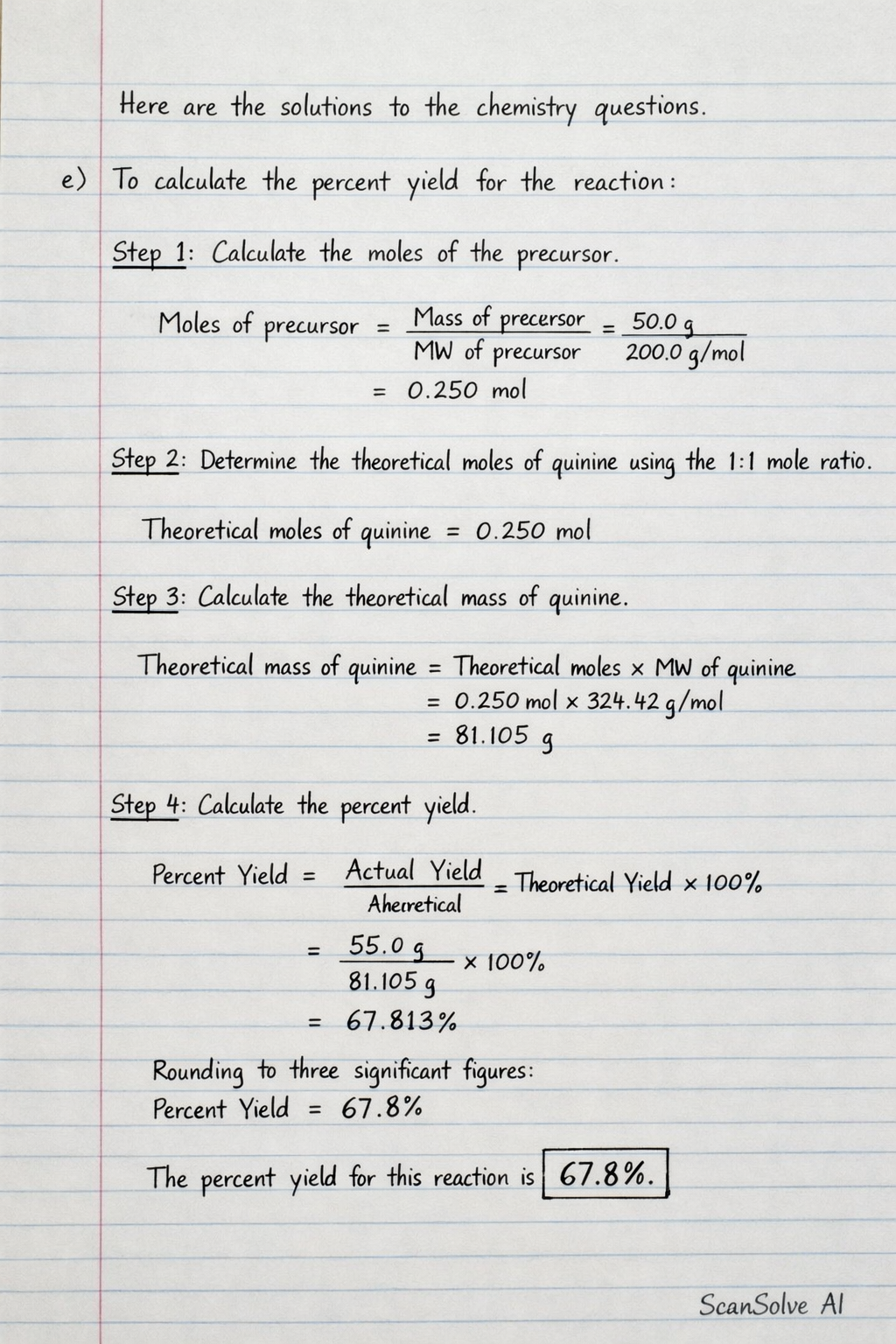
Here are the solutions to the chemistry questions. e) To calculate the percent yield for the reaction: Step 1: Calculate the moles of the precursor. Moles of precursor = Mass of precursorMW of precursor = 50.0 g200.0 g/mol = 0.250 mol Step 2: Determine the theoretical moles of quinine using the 1:1 mole ratio. Theoretical moles of quinine = 0.250 mol Step 3: Calculate the theoretical mass of quinine. Theoretical mass of quinine = Theoretical moles × MW of quinine Theoretical mass of quinine = 0.250 mol × 324.42 g/mol = 81.105 g Step 4: Calculate the percent yield. Percent Yield = Actual YieldTheoretical Yield × 100\% Percent Yield = 55.0 g81.105 g × 100\% = 67.813\% Rounding to three significant figures: Percent Yield = 67.8\% The percent yield for this reaction is 67.8\%. a) To separate two miscible liquids with different boiling points (50°C and 110°C), fractional distillation is the appropriate technique. Description of separation: The mixture of liquids A (boiling point 50°C) and B (boiling point 110°C) is heated in a distillation flask. As the temperature increases, liquid A, having the lower boiling point, will vaporize preferentially. The vapor rises into a fractionating column, where it undergoes repeated cycles of vaporization and condensation, becoming progressively richer in liquid A. This enriched vapor then passes into a condenser, where it cools and condenses back into liquid form, which is collected in a receiving flask. Liquid B, with the higher boiling point, remains predominantly in the distillation flask. Diagram of equipment setup: A diagram would typically include: • A round-bottom distillation flask containing the mixture, heated by a heating mantle or Bunsen burner. • A fractionating column (e.g., packed with glass beads or rings) attached vertically above the flask. • A thermometer placed at the top of the fractionating column to measure the temperature of the vapor distilling over. • A condenser (e.g., Liebig condenser) connected to the side arm of the fractionating column, with water flowing through its jacket to cool the vapor. • A receiving flask or beaker to collect the distillate, placed at the end of the condenser. b) To show that Carbon Monoxide (CO) and Carbon Dioxide (CO₂) obey the Law of Multiple Proportions: Step 1: Determine the mass of oxygen that combines with a fixed mass of carbon in each compound. Let's fix the mass of carbon at 12.01 g (1 mole of carbon). • In Carbon Monoxide (CO): 1 mole of carbon (12.01 g) combines with 1 mole of oxygen (16.00 g). • In Carbon Dioxide (CO₂): 1 mole of carbon (12.01 g) combines with 2 moles of oxygen (2 × 16.00 g = 32.00 g). Step 2: Calculate the ratio of the masses of oxygen. The masses of oxygen combining with 12.01 g of carbon are 16.00 g (in CO) and 32.00 g (in CO₂). Ratio of oxygen masses = Mass of O in CO_2Mass of O in CO = 32.00 g16.00 g = (2)/(1) Since the ratio of the masses of oxygen that combine with a fixed mass of carbon is 2:1, which is a ratio of small whole numbers, these compounds obey the Law of Multiple Proportions. c) The systematic names for the given compounds are: i) MgBr₂: Magnesium Bromide ii) Al₂O₃: Aluminum Oxide iii) FeCl₃: Iron(III) Chloride iv) CuO: Copper(II) Oxide v) N₂O₄: Dinitrogen Tetroxide vi) SF₆: Sulfur Hexafluoride vii) ClO₂: Chlorine Dioxide viii) PCl₅: Phosphorus Pentachloride ix) BaCl₂·2H₂O: Barium Chloride Dihydrate d) Balance each equation and identify the type of reaction: i) The equation Al_2(CO_3)_3 → Al_2O_3 + CO cannot be balanced as written for a simple decomposition. If we assume oxygen gas is also a product, it can be balanced as: 2Al_2(CO_3)_3 → 2Al_2O_3 + 6CO + 3O_2 Type of reaction: Decomposition reaction ii) BaO_2 + H_2SO_4 → BaSO_4 + H_2O_2 This equation is already balanced as written. Type of reaction: Double Displacement reaction iii) Ba(ClO_3)_2 → BaCl_2 + 3O_2 Type of reaction: Decomposition reaction iv) 3Cu + 8HNO_3 → 3Cu(NO_3)_2 + 2NO + 4H_2O Type of reaction: Redox reaction v) The equation H_3BO_3 → H_4B_4O_11 + H_2O cannot be balanced as written. The stoichiometry of atoms does not allow for a balanced equation with these specific products. vi) 10P_2I_4 + 13P_4 + 128H_2O → 40PH_4I + 32H_3PO_4 Type of reaction: Redox reaction