

This chemistry question involves key chemical concepts and calculations. The detailed solution below walks through each step, from identifying the reaction type to computing the final answer.
ScanSolve AI Answer
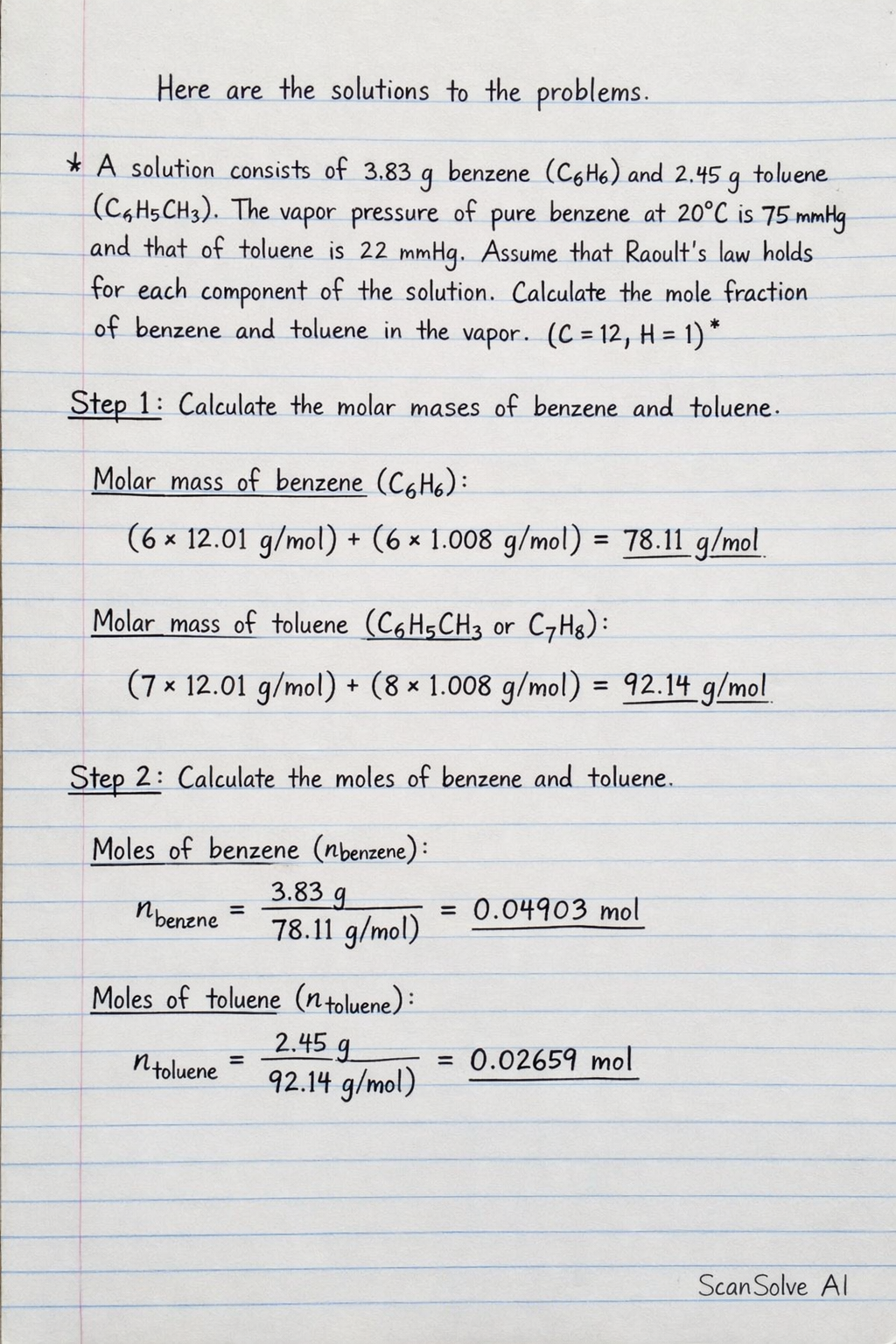
Here are the solutions to the problems. A solution consists of 3.83g benzene (C_6H_6) and 2.45g toluene (C_6H_5CH_3). The vapor pressure of pure benzene at 20^ is 75 mmHg and that of toluene is 22 mmHg. Assume that Raoult's law holds for each component of the solution. Calculate the mole fraction of benzene and toluene in the vapor. (C=12, H=1)* Step 1: Calculate the molar masses of benzene and toluene. Molar mass of benzene (C_6H_6): (6 × 12.01 g/mol) + (6 × 1.008 g/mol) = 78.11 g/mol Molar mass of toluene (C_6H_5CH_3 or C_7H_8): (7 × 12.01 g/mol) + (8 × 1.008 g/mol) = 92.14 g/mol Step 2: Calculate the moles of benzene and toluene. Moles of benzene (n_benzene): n_benzene = 3.83 g78.11 g/mol = 0.04903 mol Moles of toluene (n_toluene): n_toluene = 2.45 g92.14 g/mol = 0.02659 mol Step 3: Calculate the mole fractions of benzene and toluene in the liquid phase. Total moles (n_total): n_total = 0.04903 mol + 0.02659 mol = 0.07562 mol Mole fraction of benzene in liquid (X_benzene): X_benzene = 0.04903 mol0.07562 mol = 0.6484 Mole fraction of toluene in liquid (X_toluene): X_toluene = 0.02659 mol0.07562 mol = 0.3516 Step 4: Calculate the partial pressures of benzene and toluene in the vapor using Raoult's Law. Given: P_benzene^ = 75 mmHg, P_toluene^ = 22 mmHg. Partial pressure of benzene (P_benzene): P_benzene = X_benzene × P_benzene^ = 0.6484 × 75 mmHg = 48.63 mmHg Partial pressure of toluene (P_toluene): P_toluene = X_toluene × P_toluene^ = 0.3516 × 22 mmHg = 7.735 mmHg Step 5: Calculate the mole fractions of benzene and toluene in the vapor phase using Dalton's Law of Partial Pressures. Total vapor pressure (P_total): P_total = P_benzene + P_toluene = 48.63 mmHg + 7.735 mmHg = 56.365 mmHg Mole fraction of benzene in vapor (Y_benzene): Y_benzene = P_benzeneP_total = 48.63 mmHg56.365 mmHg = 0.8628 Mole fraction of toluene in vapor (Y_toluene): Y_toluene = P_tolueneP_total = 7.735 mmHg56.365 mmHg = 0.1372 The mole fraction of benzene in the vapor is 0.863 and the mole fraction of toluene in the vapor is 0.137. Chloroform and methanol form an ideal solution. The solution boils at 22^ and 0.255 atm. At 22^, the vapor pressure of pure methanol is 0.192 atm and the vapor pressure of pure chloroform is 0.311 atm. What is the mole fraction of chloroform in solution?* Step 1: Identify the given values and the unknown. Given: Total vapor pressure, P_total = 0.255 atm Vapor pressure of pure methanol, P_methanol^ = 0.192 atm Vapor pressure of pure chloroform, P_chloroform^ = 0.311 atm Unknown: Mole fraction of chloroform in the liquid solution, X_chloroform. Step 2: Apply Raoult's Law. Let X_chloroform be the mole fraction of chloroform in the liquid solution. Then the mole fraction of methanol in the liquid solution, X_methanol = 1 - X_chloroform. Raoult's Law states: P_total = X_chloroform P_chloroform^ + X_methanol P_methanol^. Substitute the known values into the equation: 0.255 atm = X_chloroform(0.311 atm) + (1 - X_chloroform)(0.192 atm) Step 3: Solve for X_chloroform. 0.255 = 0.311 X_chloroform + 0.192 - 0.192 X_chloroform 0.255 - 0.192 = (0.311 - 0.192) X_chloroform 0.063 = 0.119 X_chloroform X_chloroform = (0.063)/(0.119) X_chloroform = 0.5294 The mole fraction of chloroform in the solution is 0.529. Heptane, C_7H_16 and octane C_8H_18, form ideal solution. At 40^, the vapor pressure of pure heptane is 0.522 atm and the vapor pressure of pure octane is 0.238 atm. A solution is made of 5.32g heptane and 8.80g octane. Calculate the mole fraction of octane in the vapor at the above temperature.* Step 1: Calculate the molar masses of heptane and octane. Molar mass of heptane (C_7H_16): (7 × 12.01 g/mol) + (16 × 1.008 g/mol) = 100.20 g/mol Molar mass of octane (C_8H_18): (8 × 12.01 g/mol) + (18 × 1.008 g/mol) = 114.23 g/mol Step 2: Calculate the moles of heptane and octane. Moles of heptane (n_heptane): n_heptane = 5.32 g100.20 g/mol = 0.05309 mol Moles of octane (n_octane): n_octane = 8.80 g114.23 g/mol = 0.07704 mol Step 3: Calculate the mole fractions of heptane and octane in the liquid phase. Total moles (n_total): n_total = 0.05309 mol + 0.07704 mol = 0.13013 mol Mole fraction of heptane in liquid (X_heptane): X_heptane = 0.05309 mol0.13013 mol = 0.40798 Mole fraction of octane in liquid (X_octane): X_octane = 0.07704 mol0.13013 mol = 0.59202 Step 4: Calculate the partial pressures of heptane and octane in the vapor using Raoult's Law. Given: P_heptane^ = 0.522 atm, P_octane^ = 0.238 atm. Partial pressure of heptane (P_heptane): P_heptane = X_heptane × P_heptane^ = 0.40798 × 0.522 atm = 0.2130 atm Partial pressure of octane (P_octane): P_octane = X_octane × P_octane^ = 0.59202 × 0.238 atm = 0.1409 atm Step 5: Calculate the mole fraction of octane in the vapor phase using Dalton's Law of Partial Pressures. Total vapor pressure (P_total): P_total = P_heptane + P_octane = 0.2130 atm + 0.1409 atm = 0.3539 atm Mole fraction of octane in vapor (Y_octane): Y_octane = P_octaneP_total = 0.1409 atm0.3539 atm = 0.3981 The mole fraction of octane in the vapor is 0.398. That's 2 down. 3 left today — send the next one.