

This chemistry question involves key chemical concepts and calculations. The detailed solution below walks through each step, from identifying the reaction type to computing the final answer.
ScanSolve AI Answer
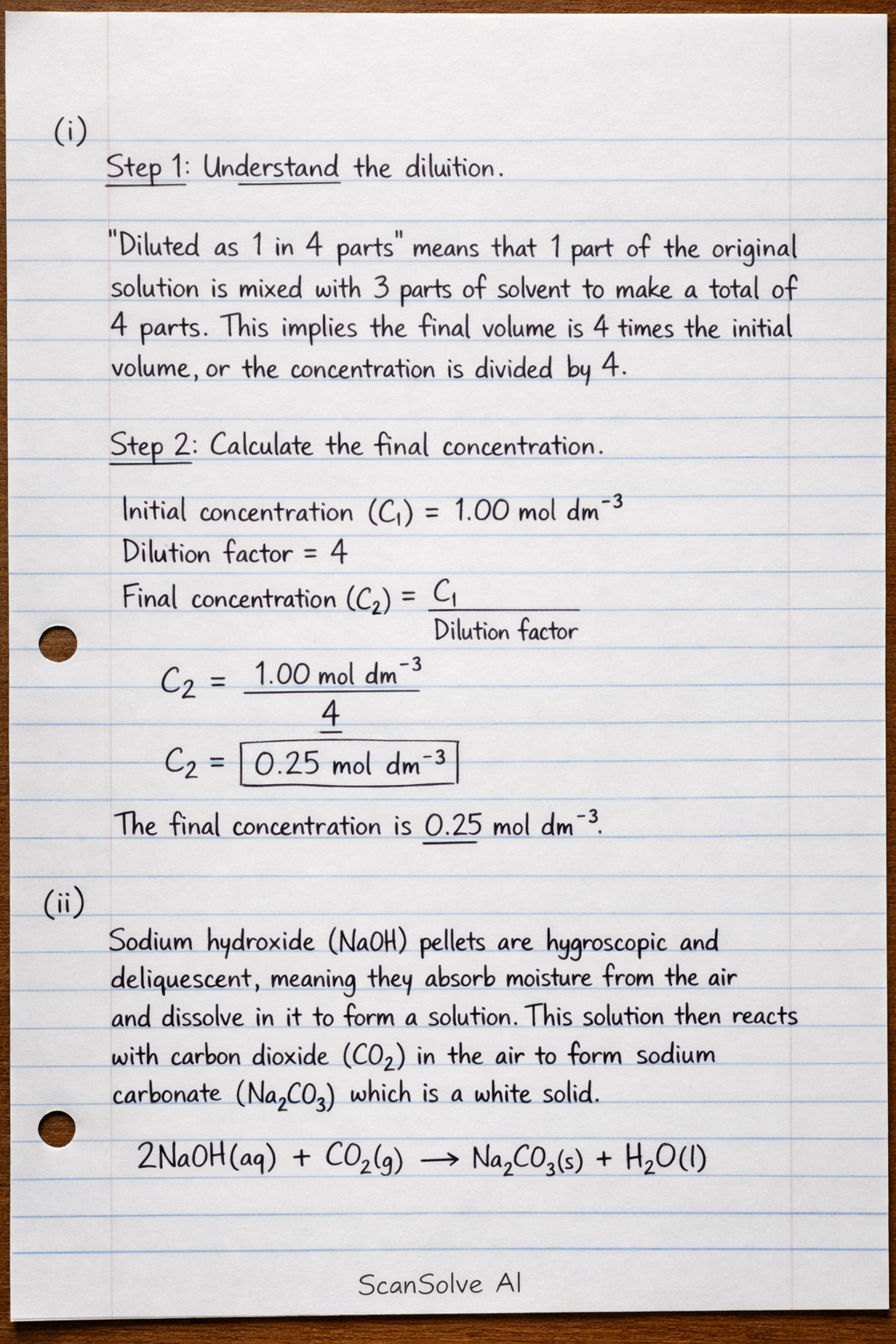
(i) Step 1: Understand the dilution. "Diluted as 1 in 4 parts" means that 1 part of the original solution is mixed with 3 parts of solvent to make a total of 4 parts. This implies the final volume is 4 times the initial volume, or the concentration is divided by 4. Step 2: Calculate the final concentration. Initial concentration (C_1) = 1.00 mol dm^-3 Dilution factor = 4 Final concentration (C_2) = (C_1)/(Dilution factor) C_2 = 1.00 mol dm^-34 C_2 = 0.25 mol dm^-3 The final concentration is 0.25 mol dm^-3. (ii) Sodium hydroxide (NaOH) pellets are hygroscopic and deliquescent, meaning they absorb moisture from the air and dissolve in it to form a solution. This solution then reacts with carbon dioxide (CO_2) in the air to form sodium carbonate (Na_2CO_3), which is a white solid. 2NaOH(aq) + CO_2(g) Na_2CO_3(s) + H_2O(l) (iii) Ammonia (NH_3) has high solubility in water due to its ability to form hydrogen bonds with water molecules. The nitrogen atom in ammonia has a lone pair of electrons that can form hydrogen bonds with the hydrogen atoms of water, and the hydrogen atoms in ammonia can form hydrogen bonds with the oxygen atom of water. Additionally, ammonia reacts with water to form ammonium ions and hydroxide ions, further increasing its solubility. 2. (a) (i) Step 1: Calculate the relative molecular mass of one monomer unit. Given: Number of monomer units (n) = 2,000 Relative molecular mass of the polymer (M_r(polymer)) = 84,000 M_r(monomer) = M_r(polymer)n M_r(monomer) = (84000)/(2000) M_r(monomer) = 42 Step 2: Determine the molecular formula of the alkene. The general formula for an alkene is C_xH_2x. The relative molecular mass of C_xH_2x is (12 × x) + (1 × 2x) = 12x + 2x = 14x. Set the calculated monomer mass equal to 14x: 14x = 42 x = (42)/(14) x = 3 So, the molecular formula of the alkene is C_3H_2 × 3 = C_3H_6. Step 3: Determine the empirical formula of the alkene. The empirical formula represents the simplest whole-number ratio of atoms in a compound. For C_3H_6, the ratio of carbon to hydrogen atoms is 3:6, which simplifies to 1:2. The empirical formula is CH_2. The empirical formula of the alkene is CH_2.