
We read your photo as:
A student was given an image of a graph showing the volume of gas produced over time for a chemical reaction. They were asked to: a) determine when the reaction ended and the volume of gas produced af
ScanSolve AI Answer
Step-by-step solution
5 stepsHere's the solution to the questions based on the provided image:
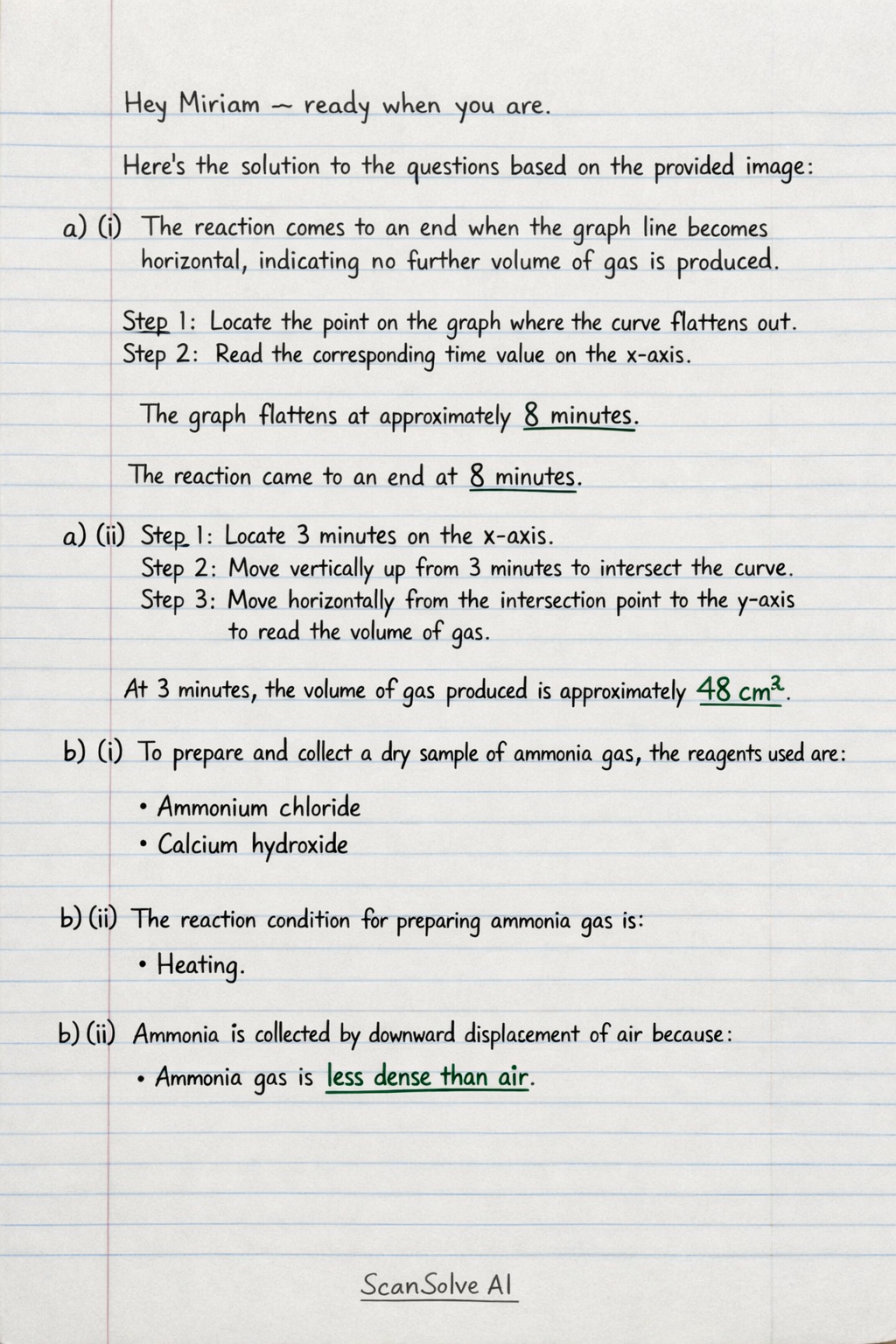
a) (i) The reaction comes to an end when the graph line becomes horizontal, indicating no further volume of gas is produced.
Locate the point on the graph where the curve flattens out.
Read the corresponding time value on the x-axis.
The graph flattens at approximately 8 minutes.
The reaction came to an end at 8 minutes.a) (ii)
Locate 3 minutes on the x-axis.
Move vertically up from 3 minutes to intersect the curve.
Move horizontally from the intersection point to the y-axis to read the volume of gas.
At 3 minutes, the volume of gas produced is approximately 48 cm³.
b) (i) To prepare and collect a dry sample of ammonia gas, the reagents used are:
- Ammonium chloride
- Calcium hydroxide
b) (ii) The reaction condition for preparing ammonia gas is:
- Heating
b) (iii) Ammonia is collected by downward displacement of air because:
- Ammonia gas is less dense than air.
c) This question describes a titration experiment to determine the concentration of dilute sulphuric acid using a standard solution of sodium carbonate.
The requirements listed are:- Beaker
- Pipette
- 250 cm³ volumetric flask
- Burette
- Conical flask
- Anhydrous sodium carbonate
- Wash bottle
- Dilute sulphuric acid
- Distilled water
- Phenolphthalein indicator
The task is to prepare 250 cm³ of 0.1 M and use this standard solution to determine the concentration of dilute sulphuric acid. This is a description of a practical procedure rather than a question requiring a numerical answer or explanation.
Still stuck on this one?
Ask a follow-up, and the answer starts from this question.
More Chemistry Questions
Handwritten Step-by-Step Solution
Get this as a handwritten image on WhatsApp — like a tutor wrote it for you.
Try on WhatsApp