
We read your photo as:
Answer the following questions: What is atomicity? What is rusting? Distinguish between physical and chemical changes. What is crystallisation? What is precipitation reaction?
ScanSolve AI Answer
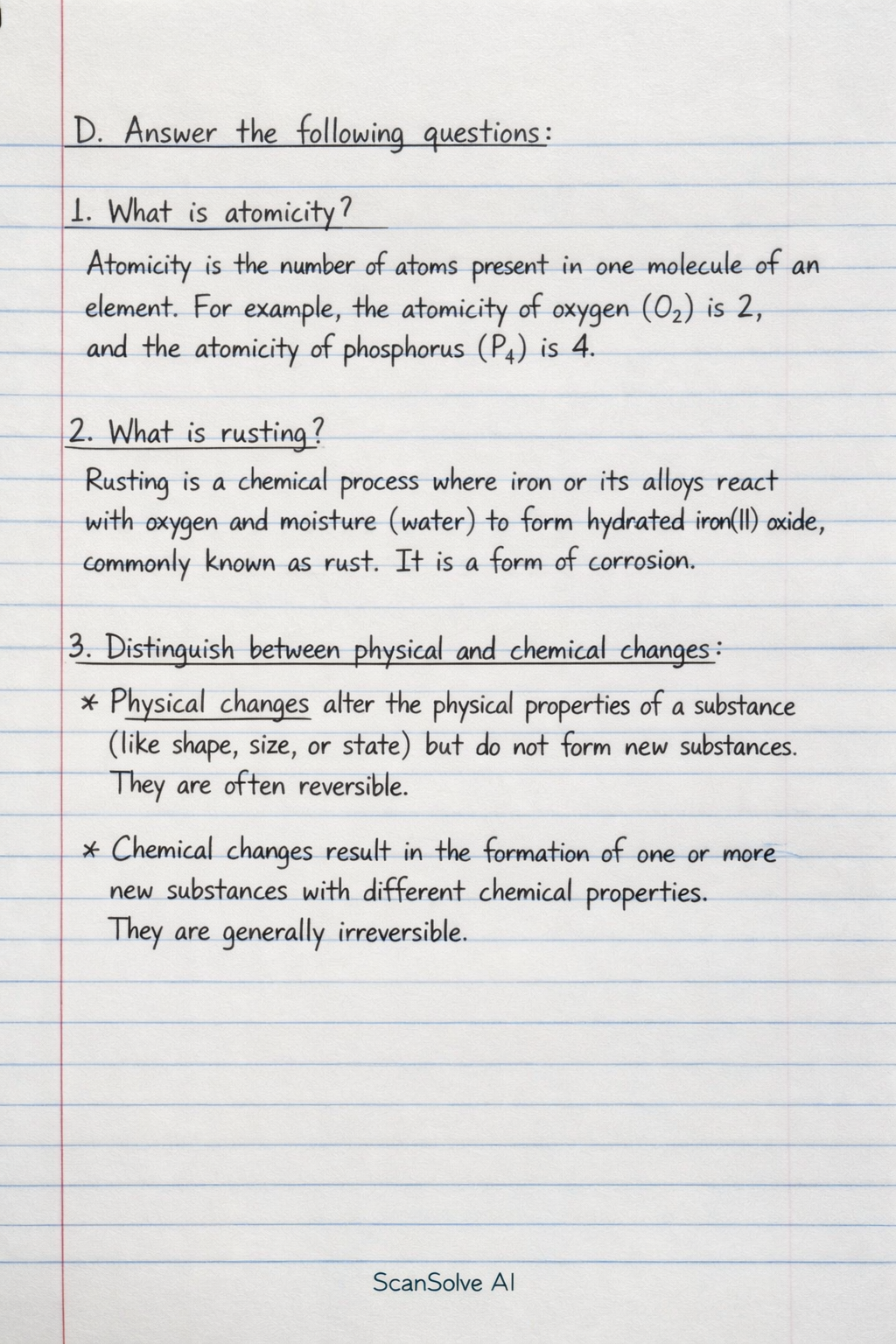
D. Answer the following questions:
-
What is atomicity? Atomicity is the number of atoms present in one molecule of an element. For example, the atomicity of oxygen (O₂) is 2, and the atomicity of phosphorus (P₄) is 4.
-
What is rusting? Rusting is a chemical process where iron or its alloys react with oxygen and moisture (water) to form hydrated iron(III) oxide, commonly known as rust. It is a form of corrosion.
-
Distinguish between physical and chemical changes.
- Physical changes alter the physical properties of a substance (like shape, size, or state) but do not form new substances. They are often reversible.
- Chemical changes result in the formation of one or more new substances with different chemical properties. They are generally irreversible.
-
What is crystallisation? How can you get crystals of sugar from its solution?
- Crystallisation is a process used to separate a pure solid in the form of its crystals from a solution.
- To get crystals of sugar from its solution, dissolve sugar in hot water to create a saturated solution. Allow the solution to cool slowly and undisturbed. As the solution cools, the sugar's solubility decreases, causing pure sugar crystals to form and separate out.
-
What is precipitation reaction? A precipitation reaction is a chemical reaction occurring in an aqueous solution where two soluble ionic compounds react to form an insoluble product, called a precipitate, which separates from the solution as a solid.
-
What are the two methods of separating a solid from a liquid? Two common methods for separating a solid from a liquid are:
- Filtration: Used to separate insoluble solids from a liquid.
- Evaporation: Used to separate a soluble solid from a liquid by heating the solution to vaporize the liquid, leaving the solid behind.
HOTS (Critical Thinking)
- "Cutting of wood and burning of wood," belong to the same kind of changes. True or False? Explain.
- False.
- Cutting of wood is a physical change because only the size and shape of the wood change; no new substance is formed.
- Burning of wood is a chemical change because the wood reacts with oxygen to produce new substances like ash, carbon dioxide, and water vapor.
Still stuck on this one?
Ask a follow-up, and the answer starts from this question.
More Chemistry Questions
Handwritten Step-by-Step Solution
Get this as a handwritten image on WhatsApp — like a tutor wrote it for you.
Try on WhatsApp