
We read your photo as:
Summarize the processes of rusting prevention, separation of solids, differences between CO and CO2, and aluminium-chlorine reaction.
Chemistry
ScanSolve AI Answer
Answer
a
Step-by-step solution
3 steps- In an attempt to prevent rusting:
- Set up X: Iron is in contact with copper. Copper is less reactive than iron. Iron will rust faster because it acts as the anode and corrodes preferentially.
- Set up Y: Iron is in contact with zinc. Zinc is more reactive than iron. Zinc will corrode preferentially, protecting the iron from rusting (sacrificial protection).
- To separate a mixture of ammonium chloride () and sodium chloride ():
Heat the mixture gently in an evaporating dish.
Ammonium chloride will sublime (change directly from solid to gas) and can be collected by deposition on a cool surface (e.g., a watch glass placed over the dish).
Sodium chloride will remain in the evaporating dish as a solid, as it does not sublime.
- Three differences between carbon (II) oxide () and carbon (IV) oxide ():
- Carbon (II) oxide () is a neutral oxide, while carbon (IV) oxide () is an acidic oxide.
- Carbon (II) oxide () is flammable, while carbon (IV) oxide () is non-flammable.
- Carbon (II) oxide () is highly toxic, while carbon (IV) oxide () is non-toxic (though high concentrations can be harmful).
- a) Aluminium reacts with chlorine gas.
b)
The type of bond is ionic.
The structure formed is a giant ionic lattice.- Convert the following values from degrees Celsius to Kelvin:
a)
To convert Celsius to Kelvin, add 273.15.The value is .
Was this helpful?
Try one yourself
A new problem that tests the same skill.
Still stuck on this one?
Ask a follow-up, and the answer starts from this question.
Got a different question?Ask your own question
More Chemistry Questions
QIdentify and differentiate between physical and chemical changes, define atomicity, and explain…QA school student was asked to explain rusting and how aluminium protects iron, and to label…QWhat are the answers to questions 11, 12, and 13 regarding chemical reactions, rusting, and gas…QWrite an equation for the reaction of A and excess oxygen. Explain observations: copper (II) sulfate…QExplain three methods to prevent rusting of iron and determine the oxidation state of iron in…
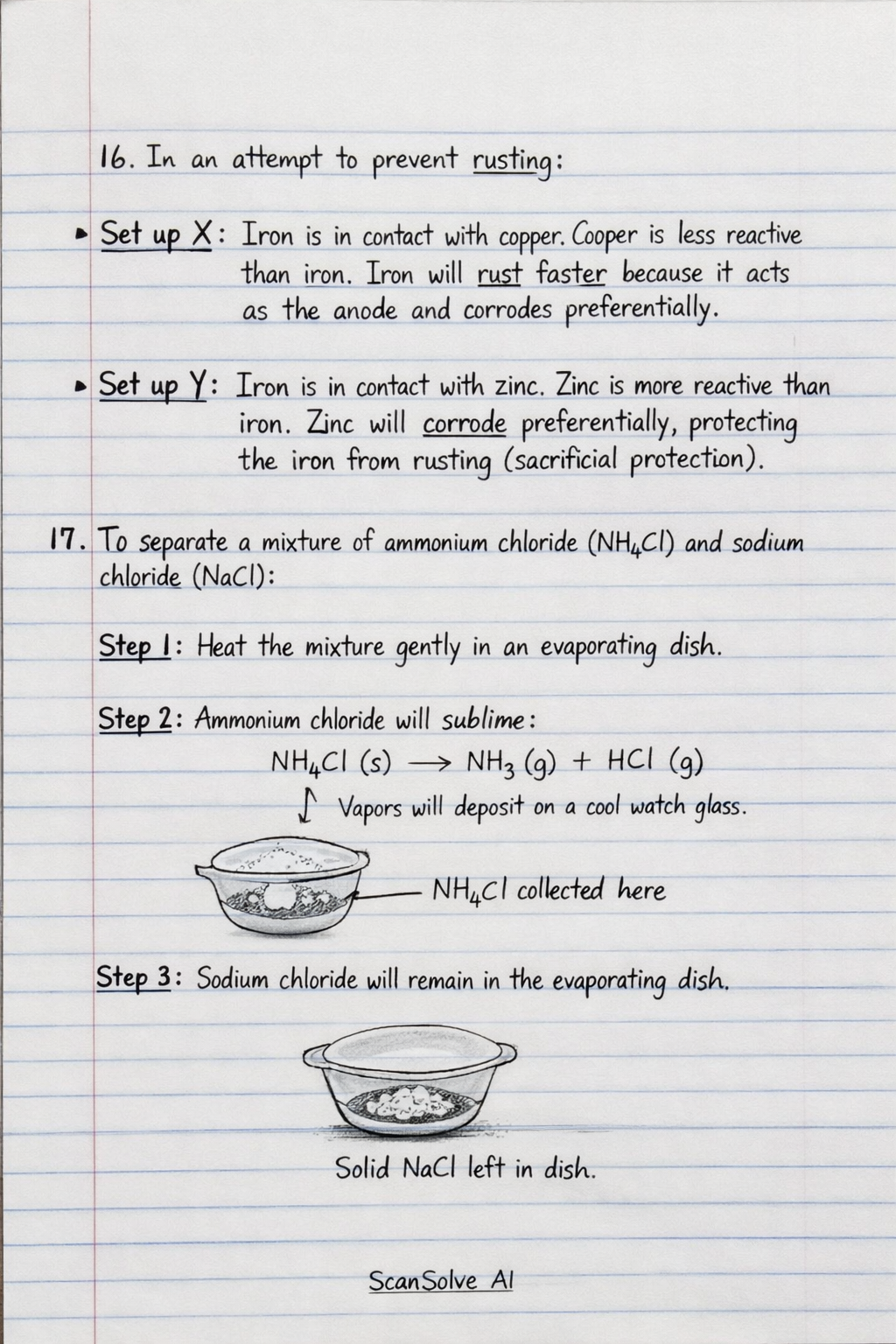
Handwritten Step-by-Step Solution
Get this as a handwritten image on WhatsApp — like a tutor wrote it for you.
Try on WhatsApp