
We read your photo as:
Identify and differentiate between physical and chemical changes, define atomicity, and explain rusting.
ScanSolve AI Answer
Here are the answers to the questions from the image:
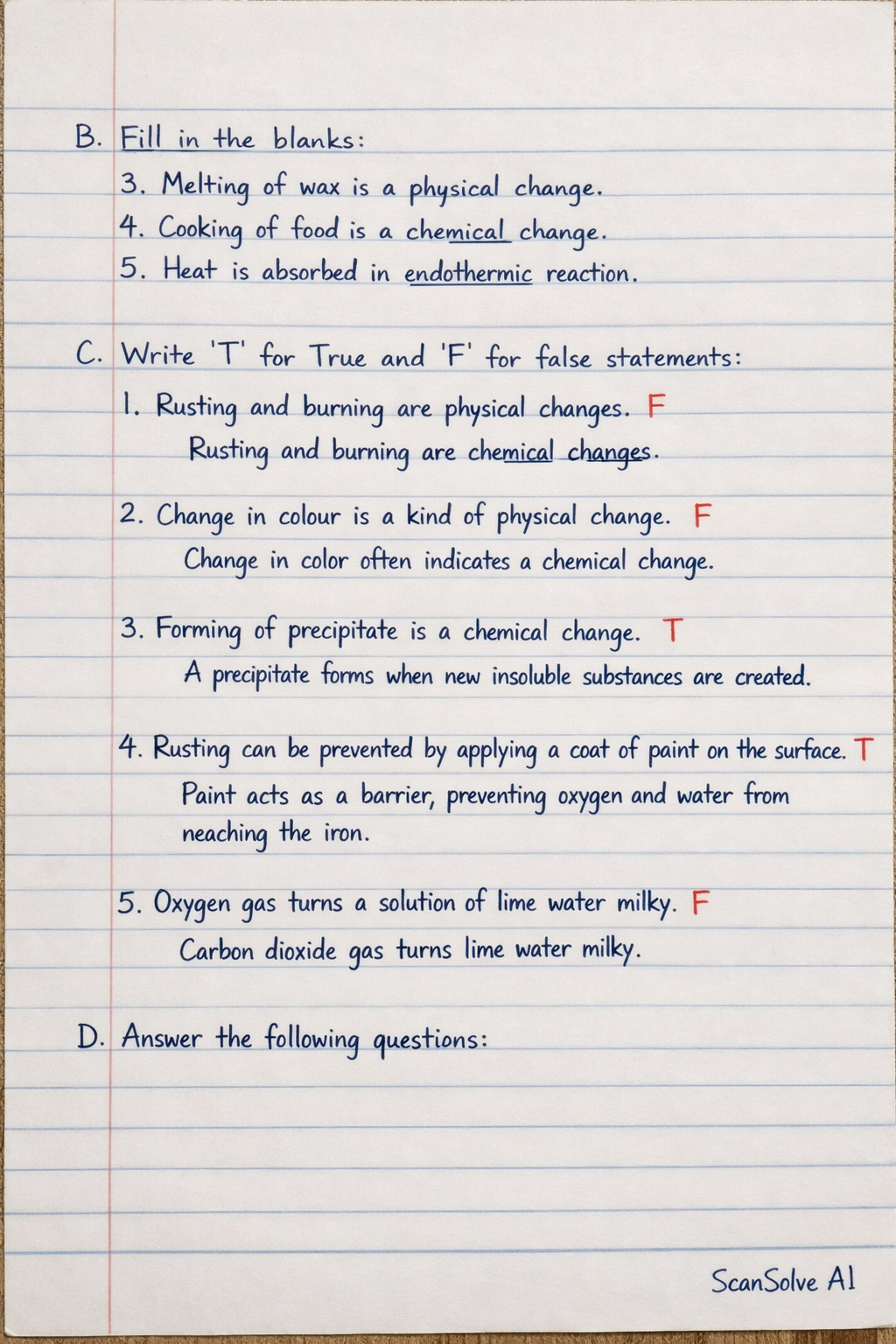
B. Fill in the blanks:
- Melting of wax is a physical change.
- Cooking of food is a chemical change.
- Heat is absorbed in endothermic reaction.
C. Write 'T' for True and 'F' for false statements:
- Rusting and burning are physical changes. F
- Rusting and burning are chemical changes.
- Change in colour is a kind of physical change. F
- Change in color often indicates a chemical change.
- Forming of precipitate is a chemical change. T
- A precipitate forms when new insoluble substances are created.
- Rusting can be prevented by applying a coat of paint on the surface. T
- Paint acts as a barrier, preventing oxygen and water from reaching the iron.
- Oxygen gas turns a solution of lime water milky. F
- Carbon dioxide gas turns lime water milky.
D. Answer the following questions:
-
Atomicity is the number of atoms present in one molecule of an element or compound. For example, oxygen gas () has an atomicity of 2, and ozone () has an atomicity of 3.
-
Rusting is the common term for the corrosion of iron and its alloys, such as steel. It occurs when iron reacts with oxygen in the presence of water or moisture, forming iron oxides (typically hydrated iron(III) oxides).
-
Physical changes alter the form or appearance of a substance but do not change its chemical composition (e.g., melting ice). Chemical changes result in the formation of new substances with different chemical properties (e.g., burning wood).
-
Crystallisation is the process by which solid crystals form from a solution, melt, or gas. To get crystals of sugar from its solution, you can dissolve a large amount of sugar in hot water to create a saturated solution, then allow the solution to cool slowly. As it cools, the sugar becomes less soluble and forms crystals.
-
A precipitation reaction is a type of chemical reaction in which two soluble ionic compounds react in an aqueous solution to form an insoluble product called a precipitate. This precipitate then separates from the solution as a solid.
-
Two common methods of separating a solid from a liquid are filtration and decantation. Filtration uses a filter medium to separate solid particles from a liquid, while decantation involves carefully pouring off the liquid, leaving the solid behind.
Still stuck on this one?
Ask a follow-up, and the answer starts from this question.
More Chemistry Questions
Handwritten Step-by-Step Solution
Get this as a handwritten image on WhatsApp — like a tutor wrote it for you.
Try on WhatsApp