
We read your photo as:
Classify the following into physical and chemical change: Dissolution of salt in water, Burning of paper, Magnetization of iron, Rusting of iron.
ScanSolve AI Answer
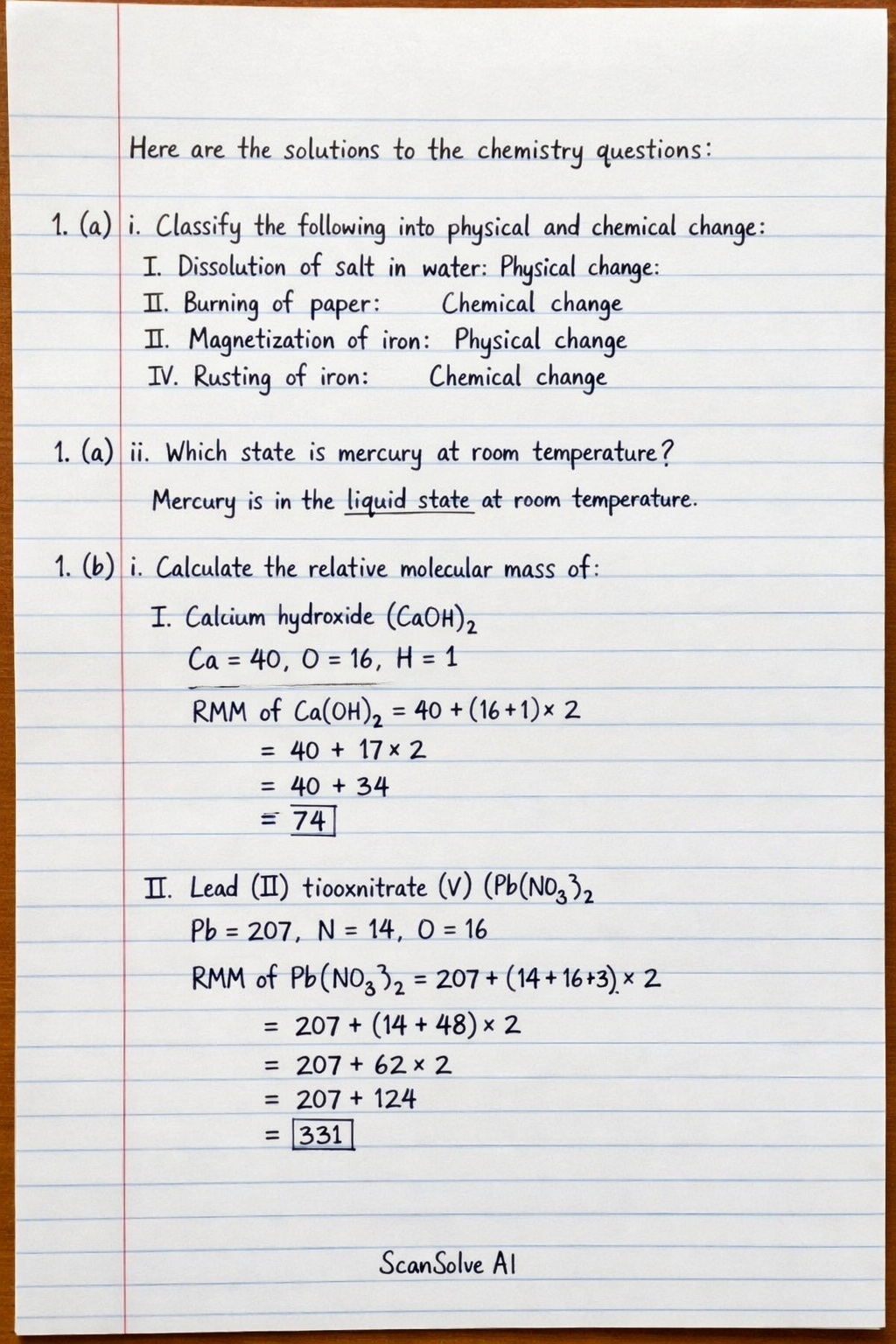
here are the solutions to the chemistry questions:
1. (a) i. Classify the following into physical and chemical change:
- I. Dissolution of salt in water: Physical change
- II. Burning of paper: Chemical change
- III. Magnetization of iron: Physical change
- IV. Rusting of iron: Chemical change
1. (a) ii. Which state is mercury at room temperature?
- Mercury is in the liquid state at room temperature.
1. (b) i. Calculate the relative molecular mass of:
- I. Calcium hydroxide ()
- Atomic masses: , ,
- II. Lead (II) trioxonitrate (V) ()
- Atomic masses: , ,
1. (b) ii. Define isotope.
- Isotopes are atoms of the same element that have the same number of protons but different numbers of neutrons.
1. (b) iii. Consider the following pairs of elements: 6A & 8B, 11C & 16D and 3E & 19F.
- I. Which pair will form ionic compound?
- Element A (atomic number 6) is Carbon (non-metal).
- Element B (atomic number 8) is Oxygen (non-metal).
- Element C (atomic number 11) is Sodium (metal).
- Element D (atomic number 16) is Sulfur (non-metal).
- Element E (atomic number 3) is Lithium (metal).
- Element F (atomic number 19) is Potassium (metal).
- Ionic compounds form between a metal and a non-metal. The pair that fits this description is 11C & 16D (Sodium and Sulfur).
- II. Give the name of the compound formed in (b)iii I.
- Sodium (C) forms ions, and Sulfur (D) forms ions. The compound formed is .
- The name of the compound is Sodium sulfide.
1. (c) i. State Charles' law.
- Charles' law states that for a fixed mass of gas at constant pressure, the volume is directly proportional to its absolute temperature.
1. (c) ii. Calculate the volume of a gas at s.t.p. if it occupies 15 cm at 7.50 x 10 Nm and 50.0C.
- Given:
- Initial volume () =
- Initial pressure () =
- Initial temperature () =
- At S.T.P. (Standard Temperature and Pressure):
- Standard pressure () = (as given by 1 pascal = )
- Standard temperature () =
- Using the Combined Gas Law:
- Rearrange to solve for :
1. (d) i. State two phenomena that support kinetic theory of gases.
-
- Diffusion
-
- Brownian motion
1. (d) ii. Define ionisation energy.
- Ionisation energy is the minimum energy required to remove one mole of electrons from one mole of gaseous atoms in their ground state to form one mole of gaseous ions.
1. (d) iii. Copy and complete Table 2.1 below:
| Periodic properties | Down a group | Across the period |
|---|---|---|
| Atomic radius | Increases | Decreases |
| Electron affinity | Decreases | Decreases |
| Electronegativity | Decreases | Increases |
Still stuck on this one?
Ask a follow-up, and the answer starts from this question.
More Chemistry Questions
Handwritten Step-by-Step Solution
Get this as a handwritten image on WhatsApp — like a tutor wrote it for you.
Try on WhatsApp