
We read your photo as:
Give two examples of iron ores. State three adverse effects of chemical products.
ScanSolve AI Answer
Step-by-step solution
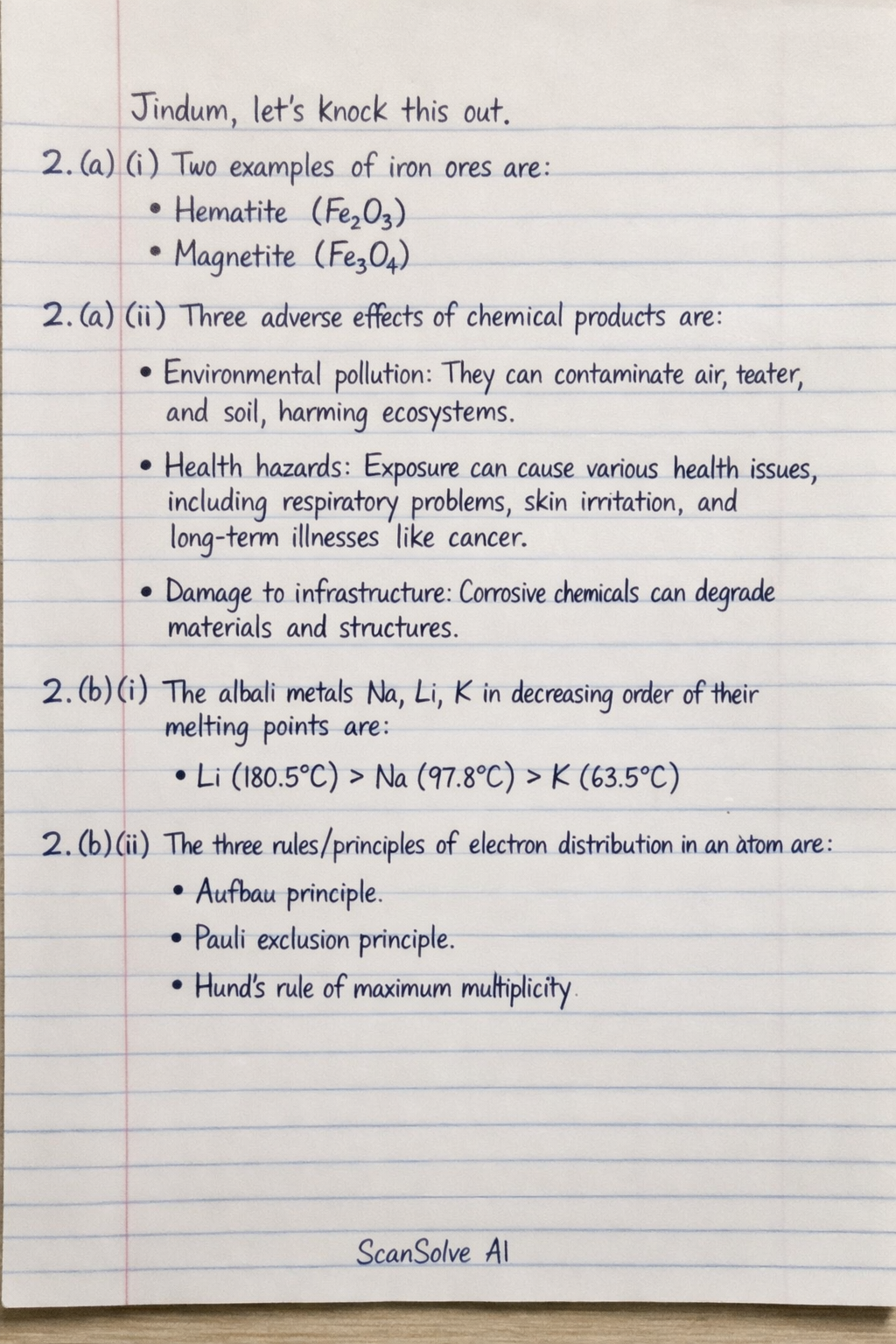
9 steps2. (a) (i) Two examples of iron ores are:
- Hematite ()
- Magnetite ()
2. (a) (ii) Three adverse effects of chemical products are:
- Environmental pollution: They can contaminate air, water, and soil, harming ecosystems.
- Health hazards: Exposure can cause various health issues, including respiratory problems, skin irritation, and long-term illnesses like cancer.
- Damage to infrastructure: Corrosive chemicals can degrade materials and structures.
2. (b) (i) The alkali metals Na, Li, K in decreasing order of their melting points are:
- Li () > Na () > K ()
2. (b) (ii) The three rules/principles of electron distribution in an atom are:
- Aufbau principle
- Pauli exclusion principle
- Hund's rule of maximum multiplicity
2. (c) (i)
- An oxidizing agent is a substance that gains electrons and causes the oxidation of another substance.
- A reducing agent is a substance that loses electrons and causes the reduction of another substance.
2. (c) (ii) The ions formed when the following compounds dissociate are:
I. KOH:
II. :
III. :
2. (d) (i)
I. An anode is the electrode where oxidation (loss of electrons) occurs during an electrochemical reaction.
II. A cathode is the electrode where reduction (gain of electrons) occurs during an electrochemical reaction.
2. (d) (ii)
Calculate the total charge passed.
The current and time .
Determine the moles of electrons.
Using Faraday's constant :
Write the half-reaction for hydrogen production at the cathode.
During the electrolysis of dilute tetraoxosulphate (VI) acid (), hydrogen gas is produced at the cathode:
From the stoichiometry, 2 moles of electrons produce 1 mole of gas.
Calculate the moles of hydrogen gas produced.
Calculate the volume of hydrogen gas at s.t.p.
At s.t.p., 1 mole of any gas occupies .
The volume of hydrogen produced is .
3. (a)
An energy profile diagram illustrating the effect of a catalyst on an exothermic reaction:\begin{tikzpicture}[scale=0.8] % Axes \draw[->] (0,0) -- (8,0) node[right] {Reaction Progress}; \draw[->] (0,0) -- (0,6) node[above] {Energy}; % Reactants and Products \node at (1,5) (reactants) {Reactants}; \node at (7,1) (products) {Products}; % Uncatalyzed reaction \draw[thick, blue] (1,5) .. controls (3,7) and (5,7) .. (7,1); \draw[dashed] (1,5) -- (1,0); \draw[dashed] (7,1) -- (7,0); \draw[<->] (1.2,5.2) -- (3.8,6.8) node[midway, above right] {$\text{E}_{\text{a (uncatalyzed)}}$}; % Catalyzed reaction \draw[thick, red] (1,5) .. controls (3,6) and (5,6) .. (7,1); \draw[<->] (1.2,5.2) -- (3.8,5.8) node[midway, below right] {$\text{E}_{\text{a (catalyzed)}}$}; % Enthalpy change \draw[<->] (7.3,5) -- (7.3,1) node[midway, right] {$\Delta\text{H}$}; % Labels \node[blue] at (4,7.3) {Uncatalyzed Pathway}; \node[red] at (4,6.3) {Catalyzed Pathway}; \end{tikzpicture}In an exothermic reaction, the energy of the products is lower than that of the reactants. A catalyst provides an alternative reaction pathway with a lower activation energy (), thereby increasing the reaction rate. The overall enthalpy change () of the reaction remains unchanged.
3. (b) (i) One difference between endothermic and exothermic reactions is:
- Endothermic reactions absorb heat from the surroundings, resulting in a positive enthalpy change ().
- Exothermic reactions release heat to the surroundings, resulting in a negative enthalpy change ().
3. (b) (ii) Le Chatelier's principle states that if a change of condition (such as temperature, pressure, or concentration) is applied to a system in equilibrium, the system will shift in a direction that relieves the stress and re-establishes a new equilibrium.
3. (b) (iii) Three factors that affect the equilibrium position of a chemical reaction are:
- Concentration of reactants or products
- Temperature
- Pressure (for reactions involving gases)
3. (c) (i)
I. A saturated solution is a solution that contains the maximum amount of solute that can be dissolved in a given amount of solvent at a specific temperature and pressure.
II. A molar solution is a solution that contains one mole of solute per liter (or ) of solution. Its concentration is expressed in moles per ( or M).3. (c) (ii)
Determine the chemical formula and molar mass of sodium trioxocarbonate (IV).
Sodium trioxocarbonate (IV) is .
Given atomic masses: , , .
Molar mass of .Convert the volume from to .
Given volume .
Calculate the number of moles of needed.
Concentration .
Calculate the mass of needed.
The mass of sodium trioxocarbonate (IV) needed is .
Still stuck on this one?
Ask a follow-up, and the answer starts from this question.
More Chemistry Questions
Handwritten Step-by-Step Solution
Get this as a handwritten image on WhatsApp — like a tutor wrote it for you.
Try on WhatsApp