
We read your photo as:
Describe the dot and cross diagrams for the ionic bonds formed between lithium and fluorine, and sodium and sulphur.
Chemistry
ScanSolve AI Answer
Answers
3 partsb
c
d
Here are the descriptions of the dot and cross diagrams for the ionic bonds formed:
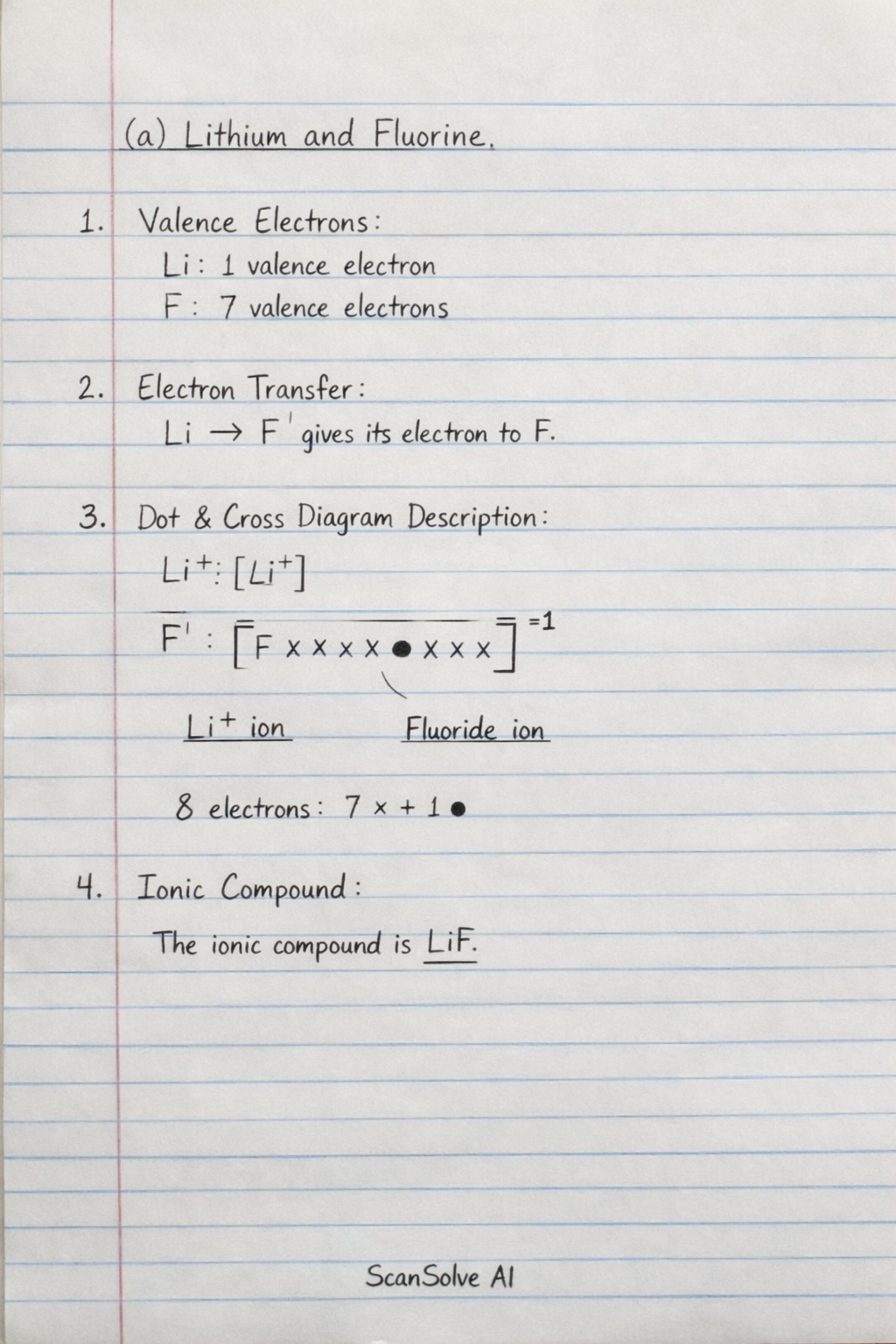
a) Lithium and fluorine
- Valence Electrons: Lithium (Li) has 1 valence electron. Fluorine (F) has 7 valence electrons.
- Electron Transfer: Lithium transfers its single valence electron to fluorine.
- Dot and Cross Diagram Description:
- The lithium ion is represented as , having lost its valence electron. Its electron configuration is now stable (like helium).
- The fluoride ion is represented as . It has 8 electrons in its outermost shell: 7 original valence electrons from fluorine (represented by crosses, ) and 1 electron gained from lithium (represented by a dot, ). These 8 electrons are shown surrounding the F symbol within square brackets, with a charge outside.
- Ionic Compound: The ionic compound formed is LiF.
b) Sodium and sulphur
- Valence Electrons: Sodium (Na) has 1 valence electron. Sulphur (S) has 6 valence electrons.
- Electron Transfer: Two sodium atoms each transfer 1 valence electron to one sulphur atom.
- Dot and Cross Diagram Description:
- Each sodium ion is represented as , having lost its valence electron. Its electron configuration is now stable (like neon).
- The sulphide ion is represented as . It has 8 electrons in its outermost shell: 6 original valence electrons from sulphur (represented by crosses, ) and 2 electrons gained from the two sodium atoms (represented by dots, ). These 8 electrons are shown surrounding the S symbol within square brackets, with a charge outside.
- Ionic Compound: The ionic compound formed is .
c) Magnesium and sulphur
- Valence Electrons: Magnesium (Mg) has 2 valence electrons. Sulphur (S) has 6 valence electrons.
- Electron Transfer: Magnesium transfers its 2 valence electrons to sulphur.
- Dot and Cross Diagram Description:
- The magnesium ion is represented as , having lost its two valence electrons. Its electron configuration is now stable (like neon).
- The sulphide ion is represented as . It has 8 electrons in its outermost shell: 6 original valence electrons from sulphur (represented by crosses, ) and 2 electrons gained from magnesium (represented by dots, ). These 8 electrons are shown surrounding the S symbol within square brackets, with a charge outside.
- Ionic Compound: The ionic compound formed is .
d) Aluminum and nitrogen
- Valence Electrons: Aluminum (Al) has 3 valence electrons. Nitrogen (N) has 5 valence electrons.
- Electron Transfer: Aluminum transfers its 3 valence electrons to nitrogen.
- Dot and Cross Diagram Description:
- The aluminum ion is represented as , having lost its three valence electrons. Its electron configuration is now stable (like neon).
- The nitride ion is represented as . It has 8 electrons in its outermost shell: 5 original valence electrons from nitrogen (represented by crosses, ) and 3 electrons gained from aluminum (represented by dots, ). These 8 electrons are shown surrounding the N symbol within square brackets, with a charge outside.
- Ionic Compound: The ionic compound formed is .
Was this helpful?
Try one yourself
A new problem that tests the same skill.
Still stuck on this one?
Ask a follow-up, and the answer starts from this question.
Got a different question?Ask your own question
More Chemistry Questions
QDraw dot (-) an cross (x) diagram to show bonding in: (i) Nitrogen molecule (N2) (ii) Hydroxonium…QDraw cross-and-dot diagrams for the ionic compounds KF, Na₂O, and MgO.QDot and cross diagram of thé bond in CLO4-QDraw Lewis dot structures for the following compounds: NaCl, CaF₂, H₂, O₂, N₂.QIdentify the elements based on their properties and atomic structure. Draw the atomic structure of…
Browse by topic:Inorganic Chemistry
Handwritten Step-by-Step Solution
Get this as a handwritten image on WhatsApp — like a tutor wrote it for you.
Try on WhatsApp