
We read your photo as:
Draw Lewis dot structures for the following compounds: NaCl, CaF₂, H₂, O₂, N₂.
ScanSolve AI Answer
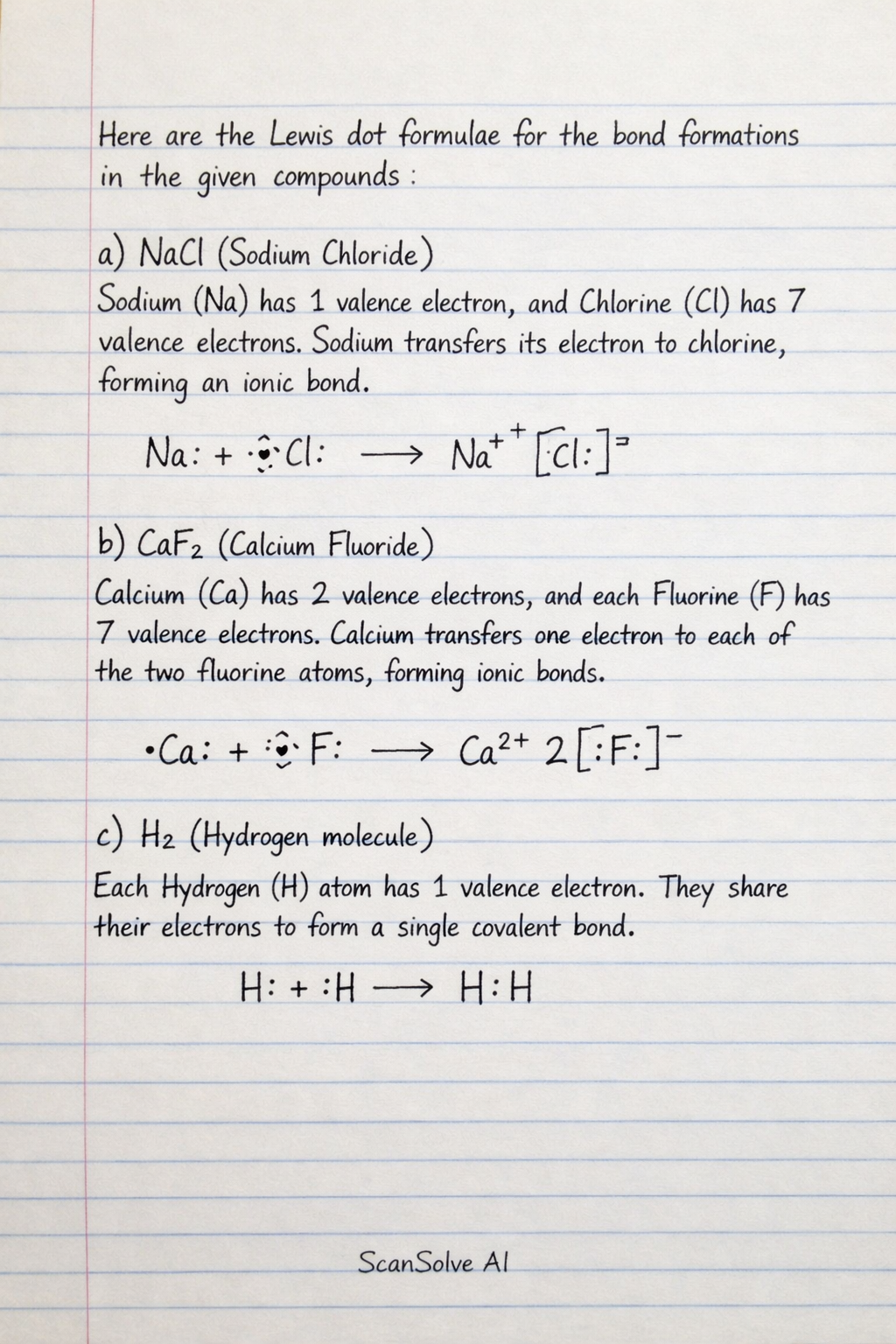
Here are the Lewis dot formulae for the bond formations in the given compounds:
a) NaCl (Sodium Chloride)
Sodium (Na) has 1 valence electron, and Chlorine (Cl) has 7 valence electrons. Sodium transfers its electron to chlorine, forming an ionic bond.
b) CaF₂ (Calcium Fluoride)
Calcium (Ca) has 2 valence electrons, and each Fluorine (F) has 7 valence electrons. Calcium transfers one electron to each of the two fluorine atoms, forming ionic bonds.
c) H₂ (Hydrogen molecule)
Each Hydrogen (H) atom has 1 valence electron. They share their electrons to form a single covalent bond.
d) O₂ (Oxygen molecule)
Each Oxygen (O) atom has 6 valence electrons. They share two pairs of electrons to form a double covalent bond, and each oxygen atom has two lone pairs.
e) N₂ (Nitrogen molecule)
Each Nitrogen (N) atom has 5 valence electrons. They share three pairs of electrons to form a triple covalent bond, and each nitrogen atom has one lone pair.
f) H₂O (Water molecule)
Oxygen (O) has 6 valence electrons, and each Hydrogen (H) has 1 valence electron. Oxygen forms a single covalent bond with each hydrogen atom and has two lone pairs.
Still stuck on this one?
Ask a follow-up, and the answer starts from this question.
More Chemistry Questions
Handwritten Step-by-Step Solution
Get this as a handwritten image on WhatsApp — like a tutor wrote it for you.
Try on WhatsApp