

This chemistry question involves key chemical concepts and calculations. The detailed solution below walks through each step, from identifying the reaction type to computing the final answer.
ScanSolve AI Answer
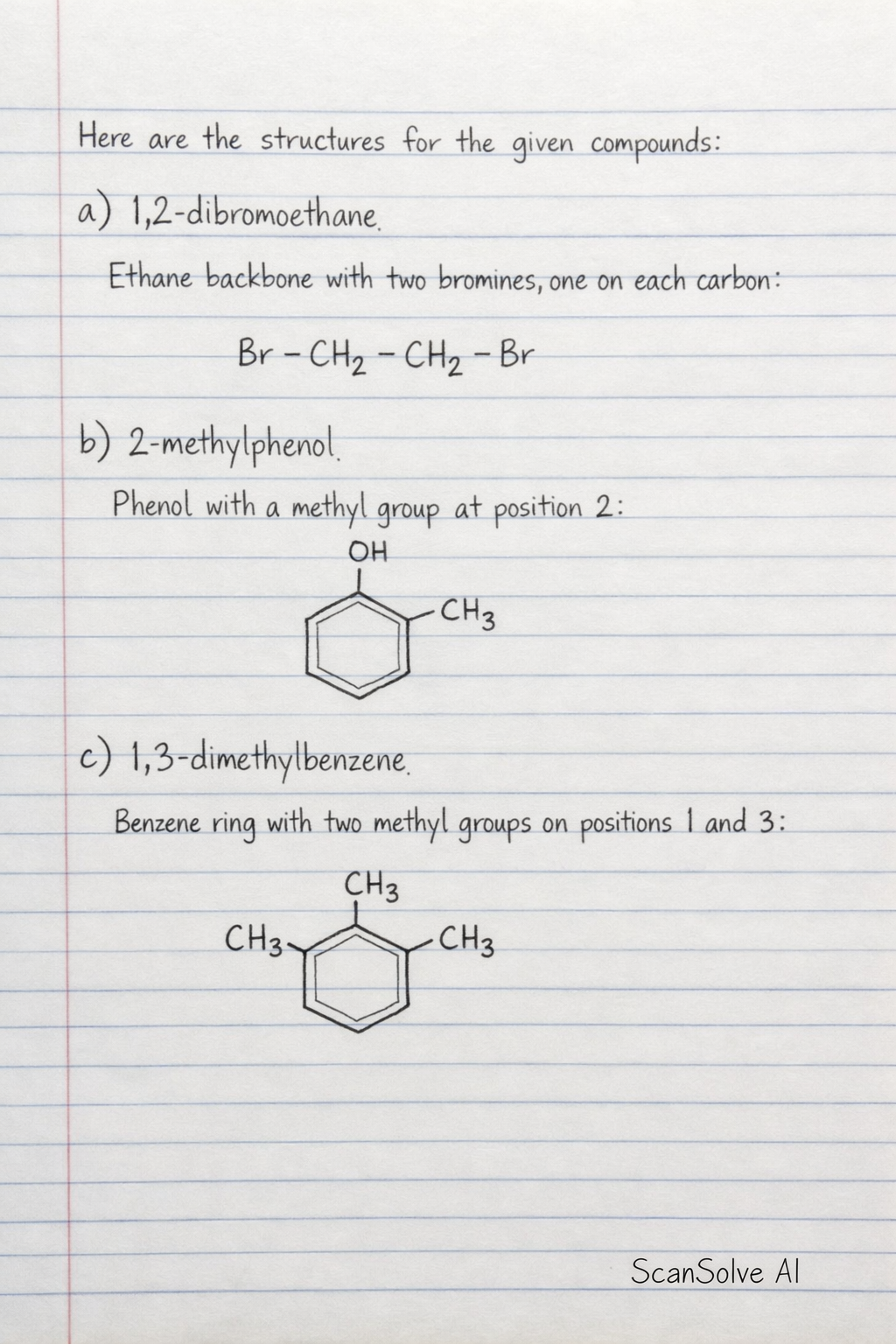
Here are the structures for the given compounds: a) 1,2-dibromoethane This compound has an ethane backbone (two carbons with a single bond) and two bromine atoms, one on each carbon. Br-CH_2-CH_2-Br b) 2-methylphenol Phenol is a benzene ring with a hydroxyl (-OH) group. The methyl (CH_3) group is at position 2 relative to the hydroxyl group (which is at position 1). [scale=0.8] (0,0) -- (1,0) -- (1.5,0.866) -- (1,1.732) -- (0,1.732) -- (-0.5,0.866) -- cycle; (0.5,0.866) circle (0.3); at (1.5,0.866) [right] OH; at (1,0) [below right] CH_3; c) 1,3-dimethylbenzene This is a benzene ring with two methyl (CH_3) groups attached at positions 1 and 3. [scale=0.8] (0,0) -- (1,0) -- (1.5,0.866) -- (1,1.732) -- (0,1.732) -- (-0.5,0.866) -- cycle; (0.5,0.866) circle (0.3); at (1.5,0.866) [right] CH_3; at (-0.5,0.866) [left] CH_3; d) 2,4,6-trichlorophenol (TCP) This is a phenol derivative with three chlorine atoms at positions 2, 4, and 6 relative to the hydroxyl group. [scale=0.8] (0,0) -- (1,0) -- (1.5,0.866) -- (1,1.732) -- (0,1.732) -- (-0.5,0.866) -- cycle; (0.5,0.866) circle (0.3); at (1.5,0.866) [right] OH; at (1,0) [below right] Cl; at (0,0) [below left] Cl; at (0,1.732) [above left] Cl; Send me the next one 📸