

This chemistry question involves key chemical concepts and calculations. The detailed solution below walks through each step, from identifying the reaction type to computing the final answer.
ScanSolve AI Answer
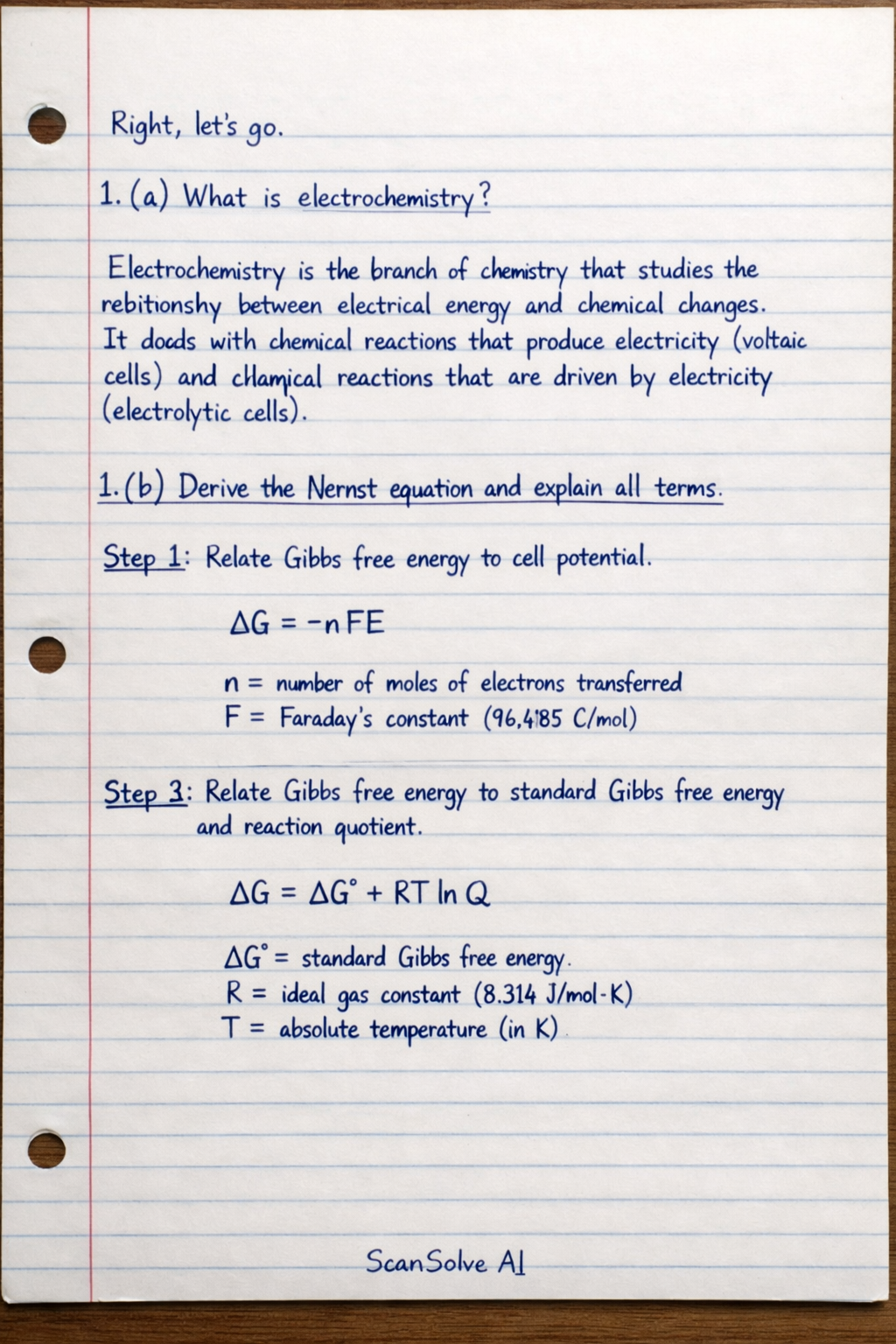
Right, let's go. 1. (a) What is electrochemistry? Electrochemistry is the branch of chemistry that studies the relationship between electrical energy and chemical changes. It deals with chemical reactions that produce electricity (voltaic cells) and chemical reactions that are driven by electricity (electrolytic cells). 1. (b) Derive the Nernst equation and explain all terms. Step 1: Relate Gibbs free energy to cell potential. The change in Gibbs free energy ( G) for a reaction is related to the cell potential (E) by the equation: G = -nFE where n is the number of moles of electrons transferred, and F is Faraday's constant. Step 2: Relate Gibbs free energy to standard Gibbs free energy and reaction quotient. The Gibbs free energy change under non-standard conditions is related to the standard Gibbs free energy change ( G^) and the reaction quotient (Q) by: G = G^ + RT Q where R is the ideal gas constant and T is the absolute temperature. Step 3: Substitute the cell potential relationships into the Gibbs free energy equation. We also know that G^ = -nFE^, where E^ is the standard cell potential. Substituting these into the equation from Step 2: -nFE = -nFE^ + RT Q Step 4: Rearrange to solve for E. Divide the entire equation by -nF: E = E^ - (RT)/(nF) Q This is the Nernst equation. Explanation of terms: E: The cell potential* (or electrode potential) under non-standard conditions, measured in volts (V). $E^