
We read your photo as:
Determine the electronic configuration and number of unpaired electrons for neutral Chromium (Cr) and Cr2+ ion.
ScanSolve AI Answer
Step-by-step solution
6 stepsDetermine the electronic configuration of neutral Chromium (Cr).
Chromium (Cr) has an atomic number of 24, meaning it has 24 electrons. Chromium is an exception to the Aufbau principle, exhibiting a half-filled d-subshell for increased stability.
The electronic configuration for Cr is:
Draw the orbital box diagram for Cr and determine the number of unpaired electrons.
The core represents 18 paired electrons. We focus on the valence electrons in and orbitals.
For : one electron in the orbital.
For : five electrons, each occupying a separate orbital due to Hund's rule.Number of unpaired electrons for Cr = .
The number of unpaired electrons for Cr is .Determine the electronic configuration of Cr.
Cr means the neutral Cr atom has lost 2 electrons. Electrons are removed from the orbital with the highest principal quantum number first. So, the electron is removed first, then one electron.
Neutral Cr:
Remove 1 electron from :
Remove 1 electron from :The electronic configuration for Cr is:
Draw the orbital box diagram for Cr and determine the number of unpaired electrons.
For : four electrons, each occupying a separate orbital.
Number of unpaired electrons for Cr = 4.
The number of unpaired electrons for Cr is .Determine the electronic configuration of Cr.
Cr means the neutral Cr atom has lost 3 electrons.
Neutral Cr:
Remove 1 electron from :
Remove 2 electrons from (to make a total of 3 removed):The electronic configuration for Cr is:
Draw the orbital box diagram for Cr and determine the number of unpaired electrons.
For : three electrons, each occupying a separate orbital.
Number of unpaired electrons for Cr = 3.
The number of unpaired electrons for Cr is .
Still stuck on this one?
Ask a follow-up, and the answer starts from this question.
More Chemistry Questions
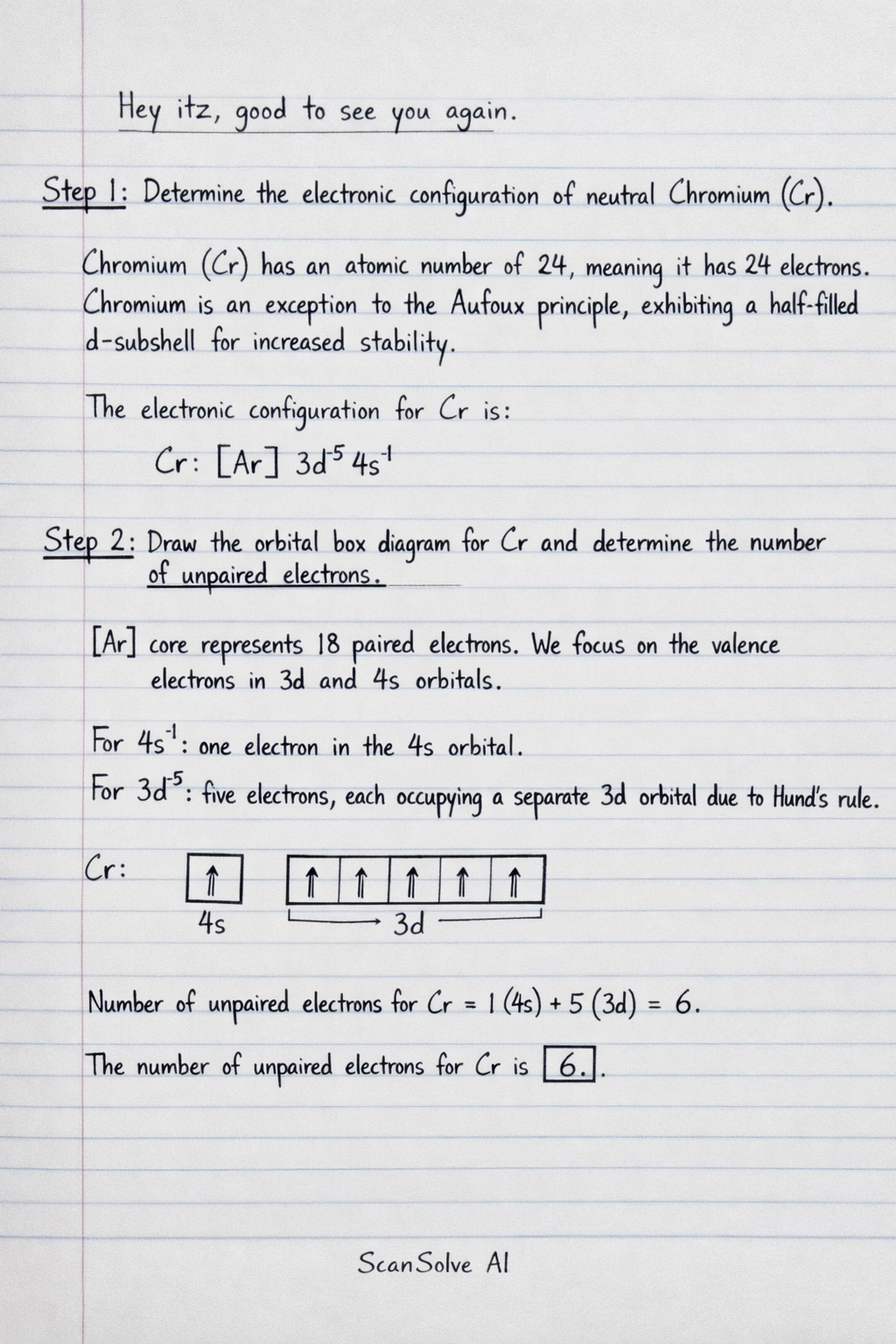
Handwritten Step-by-Step Solution
Get this as a handwritten image on WhatsApp — like a tutor wrote it for you.
Try on WhatsApp