
We read your photo as:
Determine the oxidation states of Cr and C in the reactants and products.
ScanSolve AI Answer
Step-by-step solution
7 stepsHere are the answers to your questions:
1a)
Determine the oxidation states of Cr and C in the reactants and products.
In : .
In : .
Chromium's oxidation state decreases from to , so is reduced.In : .
In : .
Carbon's oxidation state increases from to , so is oxidized.Identify the oxidizing and reducing agents.
The species that is reduced is the oxidizing agent.
The species that is oxidized is the reducing agent.- Oxidizing agent:
- Reducing agent:
1b)
The given reaction is:Write the unbalanced half-reactions.
Oxidation:
Reduction:Balance atoms other than O and H.
Oxidation:
Reduction:Balance O atoms by adding .
Oxidation: (O atoms are already balanced)
Reduction:Balance H atoms by adding (since it's an acidic medium).
Oxidation: (H atoms are already balanced)
Reduction:Balance charge by adding electrons ().
Oxidation: (Charge:
Still stuck on this one?
Ask a follow-up, and the answer starts from this question.
More Chemistry Questions
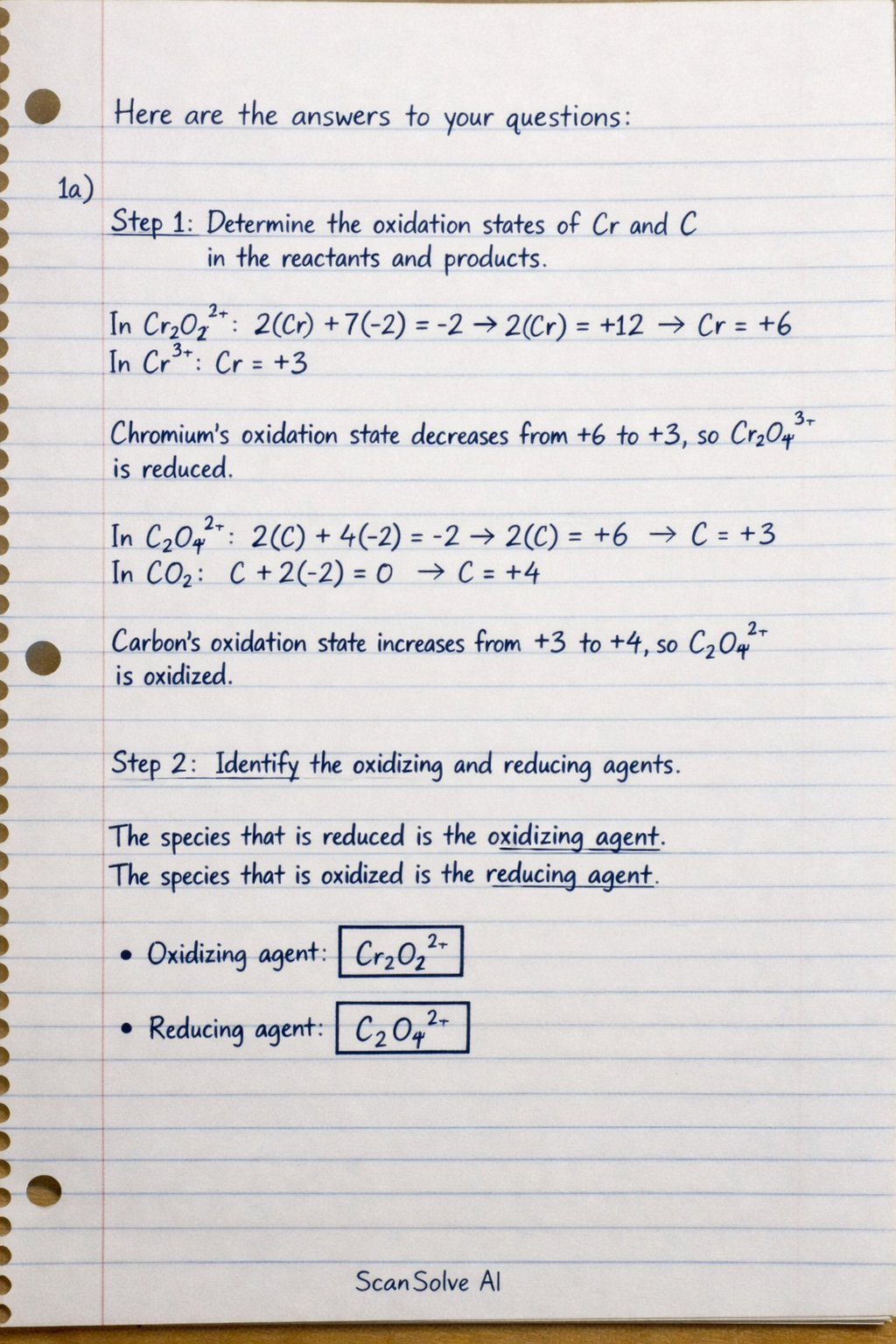
Handwritten Step-by-Step Solution
Get this as a handwritten image on WhatsApp — like a tutor wrote it for you.
Try on WhatsApp