
We read your photo as:
Calculate the enthalpy change for the combustion of ethane (C2H6) using bond enthalpy data.
ScanSolve AI Answer
Step-by-step solution
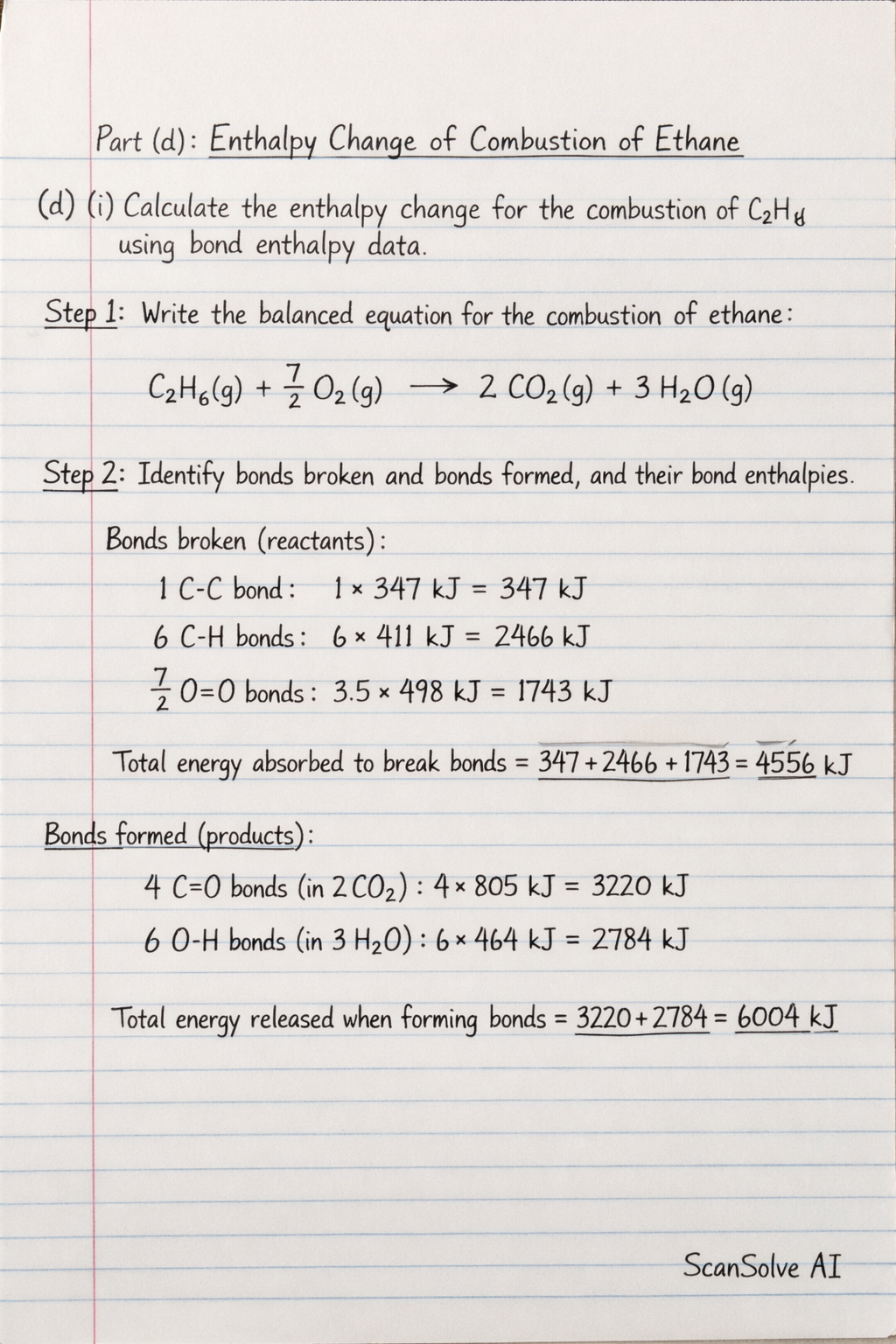
3 stepsPart (d): Enthalpy Change of Combustion of Ethane
d) (i) Calculate the enthalpy change for the combustion of ethane () using the bond enthalpy data.
Write the balanced chemical equation for the combustion of ethane.
Identify bonds broken and bonds formed, and their respective bond enthalpies.
Bonds broken (reactants):
- 1 C-C bond:
- 6 C-H bonds:
- O=O bonds: Total energy absorbed to break bonds =
Bonds formed (products):
- 4 C=O bonds (in ):
- 6 O-H bonds (in ): Total energy released when forming bonds =
Calculate the enthalpy change ().
The enthalpy change for the combustion of ethane is .
d) (ii) Suggest why this value differs from the data book value of for the enthalpy of combustion of ethane.
The calculated value uses average bond enthalpies, which are values averaged across many different compounds. The actual bond energies in a specific molecule like ethane can differ slightly from these average values due to the specific molecular environment. Additionally, standard enthalpy of combustion values often refer to water in its liquid state, whereas bond enthalpy calculations typically assume all species are in the gaseous state.Part (e): Unit Cells
e) (i) What is a centered unit cell?
A centered unit cell is a type of unit cell in a crystal lattice that contains constituent particles (atoms, ions, or molecules) at positions other than just the corners. These additional particles are located either at the center of the unit cell or at the center of its faces.e) (ii) List two types of centered unit cells.
- Body-centered cubic (BCC)
- Face-centered cubic (FCC)
Still stuck on this one?
Ask a follow-up, and the answer starts from this question.
More Chemistry Questions
Handwritten Step-by-Step Solution
Get this as a handwritten image on WhatsApp — like a tutor wrote it for you.
Try on WhatsApp