
We read your photo as:
Fig. 2.1 shows the structural formulae of isomeric hydrocarbons, P and Q. (i) Identify, with reasons, the hydrocarbon with a higher boiling point. (ii) Calculate the percentage of carbon by mass in 1 mole of P.
ScanSolve AI Answer
Answer
Step-by-step solution
7 stepsPart a(i)· 3 steps
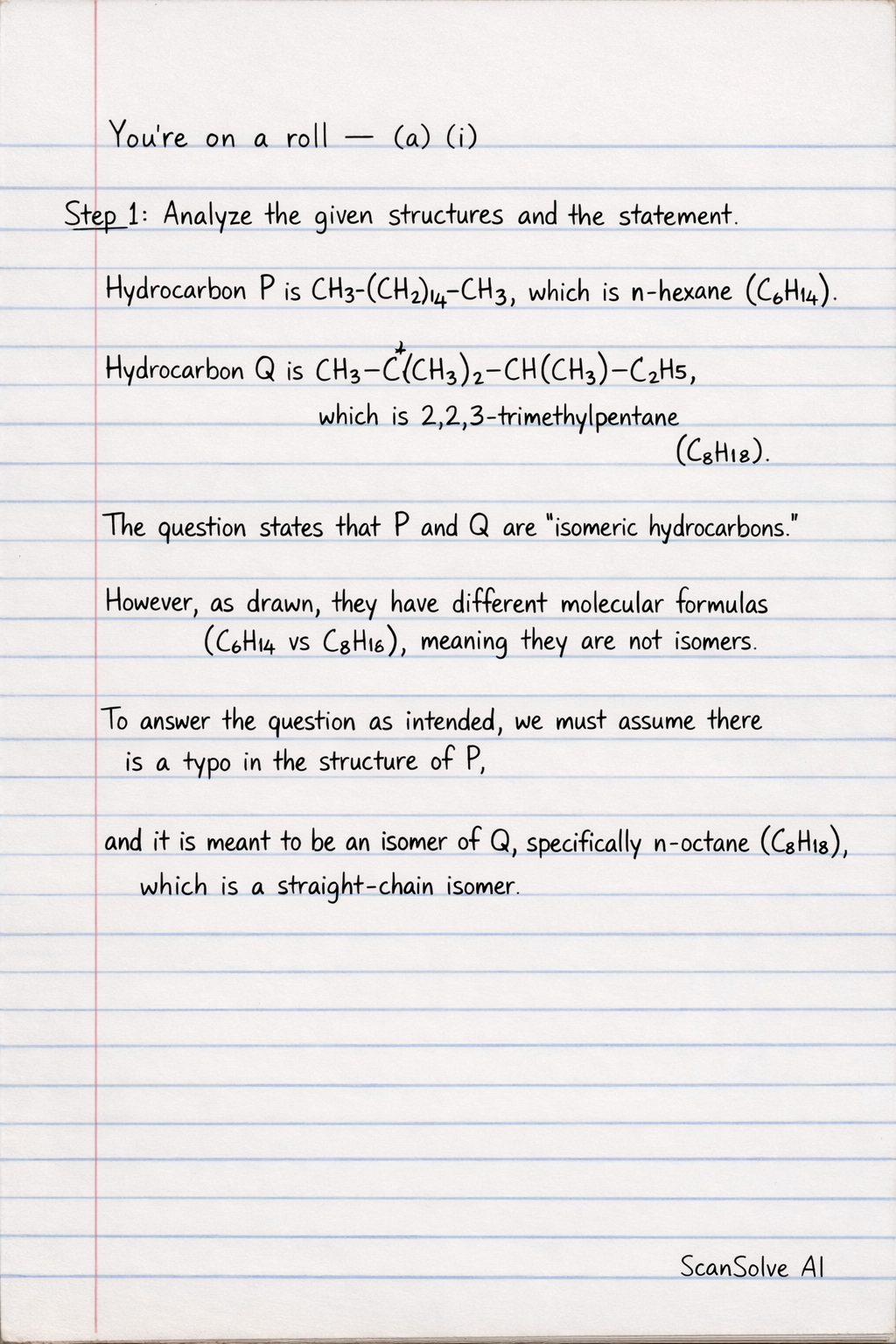
Analyze the given structures and the statement.
Hydrocarbon P is , which is n-hexane ().
Hydrocarbon Q is , which is 2,2,3-trimethylpentane ().
The question states that P and Q are "isomeric hydrocarbons". However, as drawn, they have different molecular formulas ( vs ), meaning they are not isomers. To answer the question as intended, we must assume there is a typo in the structure of P, and it is meant to be an isomer of Q, specifically n-octane (), which is a straight-chain isomer.Compare the boiling points of straight-chain and branched isomers.
Assuming P is n-octane (a straight-chain alkane) and Q is 2,2,3-trimethylpentane (a branched alkane) of the same molecular formula ():
Straight-chain alkanes have a larger surface area for intermolecular contact compared to branched alkanes. This allows for more extensive and stronger London dispersion forces (van der Waals forces) to develop between molecules of the straight-chain isomer.Conclude which hydrocarbon has a higher boiling point.
Stronger intermolecular forces require more energy to overcome during boiling. Therefore, the straight-chain isomer will have a higher boiling point.
Hydrocarbon P (assuming it's n-octane) has a higher boiling point.The hydrocarbon with a higher boiling point is P.
Reason: Assuming P and Q are isomers (e.g., P is n-octane and Q is 2,2,3-trimethylpentane), P has a straight-chain structure, while Q has a branched structure. Straight-chain alkanes have a larger surface area for intermolecular contact, leading to stronger London dispersion forces between molecules. These stronger forces require more energy to overcome, resulting in a higher boiling point for P.
Part a(ii)
Determine the molecular formula of P from the given structure.
From the diagram, P is , which is n-hexane.
The molecular formula of n-hexane is .Calculate the molar mass of P ().
Atomic mass of Carbon (C)
Atomic mass of Hydrogen (H)
Molar mass of
Molar mass ofCalculate the mass of carbon in 1 mole of P.
Mass of carbon in 1 mole of
Calculate the percentage of carbon by mass.
The percentage of carbon by mass in 1 mole of P is .
Part b
The trend in the boiling points of the hydrides of Group (VI) elements from oxygen to tellurium (, , , ) shows an initial anomaly.
Water () has an exceptionally high boiling point (around ) compared to the other hydrides in the group. This is due to the presence of strong hydrogen bonds between water molecules, which require a significant amount of energy to overcome.
For the subsequent hydrides (, , ), the boiling point generally increases down the group. This is because as the atomic number of the central atom increases, the molecular size and electron cloud also increase, leading to stronger London dispersion forces (van der Waals forces) between molecules. These forces require more energy to overcome, thus raising the boiling point.
Try one yourself
A new problem that tests the same skill.
Still stuck on this one?
Ask a follow-up, and the answer starts from this question.
More Chemistry Questions
Handwritten Step-by-Step Solution
Get this as a handwritten image on WhatsApp — like a tutor wrote it for you.
Try on WhatsApp