
We read your photo as:
Define the following terms: Enthalpy, Lattice energy, Hydration energy, Entropy, Heat of combustion. Calculate the pH and pOH of a 2.3 x 10⁻² M HCl solution diluted to 100 mL.
ScanSolve AI Answer
This answer stops before the end.
It was cut off when it was first written. Ask ScanSolve this question again for the full working.
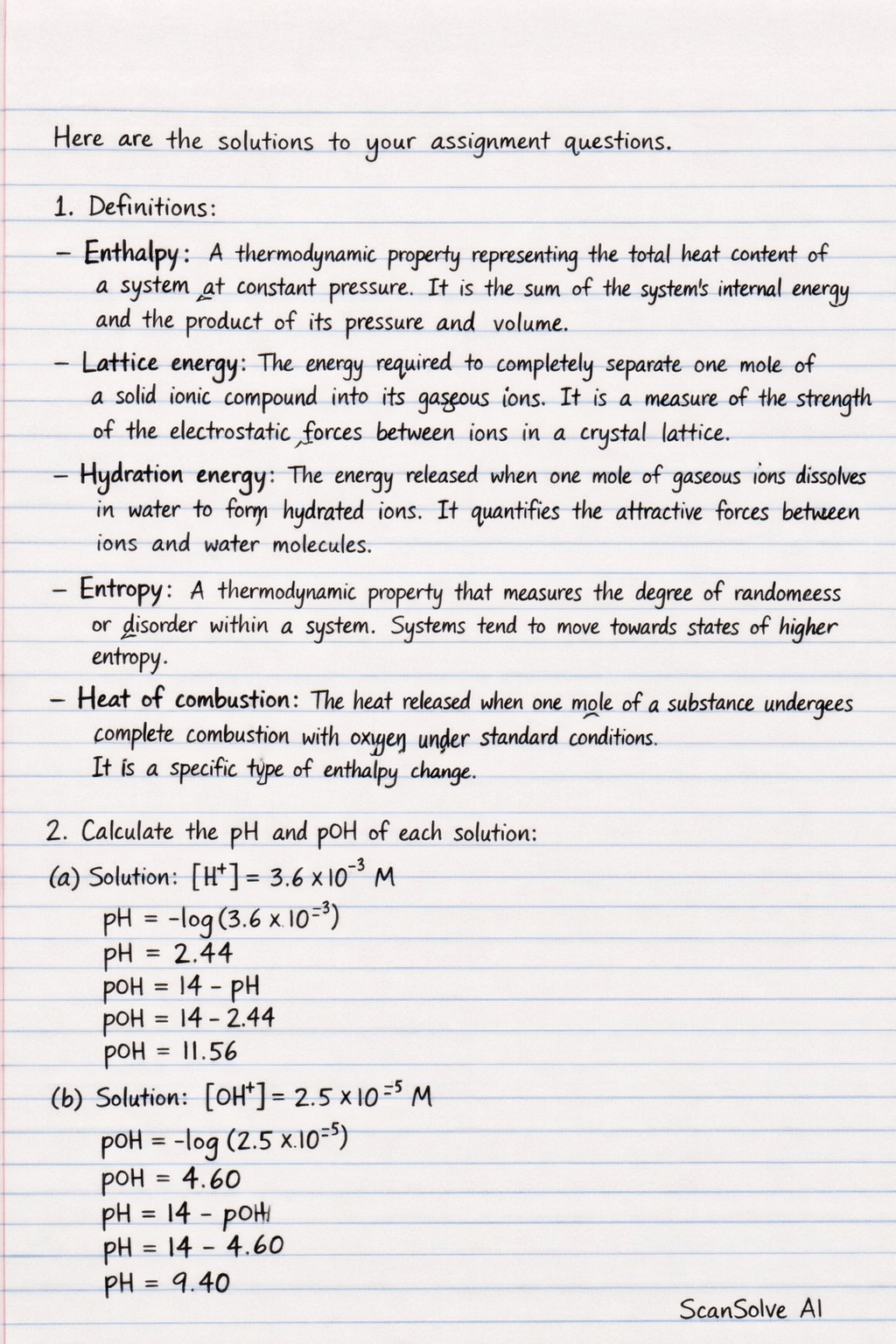
Here are the solutions to your assignment questions.
1. Definitions:
- Enthalpy: A thermodynamic property representing the total heat content of a system at constant pressure. It is the sum of the system's internal energy and the product of its pressure and volume.
- Lattice energy: The energy required to completely separate one mole of a solid ionic compound into its gaseous ions. It is a measure of the strength of the electrostatic forces between ions in a crystal lattice.
- Hydration energy: The energy released when one mole of gaseous ions dissolves in water to form hydrated ions. It quantifies the attractive forces between ions and water molecules.
- Entropy: A thermodynamic property that measures the degree of randomness or disorder within a system. Systems tend to move towards states of higher entropy.
- Heat of combustion: The heat released when one mole of a substance undergoes complete combustion with oxygen under standard conditions. It is a specific type of enthalpy change.
2. Calculate the pH and pOH of each solution:
a) 25.0 mL of M HCl, diluted to 100 mL
Step 1: Calculate the initial moles of HCl.
Step 2: Calculate the final concentration of HCl after dilution.
Since HCl is a strong acid, .
Step 3: Calculate pH.
Step 4: Calculate pOH.
The pH is and the pOH is .
b) 5.0 mL of 1.87 M NaOH, diluted to 125 mL
Step 1: Calculate the initial moles of NaOH.
Step 2: Calculate the final concentration of NaOH after dilution.
Still stuck on this one?
Ask a follow-up, and the answer starts from this question.
More Chemistry Questions
Handwritten Step-by-Step Solution
Get this as a handwritten image on WhatsApp — like a tutor wrote it for you.
Try on WhatsApp