
We read your photo as:
For each of the following equations, identify the type of reaction and describe the likely observations: a) 2KBr(aq) + Cl2(aq) -> 2KCl(aq) + Br2(aq) b) CuO(s) + H2(g) -> Cu(s) + H2O(l) c) CH2=CH2(g) +
ScanSolve AI Answer
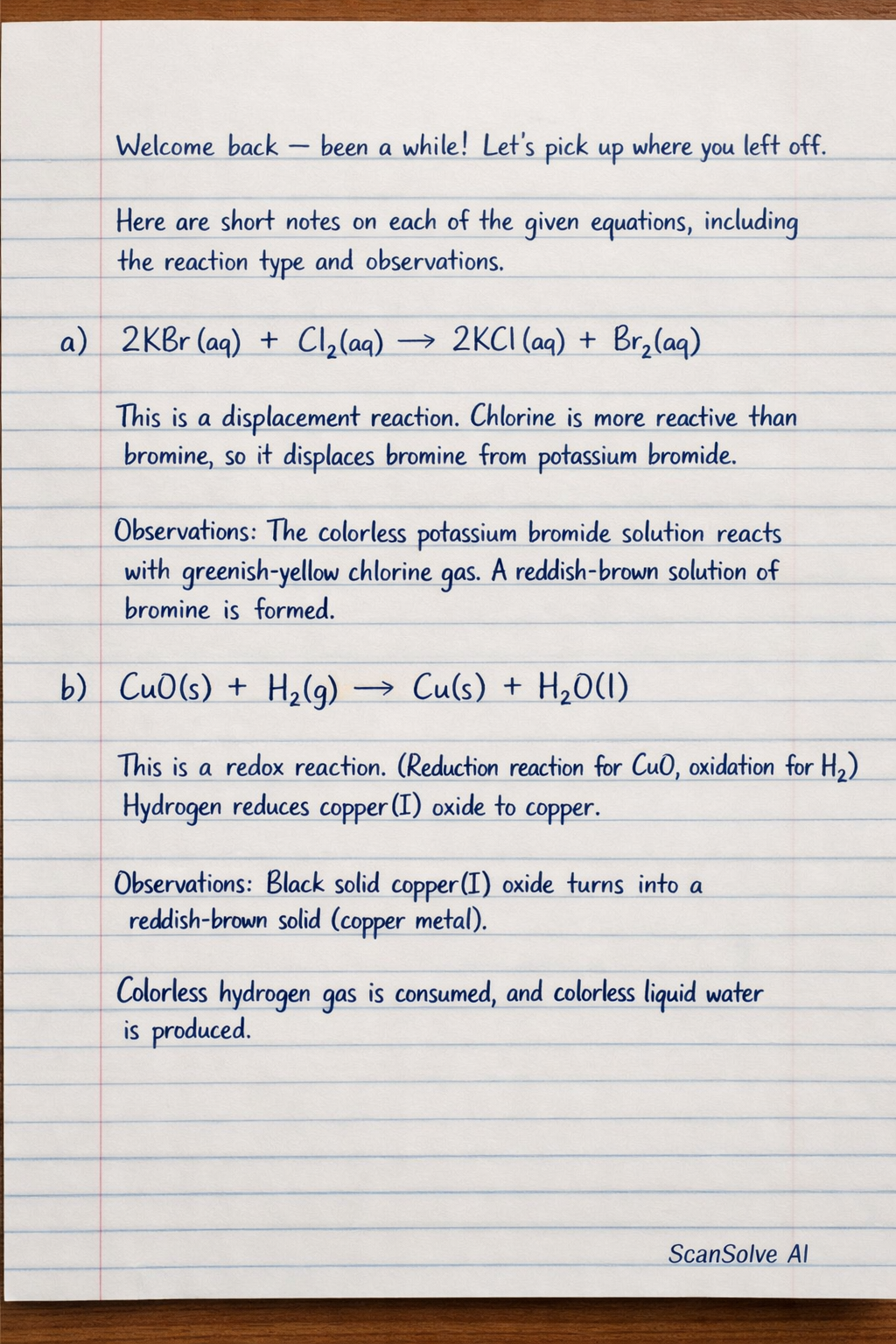
Here are short notes on each of the given equations, including the reaction type and observations.
a)
This is a displacement reaction. Chlorine is more reactive than bromine, so it displaces bromine from potassium bromide.
Observations: The colorless potassium bromide solution reacts with greenish-yellow chlorine gas. A reddish-brown solution of bromine is formed.
b)
This is a redox reaction (specifically, a reduction reaction for CuO and oxidation for H). Hydrogen reduces copper(II) oxide to copper.
Observations: Black solid copper(II) oxide turns into a reddish-brown solid (copper metal). Colorless hydrogen gas is consumed, and colorless liquid water is produced.
c)
This is an addition reaction (specifically, hydrogenation). Ethene reacts with hydrogen in the presence of a catalyst (e.g., nickel) to form ethane.
Observations: Ethene gas reacts with hydrogen gas to form ethane gas. If a catalyst like nickel is used, the reaction typically occurs at elevated temperatures and pressures. There are no visible color changes as all reactants and products are colorless gases.
d)
This is an esterification reaction (a type of condensation reaction). Ethanol reacts with ethanoic acid in the presence of a strong acid catalyst (e.g., concentrated sulfuric acid) to form ethyl ethanoate and water. It is a reversible reaction.
Observations: Ethanol and ethanoic acid, both colorless liquids, react to form ethyl ethanoate, which is a colorless liquid with a fruity smell, and water. The reaction is typically carried out by heating the mixture.
Still stuck on this one?
Ask a follow-up, and the answer starts from this question.
More Chemistry Questions
Handwritten Step-by-Step Solution
Get this as a handwritten image on WhatsApp — like a tutor wrote it for you.
Try on WhatsApp