
We read your photo as:
Explain why H2SO4 is used instead of HCl for acidification in redox titrations and why sodium thiosulphate is not a primary standard.
Chemistry
ScanSolve AI Answer
This answer stops before the end.
It was cut off when it was first written. Ask ScanSolve this question again for the full working.
Here are the solutions to the questions:
-
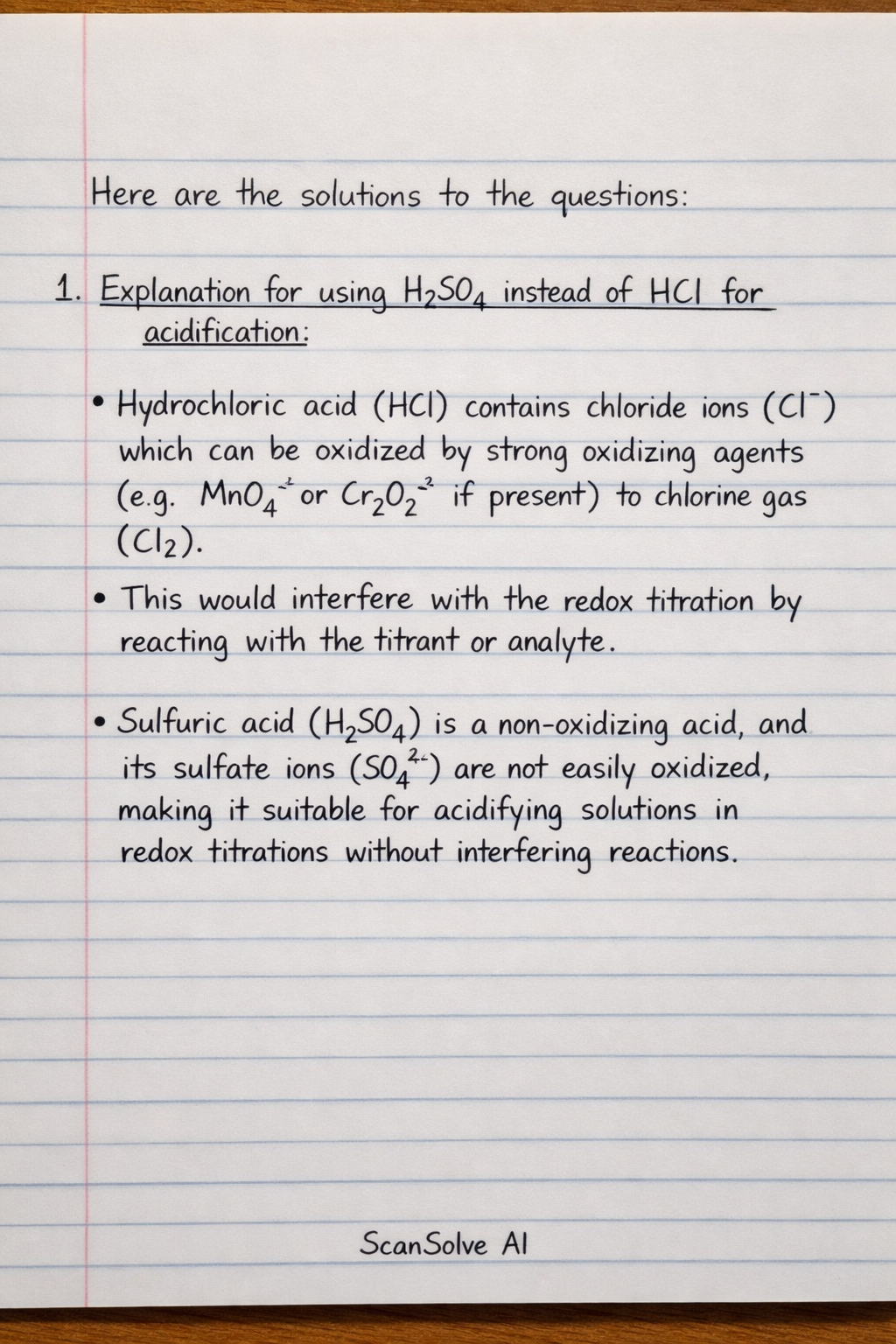
Explanation for using instead of for acidification:
- Hydrochloric acid () contains chloride ions () which can be oxidized by strong oxidizing agents (e.g., or if present) to chlorine gas (). This would interfere with the redox titration by reacting with the titrant or analyte.
- Sulfuric acid () is a non-oxidizing acid, and its sulfate ions () are not easily oxidized, making it suitable for acidifying solutions in redox titrations without interfering reactions.
-
Explanation why sodium thiosulphate is not a primary standard:
- Sodium thiosulphate () is not a primary standard because its purity and exact water content are variable. It can lose water of crystallization (effloresce) or absorb moisture (deliquesce) from the atmosphere.
- It is also susceptible to decomposition by atmospheric oxygen, light, bacteria, and in acidic solutions, leading to changes in its concentration over time.
-
Explanation why sodium thiosulphate solution is susceptible to decomposition to give elemental sulphur:
- Sodium thiosulphate solution is unstable in acidic conditions. When acidified, the thiosulphate ion () undergoes disproportionation, where sulfur in different oxidation states reacts to form elemental sulfur and sulfur dioxide.
- The reaction is:
- The elemental sulfur appears as a cloudy precipitate, indicating decomposition. (Note: The question mentions "metal sulfide" which is not a typical product of thiosulphate decomposition in acid; elemental sulfur and sulfur dioxide are the common products).
-
Equation for thiosulphate reacting with iodine, producing sodium iodide:
- The reaction between iodine and thiosulphate ions is:
- In terms of sodium salts, this is:
Was this helpful?
Still stuck on this one?
Ask a follow-up, and the answer starts from this question.
Got a different question?Ask your own question
More Chemistry Questions
QWhat are the reasons for specific procedures in a sodium carbonate and hydrochloric acid titration…QWrite the balanced chemical equation for the reaction of sodium chloride with concentrated sulfuric…QPrepare redox titration on this saltsQA) Calculate the mass concentration of iron (II). b) Explain why the solution was acidified with…QYou are to determine the concentration of a solution of tetraoxosulphate (VI) acid by titrating it…
Handwritten Step-by-Step Solution
Get this as a handwritten image on WhatsApp — like a tutor wrote it for you.
Try on WhatsApp