
We read your photo as:
I) An ionic bond is formed by the electrostatic attraction between oppositely charged ions, typically resulting from the complete transfer of electrons from a metal atom to a non-metal atom. A co
ScanSolve AI Answer
c)
i) An ionic bond is formed by the electrostatic attraction between oppositely charged ions, typically resulting from the complete transfer of electrons from a metal atom to a non-metal atom. A covalent bond is formed by the sharing of electrons between two non-metal atoms.
ii) The method used for determining the molar mass of a volatile liquid is the Victor Meyer method (or Dumas method).
iii) One condition necessary for the formation of hydrogen bonds is that a hydrogen atom must be directly bonded to a highly electronegative atom such as nitrogen (N), oxygen (O), or fluorine (F).
d)
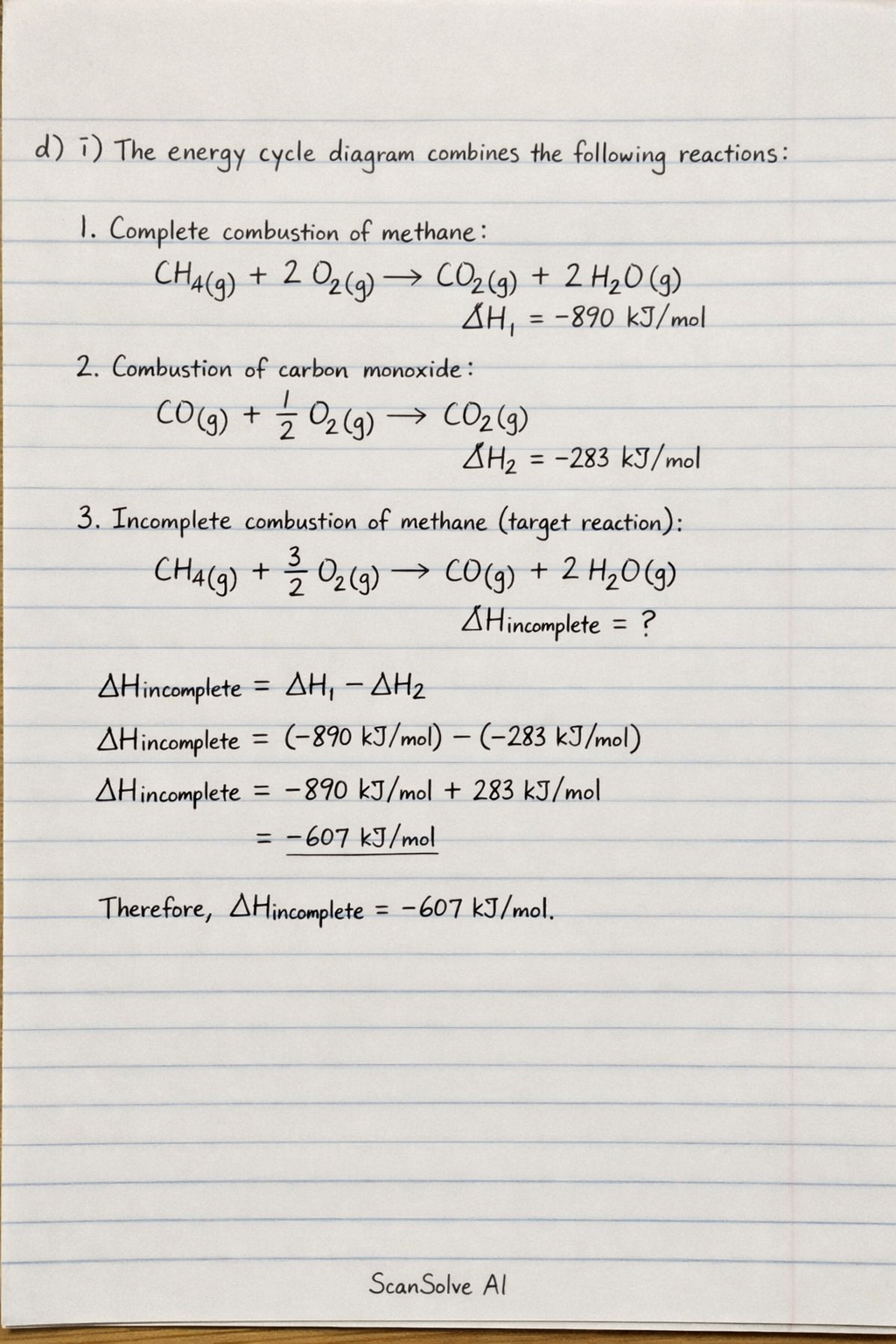
i) The energy cycle diagram combines the following reactions:
- Complete combustion of methane: ,
- Combustion of carbon monoxide: ,
- Incomplete combustion of methane (target reaction): ,
The energy cycle diagram is:
The diagram shows the initial state () at the top, the final state ($CO_2
Still stuck on this one?
Ask a follow-up, and the answer starts from this question.
More Chemistry Questions
Handwritten Step-by-Step Solution
Get this as a handwritten image on WhatsApp — like a tutor wrote it for you.
Try on WhatsApp