
We read your photo as:
I. Draw a labelled diagram to illustrate the laboratory preparation of carbon (IV) oxide from marble. ii. Write the equation for the reaction in (b)i. iii. Give two uses of carbon (IV) oxide.
Chemistry
ScanSolve AI Answer
Step-by-step solution
3 stepshere are the answers to your questions:
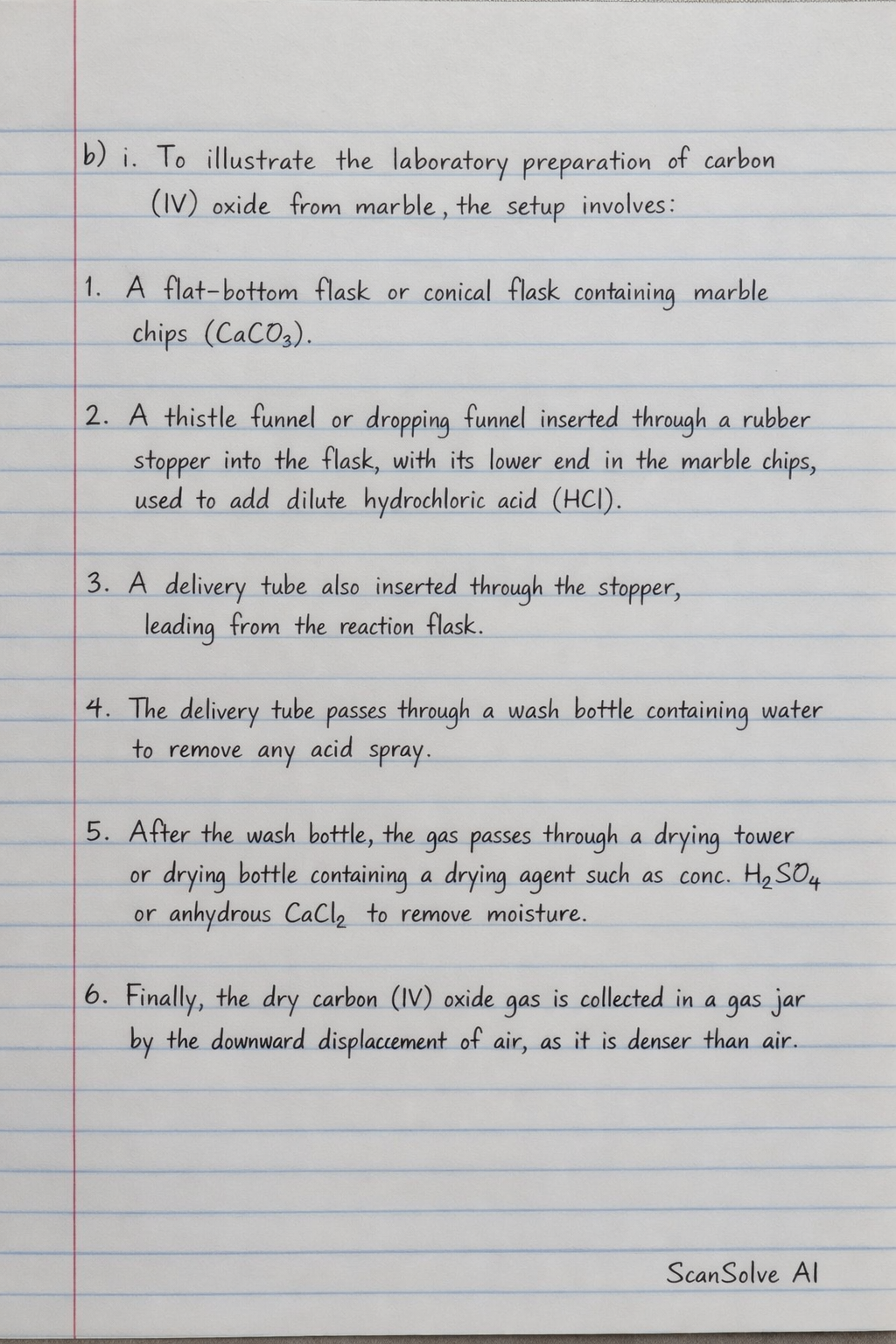
b) i. To illustrate the laboratory preparation of carbon (IV) oxide from marble, the setup involves:
- A flat-bottom flask or conical flask containing marble chips ().
- A thistle funnel or dropping funnel inserted through a rubber stopper into the flask, with its lower end submerged in the marble chips, used to add dilute hydrochloric acid ().
- A delivery tube also inserted through the stopper, leading from the reaction flask.
- The delivery tube passes through a wash bottle containing water to remove any acid spray.
- After the wash bottle, the gas passes through a drying tower or drying bottle containing a drying agent such as concentrated sulfuric acid or anhydrous calcium chloride to remove moisture.
- Finally, the dry carbon (IV) oxide gas is collected in a gas jar by the downward displacement of air, as it is denser than air.
b) ii. The equation for the reaction in (b) is:
Identify the reactants and products.
Marble is calcium carbonate (), and it reacts with dilute hydrochloric acid () to produce calcium chloride (), water (), and carbon (IV) oxide ().
Write the unbalanced equation.
Balance the equation.
Two hydrogen atoms are needed on the left side to balance the two chlorine atoms and the hydrogen atoms in water.
b) iii. Two uses of carbon (IV) oxide are:
- It is used in fire extinguishers because it is non-flammable and denser than air, thus smothering flames.
- It is used to carbonate soft drinks and other beverages, giving them their fizz.
Was this helpful?
Still stuck on this one?
Ask a follow-up, and the answer starts from this question.
Got a different question?Ask your own question
More Chemistry Questions
QWhat is the laboratory preparation of carbon iv oxideQ(i) The chemical equation for the reaction when carbon (IV) oxide gas is passed over heated charcoal…QTotal: 10 Marks Define Carbon(II) oxide and state one method of its preparation in the laboratory…QIdentify liquid P, write the equation for the reaction, and state one industrial use of carbon(IV)…QA) Write and balance the equation for the reaction between carbon (IV) oxide and heated charcoal. b)…
Handwritten Step-by-Step Solution
Get this as a handwritten image on WhatsApp — like a tutor wrote it for you.
Try on WhatsApp