
We read your photo as:
I) The valence electronic configurations for the S-block elements are:
Chemistry
ScanSolve AI Answer
Here are the solutions to the questions:
d)
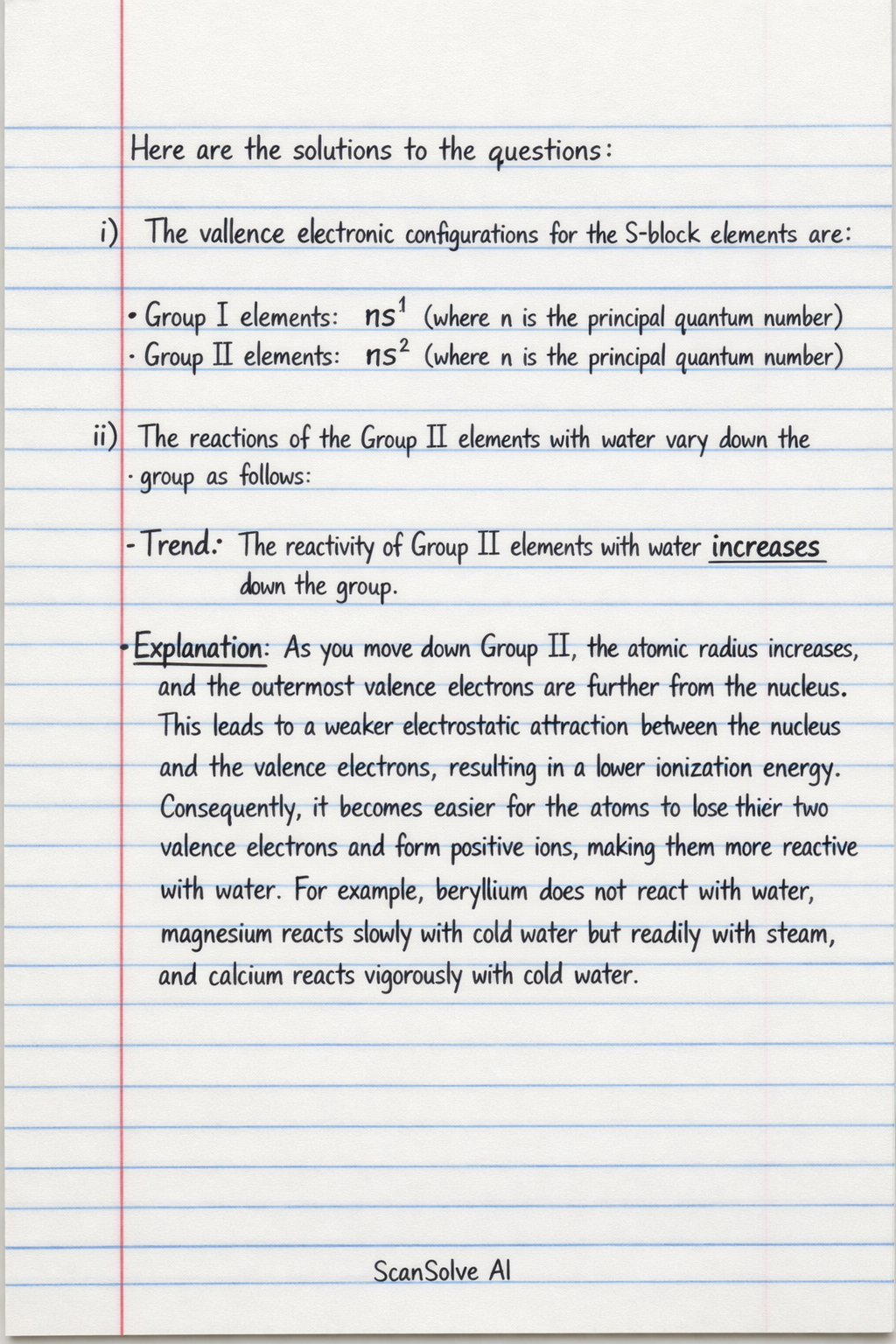
i) The valence electronic configurations for the S-block elements are:
- Group I elements: (where is the principal quantum number)
- Group II elements: (where is the principal quantum number)
ii) The reactions of the Group II elements with water vary down the group as follows:
- Trend: The reactivity of Group II elements with water increases down the group.
- Explanation: As you move down Group II, the atomic radius increases, and the outermost valence electrons are further from the nucleus. This leads to a weaker electrostatic attraction between the nucleus and the valence electrons, resulting in a lower ionization energy. Consequently, it becomes easier for the atoms to lose their two valence electrons and form positive ions, making them more reactive with water. For example, beryllium does not react with water, magnesium reacts slowly with cold water but readily with steam, and calcium reacts vigorously with cold water.
iii) Balanced chemical equations for the reactions of the following elements with cold water:
- Na(s):
- Mg(s):
Was this helpful?
Still stuck on this one?
Ask a follow-up, and the answer starts from this question.
Got a different question?Ask your own question
More Chemistry Questions
QA) The general outer electron configuration of a halogen is:QI) The Group VII elements (Halogens) in order of increasing atomic number with their physical states…QConsider the electron configuration of the following elements: Q = 1s2 2s2 2p1, R = 1s2 2s2 2p6 3s2…QA) Explain why S is not an ion. b) Determine the number of electrons in the neutral atoms of P, Q, R…QIdentify the element, and predict its group and period based on the electronic configuration…
Handwritten Step-by-Step Solution
Get this as a handwritten image on WhatsApp — like a tutor wrote it for you.
Try on WhatsApp