
We read your photo as:
Identify the synthetic polymer, first lab-created element, suspension, heterogeneous mixture, and the branch of chemistry studying atomic/molecular properties.
ScanSolve AI Answer
Answer
Polystyrene
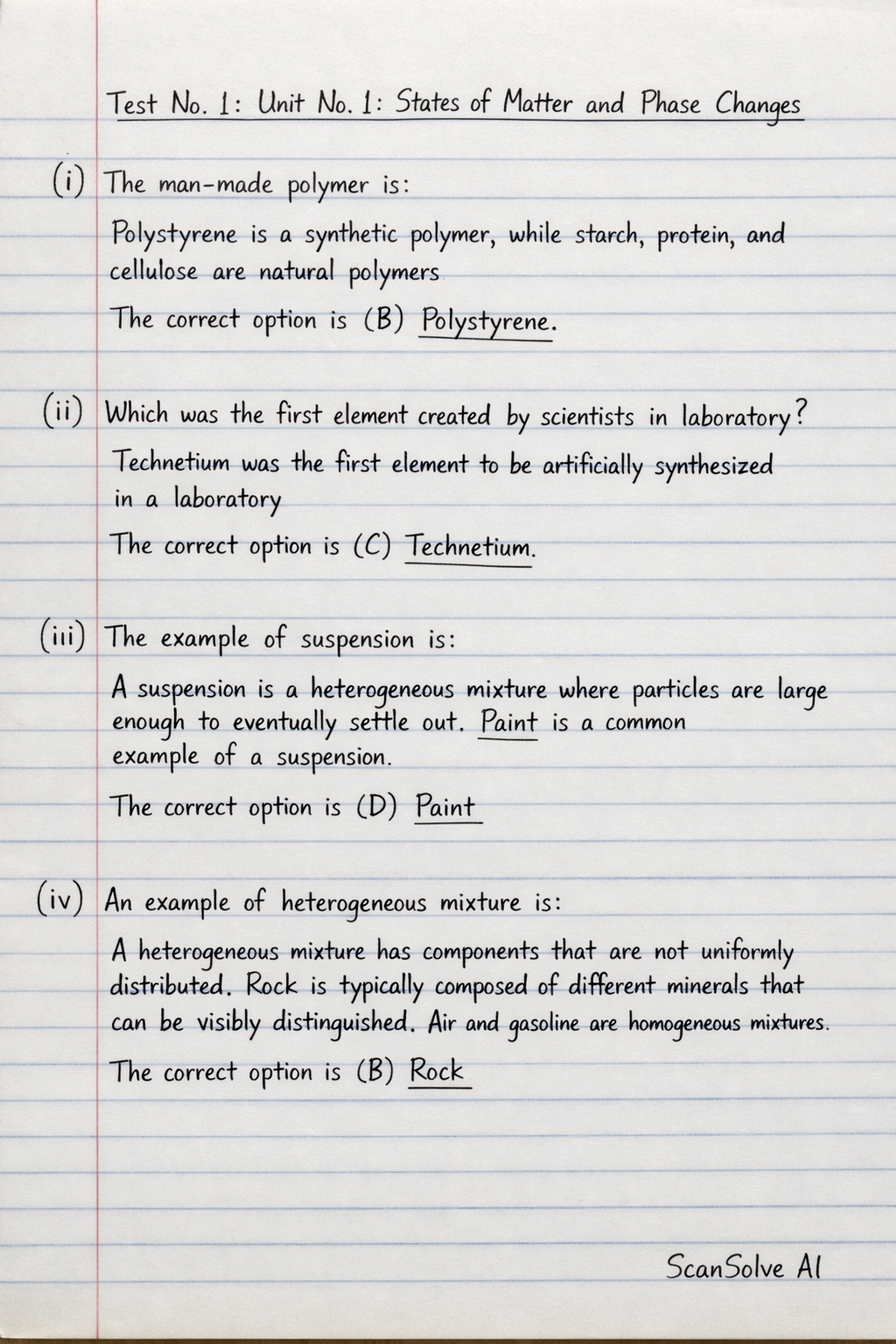
Test No. 1: Unit No. 1: States of Matter and Phase Changes
i) The man-made polymer is:
Polystyrene is a synthetic polymer, while starch, protein, and cellulose are natural polymers.
The correct option is (B) Polystyrene.
ii) Which was the first element created by scientists in laboratory?
Technetium was the first element to be artificially synthesized in a laboratory.
The correct option is (C) Technetium.
iii) The example of suspension is:
A suspension is a heterogeneous mixture where particles are large enough to eventually settle out. Paint is a common example of a suspension.
The correct option is (D) paint.
iv) An example of heterogeneous mixture is:
A heterogeneous mixture has components that are not uniformly distributed. Rock is typically composed of different minerals that can be visibly distinguished. Air and gasoline are homogeneous mixtures.
The correct option is (B) rock.
v) The branch of chemistry in which properties such as structure of atoms or formation of molecules are studied is called:
Physical chemistry studies the physical and fundamental basis of chemical systems and processes, including atomic structure and molecular formation.
The correct option is (D) physical chemistry.
vi) Which one of the following can be separated by physical means?
Mixtures can be separated into their components by physical methods (e.g., filtration, distillation). Elements and compounds require chemical or nuclear means for separation into simpler substances.
The correct option is (A) mixtures.
Test No. 2: Unit No. 2: Atomic Structure
i) How many electrons can be accommodated at the most in the third shell of the elements?
The maximum number of electrons in a shell is given by the formula , where is the principal quantum number. For the third shell, .
The correct option is (B) 18.
ii) Which element has not any neutron in its atom?
The most common isotope of hydrogen, protium (H), consists of one proton and no neutrons.
The correct option is (A) hydrogen.
iii) Mass of a proton is:
The mass of a proton is approximately 1.0073 atomic mass units (amu).
The correct option is (A) 1.0073 amu.
iv) Number of protons in oxygen is:
The atomic number of oxygen is 8, which means an oxygen atom has 8 protons.
The correct option is (A) 8.
v) Atomic number of an element is represented by symbol.
The atomic number of an element is conventionally represented by the symbol .
The correct option is (D) Z.
vi) Who presented the concept of orbit in atom?
Niels Bohr proposed the model of the atom where electrons orbit the nucleus in specific, quantized energy levels, often referred to as orbits.
The correct option is (C) Bohr.
Try one yourself
A new problem that tests the same skill.
Still stuck on this one?
Ask a follow-up, and the answer starts from this question.
More Chemistry Questions
Handwritten Step-by-Step Solution
Get this as a handwritten image on WhatsApp — like a tutor wrote it for you.
Try on WhatsApp