
We read your photo as:
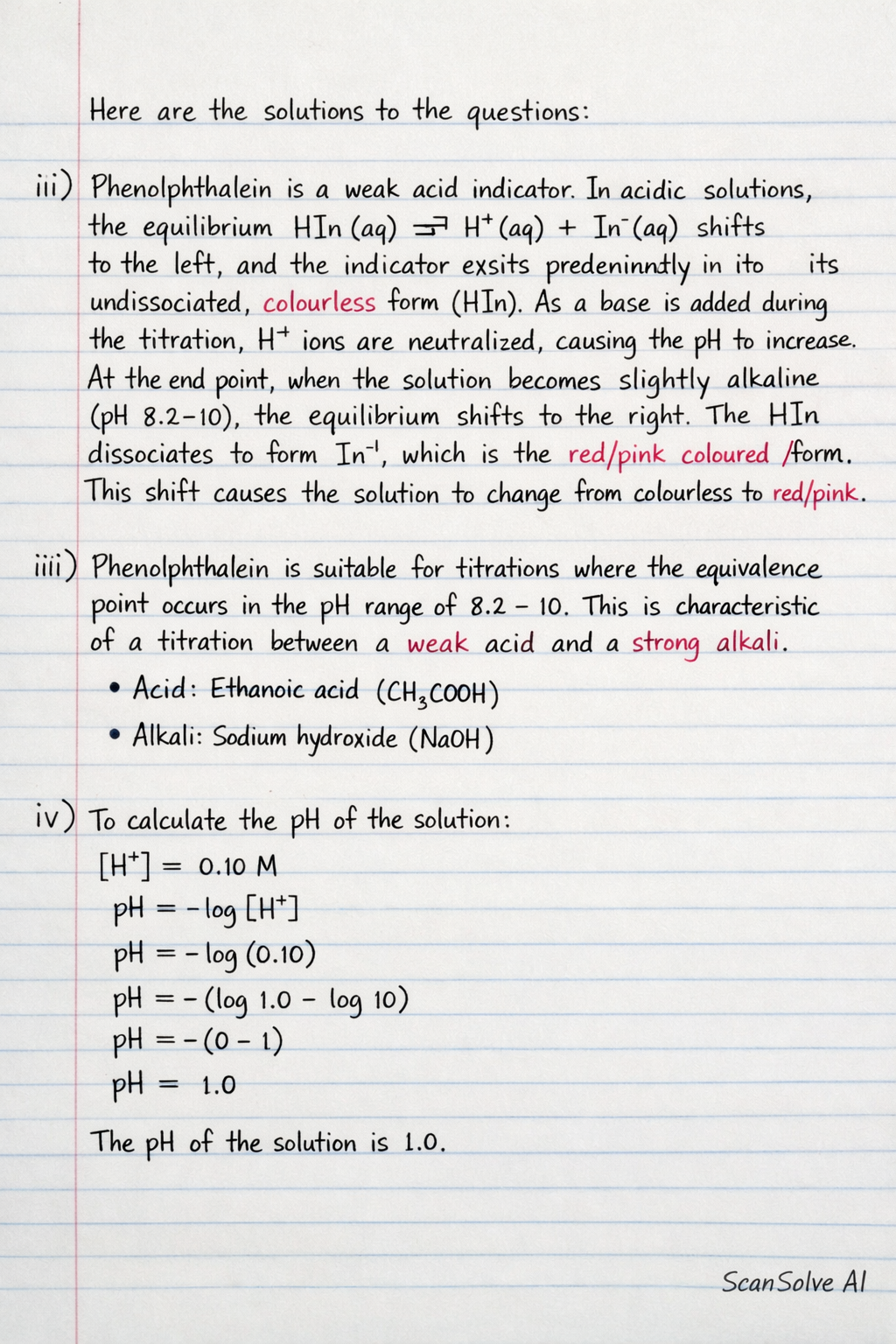
Ii) Phenolphthalein is a weak acid indicator. In acidic solutions, the equilibrium HIn(aq) H^+(aq) + In^-(aq) shifts to the left, and the indicator exists p
ScanSolve AI Answer
Answer
Step-by-step solution
2 stepsHere are the solutions to the questions:
ii) Phenolphthalein is a weak acid indicator. In acidic solutions, the equilibrium shifts to the left, and the indicator exists predominantly in its undissociated, colourless form (). As a base is added during the titration, ions are neutralized, causing the pH to increase. At the end point, when the solution becomes slightly alkaline (pH 8.2-10), the equilibrium shifts to the right. The dissociates to form , which is the red/pink coloured form. This shift causes the solution to change from colourless to red/pink.
Part iii
Phenolphthalein is suitable for titrations where the equivalence point occurs in the pH range of 8.2 - 10. This is characteristic of a titration between a weak acid and a **strong alkali
- Acid: Ethanoic acid ()
- Alkali: Sodium hydroxide ()
Part iv11.40
To calculate the pH of the solution
Calculate the pOH from the given ion concentration.
Calculate the pH using the relationship .
Try one yourself
A new problem that tests the same skill.
Still stuck on this one?
Ask a follow-up, and the answer starts from this question.
More Chemistry Questions
Handwritten Step-by-Step Solution
Get this as a handwritten image on WhatsApp — like a tutor wrote it for you.
Try on WhatsApp