
We read your photo as:
In the flow diagram below, 1, 2 and 3 represent organic reactions. A, B, C and D represent organic compounds.
ScanSolve AI Answer
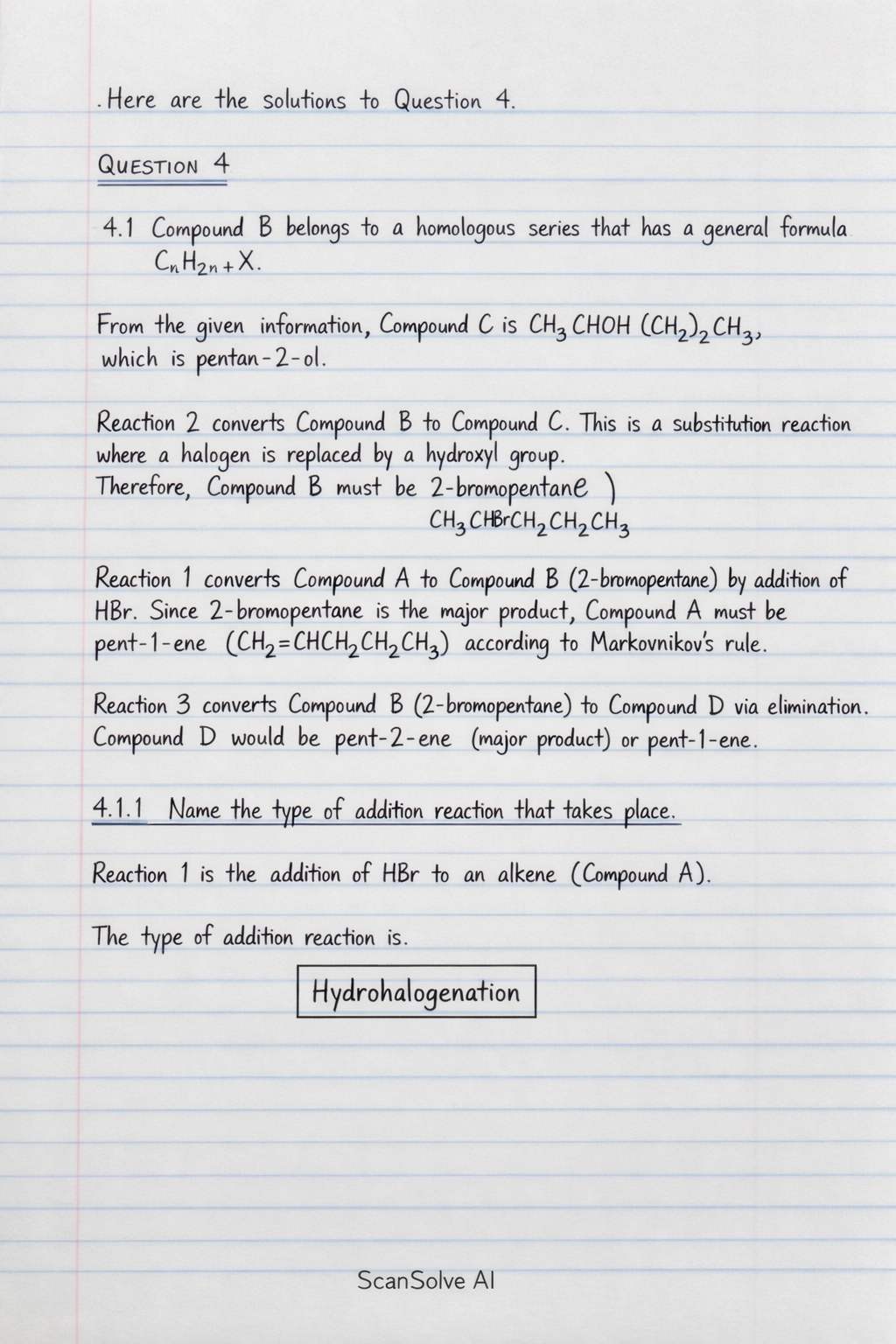
Here are the solutions to Question 4.
QUESTION 4
4.1 Compound B belongs to a homologous series that has a general formula .
From the given information, Compound C is , which is pentan-2-ol.
Reaction 2 converts Compound B to Compound C. This is a substitution reaction where a halogen is replaced by a hydroxyl group. Therefore, Compound B must be 2-bromopentane ().
Reaction 1 converts Compound A to Compound B (2-bromopentane) by addition of HBr. Since 2-bromopentane is the major product, Compound A must be pent-1-ene () according to Markovnikov's rule.
Reaction 3 converts Compound B (2-bromopentane) to Compound D via elimination. Compound D would be pent-2-ene (major product) or pent-1-ene.
4.1.1 Name the type of addition reaction that takes place.
Reaction 1 is the addition of HBr to an alkene (Compound A).
The type of addition reaction is .
4.1.2 Apart from heat, write down ONE other reaction condition for this reaction.
For the addition of HBr to an alkene, to ensure electrophilic addition and the major product according to Markovnikov's rule, the reaction is typically carried out in the absence of light.
One other reaction condition is .
4.2 Compound C is formed when compound A is treated with HBr in reaction 1. Reaction 1 is classified as an ADDITION reaction. Write down:
(Note: There appears to be a typo in the question. Based on the diagram, Compound B is formed from Compound A in reaction 1, and Compound C is formed from Compound B in reaction 2. We will proceed with the interpretation that Compound B is formed in reaction 1 and Compound C is formed in reaction 2.)
4.2.1 The structural formula of compound A.
Compound A is pent-1-ene.
The structural formula of compound A is .
4.2.2 TWO terms that describe reaction 2.
Reaction 2 is the conversion of a haloalkane (2-bromopentane) to an alcohol (pentan-2-ol).
Two terms that describe reaction 2 are and .
4.2.3 TWO properties of the base used in reaction 2.
Reaction 2 (hydrolysis of a haloalkane to an alcohol) typically uses a dilute aqueous strong base.
Two properties of the base are and .
4.3 With the aid of a catalyst, compound A can be converted directly to compound C without the formation of the intermediate compound B. Write down the:
This refers to the direct conversion of pent-1-ene (Compound A) to pentan-2-ol (Compound C). This is the hydration of an alkene.
4.3.1 Name or formula of the inorganic REACTANT needed for this direct conversion.
The inorganic reactant needed is water.
Name: or Formula: .
4.3.2 Name or formula of a catalyst that can be used.
The hydration of an alkene is catalyzed by a strong acid.
Name: or Formula: . (Phosphoric acid, , is also acceptable).
4.3.3 Type of addition reaction that takes place.
The addition of water to an alkene is called hydration.
The type of addition reaction is .
4.4 In reaction 3, compound B is treated with concentrated sodium hydroxide, and the mixture is heated.
Reaction 3 is the conversion of Compound B (2-bromopentane) to Compound D under conditions of concentrated sodium hydroxide and heat. These conditions favor elimination.
4.4.1 Name the type of reaction that takes place.
The type of reaction is .
4.4.2 Using molecular formulae, write a balanced equation for reaction 3.
Compound B is 2-bromopentane ().
The reaction is elimination (dehydrohalogenation) with concentrated sodium hydroxide () and heat. The products are an alkene (Compound D, ), sodium bromide (), and water ().
Still stuck on this one?
Ask a follow-up, and the answer starts from this question.
More Chemistry Questions
Handwritten Step-by-Step Solution
Get this as a handwritten image on WhatsApp — like a tutor wrote it for you.
Try on WhatsApp