
This chemistry question involves key chemical concepts and calculations. The detailed solution below walks through each step, from identifying the reaction type to computing the final answer.
ScanSolve AI Answer
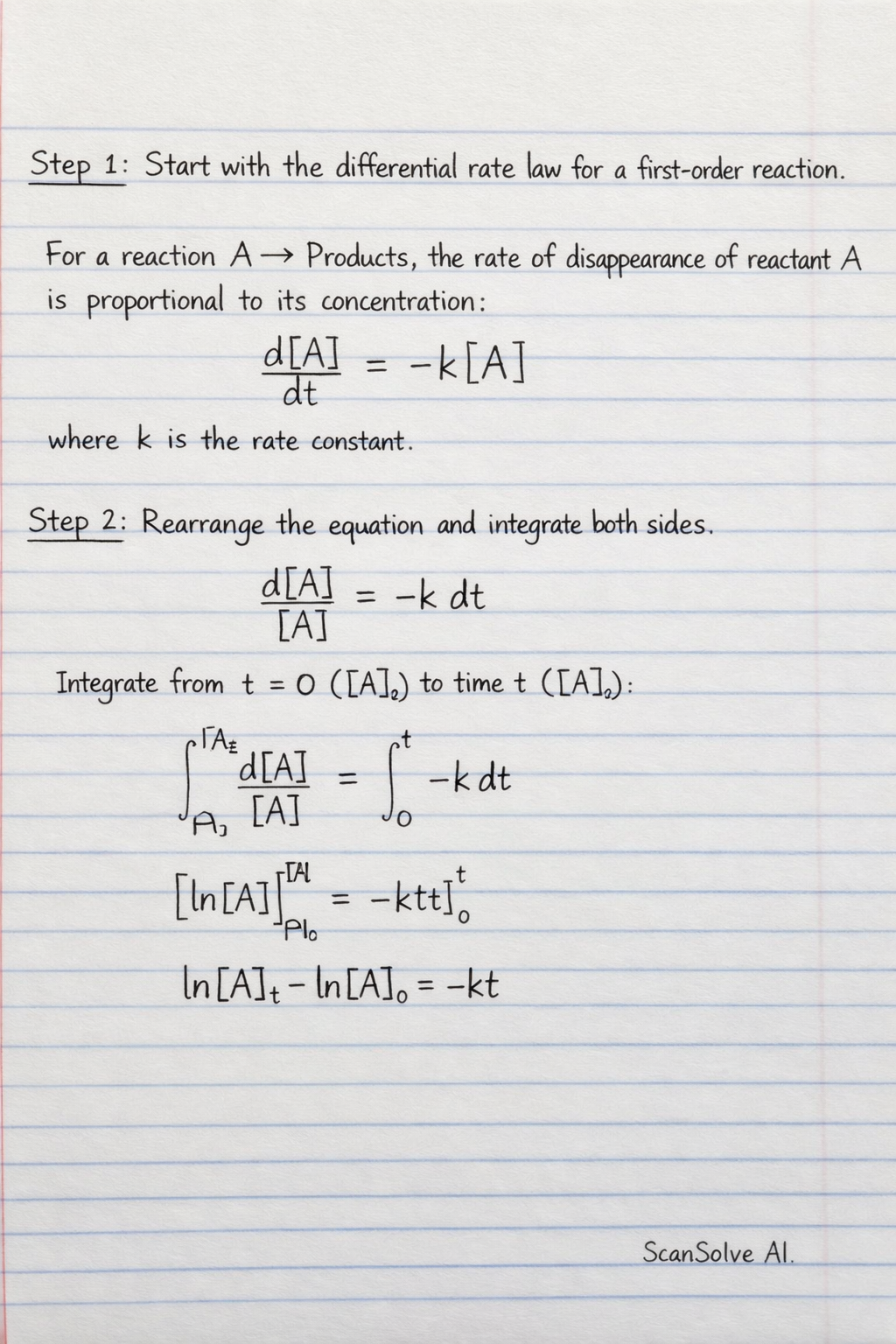
Step 1: Start with the differential rate law for a first-order reaction. For a reaction A → Products, the rate of disappearance of reactant A is proportional to its concentration: d[A]dt = -k[A] where k is the rate constant. Step 2: Rearrange the equation and integrate both sides. d[A][A] = -k\,dt Integrate from time t=0 (concentration [A]_0) to time t (concentration [A]_t): _[A]_0^[A]_t d[A][A] = _0^t -k\,dt [[A]]_[A]_0^[A]_t = -k[t]_0^t [A]_t - [A]_0 = -kt Step 3: Express the integrated rate law in its common form. ([A]_t[A]_0) = -kt This can also be written as: [A]_t = -kt + [A]_0 Or, in exponential form: [A]_t = [A]_0 e^-kt Where: • [A]_t is the concentration of reactant A at time t. • [A]_0 is the initial concentration of reactant A at t=0. • k is the rate constant. • t is the time. The integrated rate law for a first-order reaction is: [A]_t = -kt + [A]_0 3 done, 2 left today. You're making progress.