
We read your photo as:
Explain the ionization of water and calculate the H3O+ concentration at 50°C.
ScanSolve AI Answer
Answer
Step-by-step solution
3 stepsHere are the solutions to your questions:
Part 7.1· 3 steps
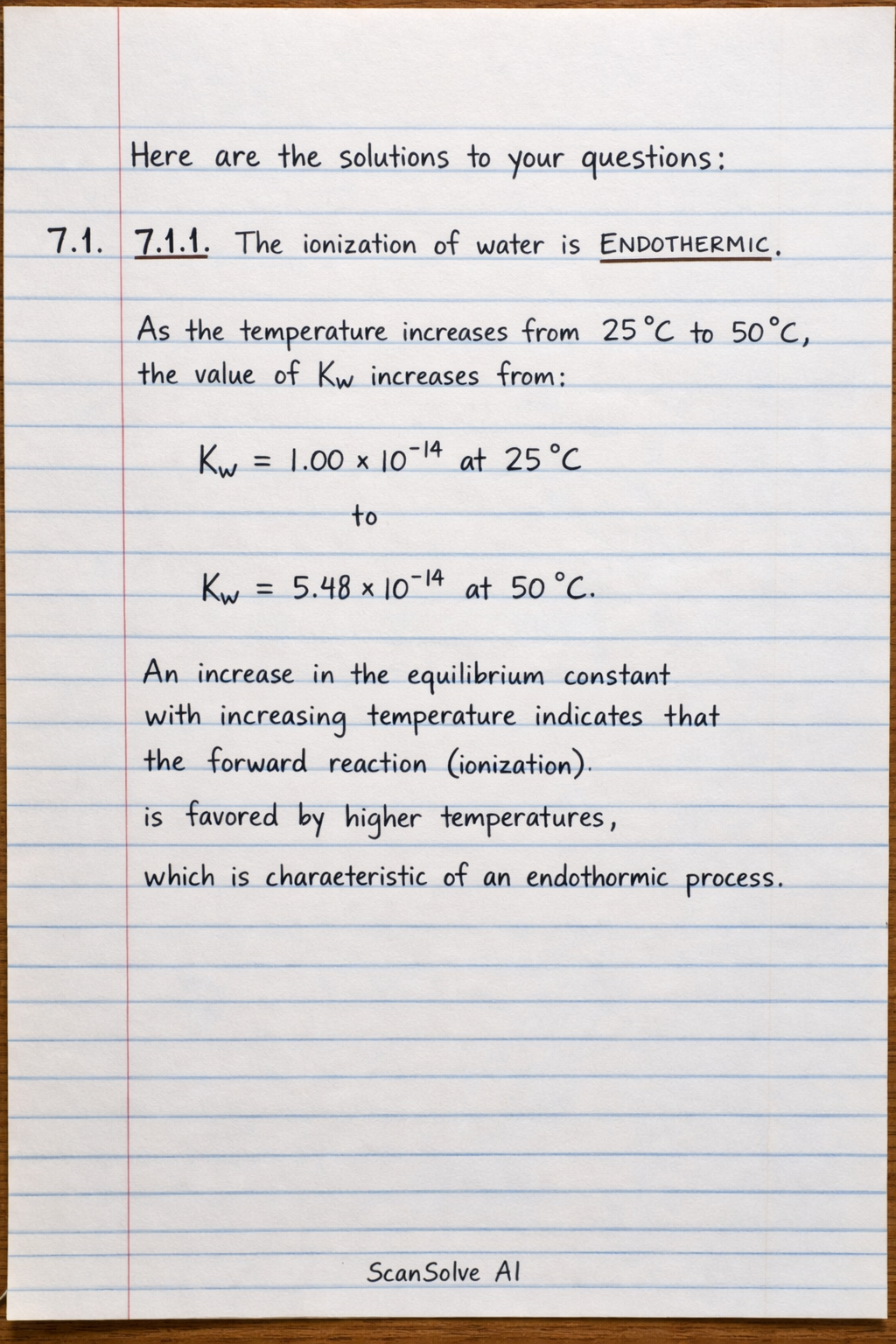
7.1.1. The ionization of water is ENDOTHERMIC.
As the temperature increases from to , the value of increases from to . An increase in the equilibrium constant with increasing temperature indicates that the forward reaction (ionization) is favored by higher temperatures, which is characteristic of an endothermic process.
7.1.2.
Identify the value at .
At , .
Use the relationship between and for pure water.
For pure water, .
Calculate .
The concentration of ions in water at is .
7.1.3. The pH of water will DECREASE.
As the temperature increases, the value of increases, which means the concentration of ions increases. Since , an increase in leads to a decrease in pH.
Part 7.2
7.2.1. Water acts as an acid (donates a proton to ):
7.2.2. Water acts as a base (accepts a proton from ):
Part 7.3
7.3.1. An electrolyte is a substance that, when dissolved in a solvent (typically water), produces ions and is therefore capable of conducting electricity.
7.3.2. The most effective electrolyte is .
The reason is that has the largest value () among the given acids. A larger value indicates a stronger acid, meaning it ionizes to a greater extent in solution, producing a higher concentration of ions and thus making it a more effective electrolyte.
Try one yourself
A new problem that tests the same skill.
Still stuck on this one?
Ask a follow-up, and the answer starts from this question.
More Chemistry Questions
Handwritten Step-by-Step Solution
Get this as a handwritten image on WhatsApp — like a tutor wrote it for you.
Try on WhatsApp