
We read your photo as:
Limestone granules react with excess HCl. Curve X shows the reaction of 0.2g. Which curve represents the reaction of 0.4g under identical conditions?
ScanSolve AI Answer
Answer
Step-by-step solution
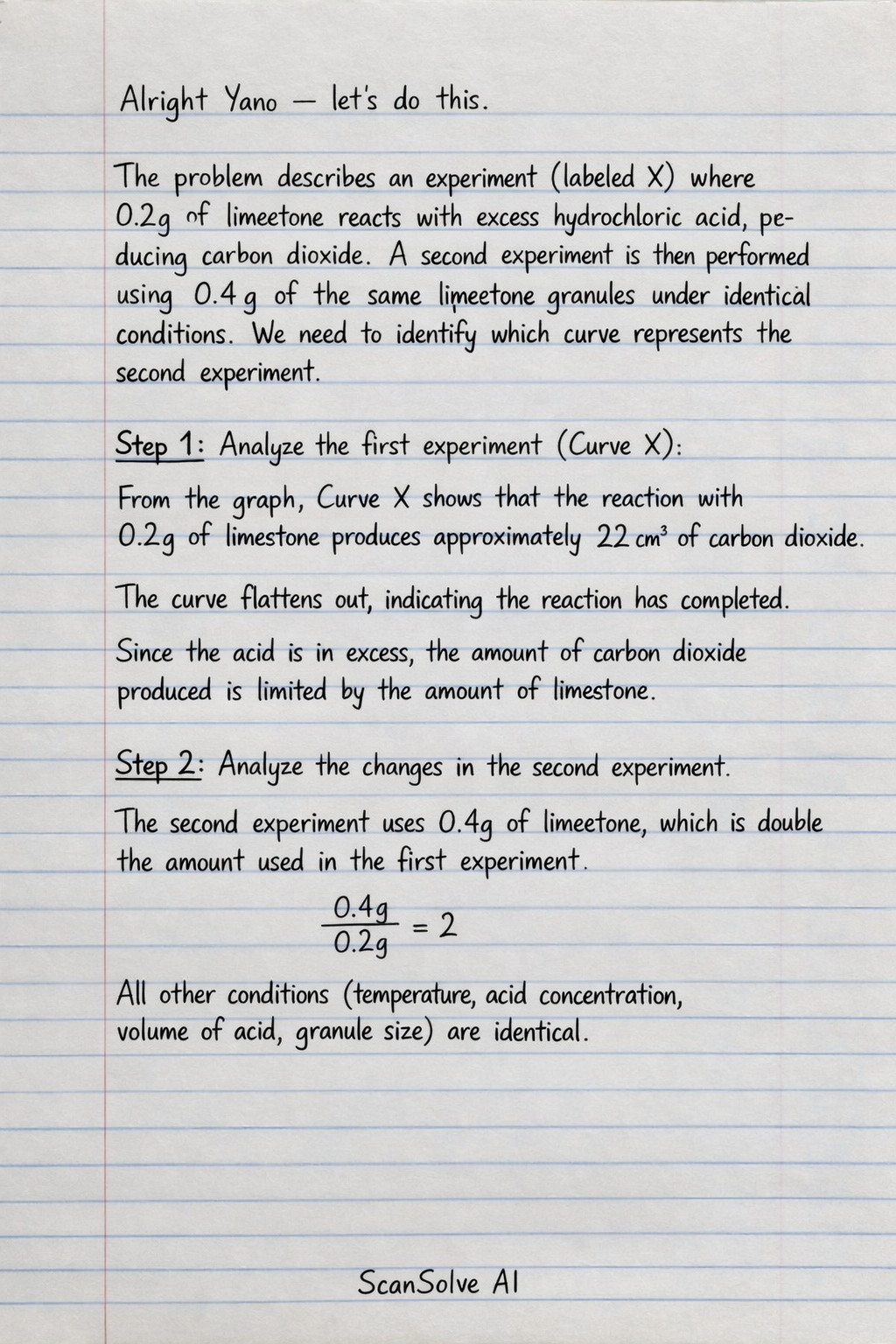
5 stepsThe problem describes an experiment (labeled X) where of limestone reacts with excess hydrochloric acid, producing carbon dioxide. A second experiment is then performed using of the same limestone granules under identical conditions. We need to identify which curve represents the second experiment.
Analyze the first experiment (Curve X).
From the graph, Curve X shows that the reaction with of limestone produces approximately of carbon dioxide. The curve flattens out, indicating the reaction has completed. Since the acid is in excess, the amount of carbon dioxide produced is limited by the amount of limestone.
Analyze the changes in the second experiment.
The second experiment uses of limestone, which is double the amount used in the first experiment (). All other conditions (temperature, acid concentration, volume of acid, granule size) are identical.
Determine the total volume of produced in the second experiment.
Since the amount of limestone is doubled, and limestone is the limiting reactant, the total volume of carbon dioxide produced will also double.
Volume of for limestone .
Volume of for limestone .Determine the initial rate of reaction in the second experiment.
Using of the same limestone granules means there is a larger total surface area available for the reaction compared to . A larger surface area leads to a faster rate of reaction because there are more sites for collisions between reactant particles. Therefore, the initial slope of the curve for the second experiment should be steeper than Curve X.
Compare these predictions with the given curves.
- Curve (i): Reaches a final volume of approximately and has a steeper initial slope than Curve X. This matches our predictions.
- Curve (ii): Reaches a final volume of approximately . This is not double the volume of X.
- Curve (iii): Reaches a final volume of approximately (same as X). This is incorrect.
- Curve (iv): Reaches a final volume of approximately and has a less steep initial slope. This is incorrect.
Therefore, Curve (i) correctly represents the results of the second experiment.
The final answer is .
Try one yourself
A new problem that tests the same skill.
Still stuck on this one?
Ask a follow-up, and the answer starts from this question.
More Chemistry Questions
Handwritten Step-by-Step Solution
Get this as a handwritten image on WhatsApp — like a tutor wrote it for you.
Try on WhatsApp