
We read your photo as:
How many potassium ions are present in 25 cm3 of 2M KOH? (Avogadro number = 6.02 x 10²³)
ScanSolve AI Answer
Answer
Step-by-step solution
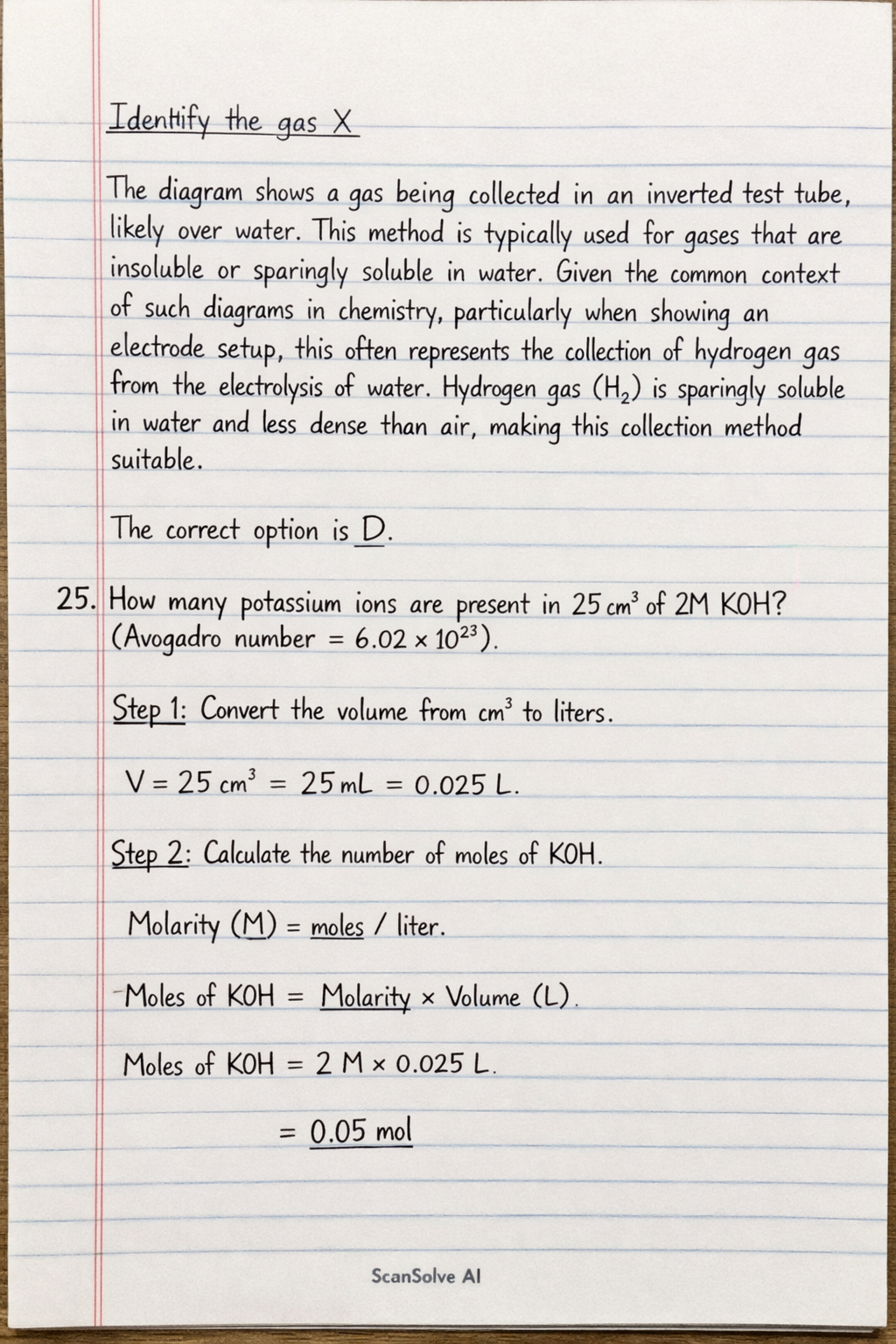
7 stepsIdentify the gas X
The diagram shows a gas being collected in an inverted test tube, likely over water. This method is typically used for gases that are insoluble or sparingly soluble in water. Given the common context of such diagrams in chemistry, particularly when showing an electrode setup (as suggested by the partial image above), this often represents the collection of hydrogen gas from the electrolysis of water. Hydrogen gas (H) is sparingly soluble in water and less dense than air, making this collection method suitable.
The correct option is D.
25. How many potassium ions are present in 25 cm of 2M KOH? (Avogadro number = 6.02 x 10)
Convert the volume from cm to liters.
Calculate the number of moles of KOH.
Molarity (M) is defined as moles per liter.
Determine the number of moles of potassium ions (K).
Potassium hydroxide (KOH) is a strong electrolyte and dissociates completely in water:
For every 1 mole of KOH, 1 mole of K ions is produced.
Calculate the total number of potassium ions.
The correct option is B.
26. A gas of volume 420 cm has a pressure of 790 mmHg. What will be its new volume if the pressure reduces to 740 mmHg?
This problem can be solved using Boyle's Law, which states that for a fixed amount of gas at constant temperature, the pressure and volume are inversely proportional ().
Identify the given values.
Initial volume () =
Initial pressure () =
Final pressure () =
Final volume () = ?Apply Boyle's Law formula.
Solve for .
Rounding to the nearest whole number, the new volume is approximately .
The correct option is C.
Try one yourself
A new problem that tests the same skill.
Still stuck on this one?
Ask a follow-up, and the answer starts from this question.
More Chemistry Questions
Handwritten Step-by-Step Solution
Get this as a handwritten image on WhatsApp — like a tutor wrote it for you.
Try on WhatsApp