
We read your photo as:
What is meant by the term isoelectronic series? A group of atoms, ions or molecules that have the same number of electrons but different nuclear charges (e.g. examples: Np⁴⁻, mg²⁺, Al³⁺, F⁻, n²⁻ all have 10 electrons).
ScanSolve AI Answer
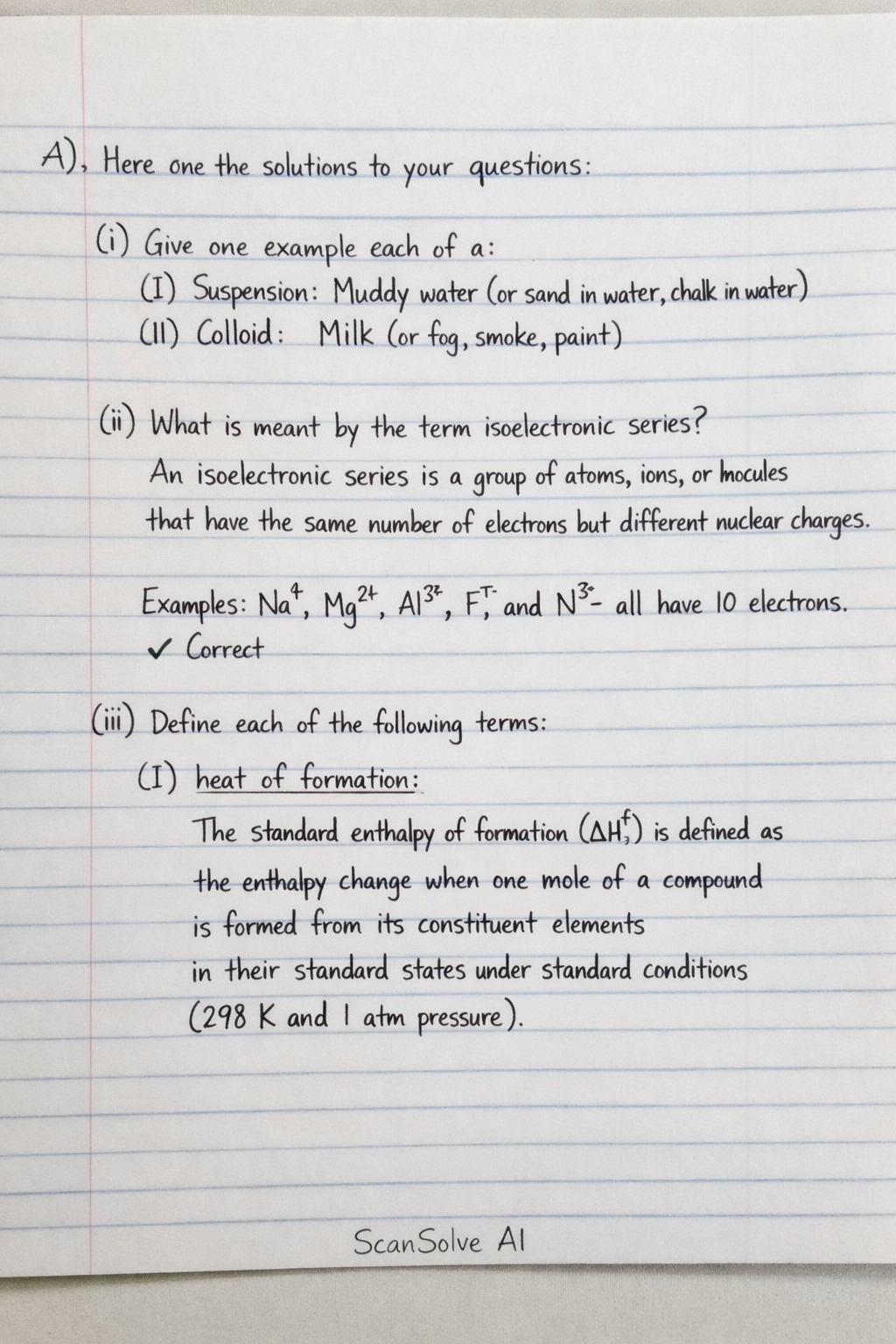
Here are the solutions to your questions:
A)
(i) Give one example each of a:
(I) suspension: Muddy water (or sand in water, chalk in water)
(II) colloid: Milk (or fog, smoke, paint)
(ii) What is meant by the term isoelectronic series?
Your definition is correct. An isoelectronic series is a group of atoms, ions, or molecules that have the same number of electrons but different nuclear charges.
Your examples are also correct: , , , , and all have 10 electrons.
✅ Correct
(iii) Define each of the following terms:
(I) heat of formation:
The standard enthalpy of formation () is defined as the enthalpy change when one mole of a compound is formed from its constituent elements in their standard states under standard conditions (298 K and 1 atm pressure).
Still stuck on this one?
Ask a follow-up, and the answer starts from this question.
More Chemistry Questions
Handwritten Step-by-Step Solution
Get this as a handwritten image on WhatsApp — like a tutor wrote it for you.
Try on WhatsApp