
We read your photo as:
Explain the mechanism of the Friedel-Crafts acylation of toluene using acetyl chloride and aluminum chloride.
ScanSolve AI Answer
Answer
Step-by-step solution
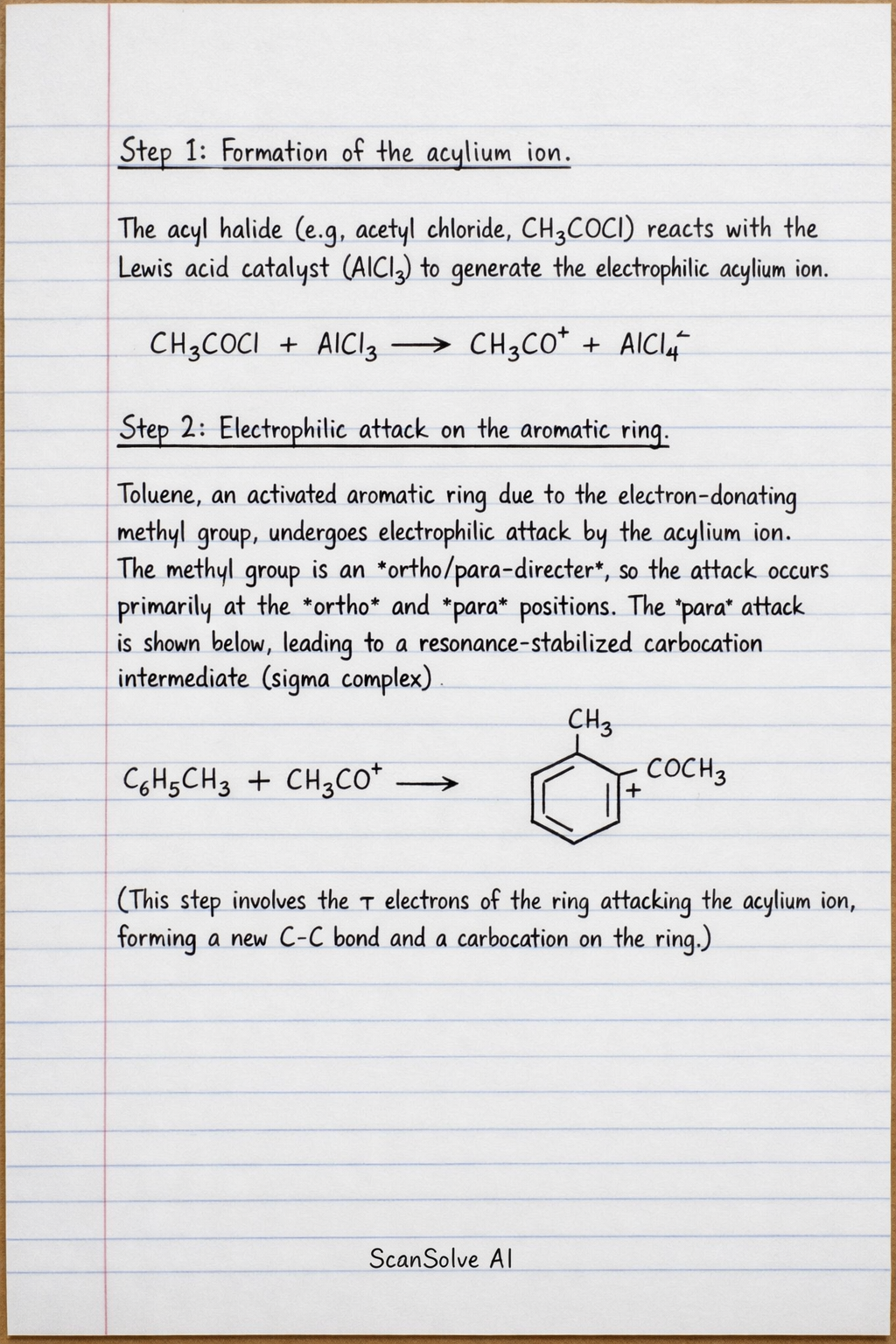
3 stepsFormation of the acylium ion.
The acyl halide (e.g., acetyl chloride, ) reacts with the Lewis acid catalyst () to generate the electrophilic acylium ion.
Electrophilic attack on the aromatic ring.
Toluene, an activated aromatic ring due to the electron-donating methyl group, undergoes electrophilic attack by the acylium ion. The methyl group is an ortho/para-director, so the attack occurs primarily at the ortho and para positions. The para attack is shown below, leading to a resonance-stabilized carbocation intermediate (sigma complex).
(This step involves the electrons of the ring attacking the acylium ion, forming a new C-C bond and a carbocation on the ring.)
Deprotonation and re-aromatization.
A base (typically ) abstracts a proton from the carbon that was attacked, restoring aromaticity to the ring and regenerating the catalyst.
Product Analysis:
The methyl group () on toluene is an activating group and an ortho/para-director. This means it increases the electron density of the aromatic ring, making it more reactive towards electrophiles, and directs the incoming acyl group () to the ortho and para positions relative to itself.Therefore, Friedel-Crafts acylation of toluene with acetyl chloride will yield a mixture of:
- ortho-methylacetophenone (1-(2-methylphenyl)ethan-1-one)
- para-methylacetophenone (1-(4-methylphenyl)ethan-1-one)
The para isomer is typically the major product due to less steric hindrance between the methyl group and the incoming acyl group compared to the ortho position.
The major product is:
Try one yourself
A new problem that tests the same skill.
Still stuck on this one?
Ask a follow-up, and the answer starts from this question.
More Chemistry Questions
Handwritten Step-by-Step Solution
Get this as a handwritten image on WhatsApp — like a tutor wrote it for you.
Try on WhatsApp