
We read your photo as:
Calculate the moles of nitric acid (HNO₃) used.
ScanSolve AI Answer
Step-by-step solution
16 stepsHere are the solutions to the questions.
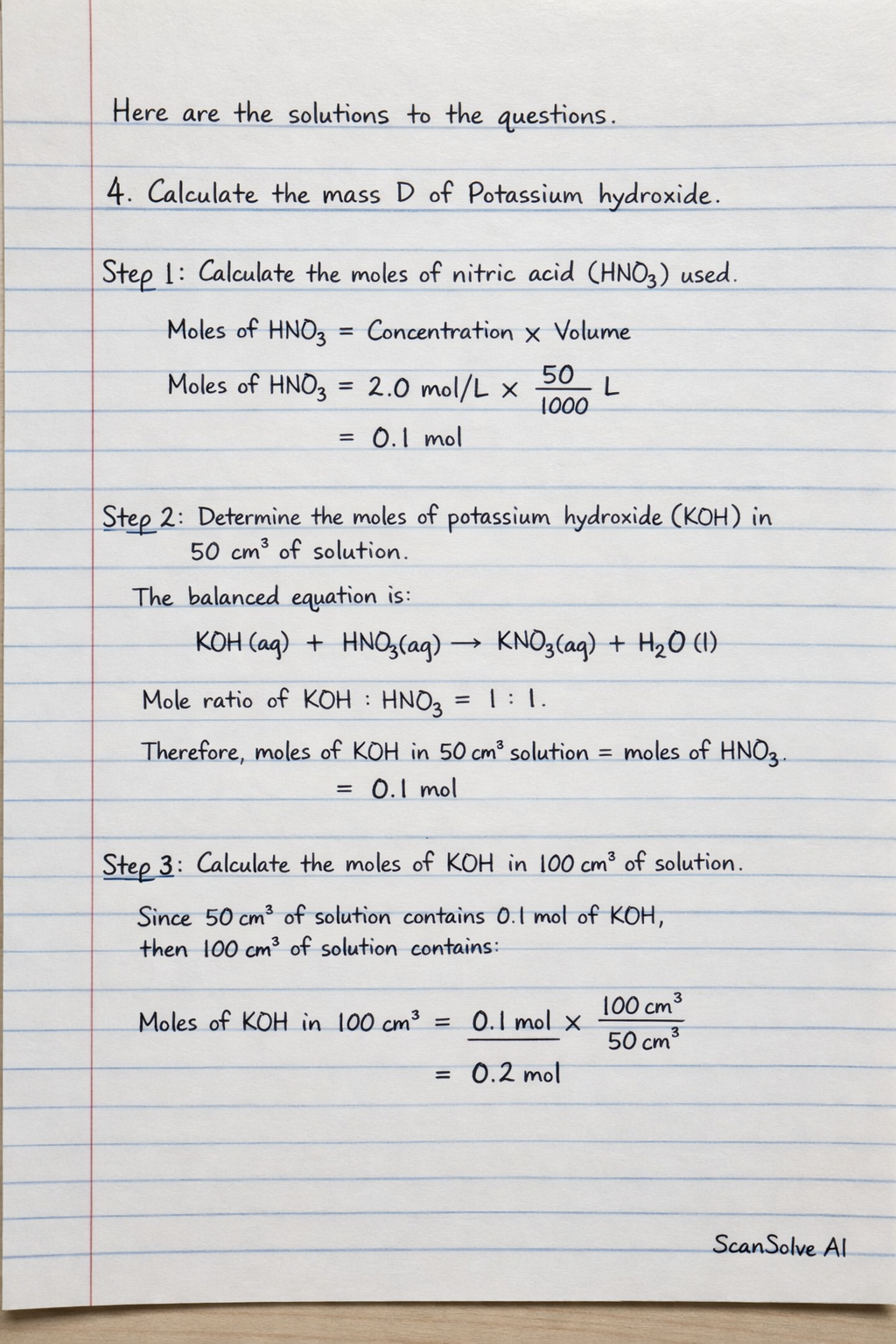
4. Calculate the mass D of Potassium hydroxide.
Calculate the moles of nitric acid () used.
Determine the moles of potassium hydroxide () in 50 of solution.
The balanced equation is .
From the equation, the mole ratio of is .
Therefore, moles of in 50 solution = moles of = 0.1 mol.Calculate the moles of in 100 of solution.
Since 50 of solution contains 0.1 mol of , then 100 of solution contains:
Calculate the mass D of .
Relative formula mass (RFM) of .
The mass D of Potassium hydroxide is .
5. Calculate the mass of sodium sulphite that was used.
Write the balanced chemical equation for the reaction.
Calculate the moles of sulphur dioxide () gas produced.
Molar gas volume = 24000 /mol.
Determine the moles of sodium sulphite () used.
From the balanced equation, the mole ratio of is .
Therefore, moles of used = 0.04 mol.Calculate the mass of sodium sulphite used.
Molar mass of sodium sulphite = 126 g/mol.
The mass of sodium sulphite used is .
6. Calculate the volume of chlorine which will react with iron to form 0.5g of Iron (III) chloride.
Calculate the molar mass of Iron (III) chloride ().
Atomic mass of Fe = 56
Atomic mass of Cl = 35.5Calculate the moles of formed.
Determine the moles of chlorine () required.
The balanced equation is .
From the equation, the mole ratio of is .Calculate the volume of chlorine gas.
Molar gas volume at 298K = 24 /mol.
Converting to :
The volume of chlorine required is approximately .
7. Calculate the concentration of the solution in moles per litre.
Calculate the mass of ethanoic acid () used.
Density of ethanoic acid = 1.05 .
Volume of ethanoic acid = 15.0 .Calculate the molar mass of ethanoic acid ().
Atomic masses: C=12, H=1, O=16.
Calculate the moles of ethanoic acid.
Calculate the concentration of the solution in moles per litre.
Total volume of solution = 500 .
The concentration of the solution is .
Still stuck on this one?
Ask a follow-up, and the answer starts from this question.
More Chemistry Questions
Handwritten Step-by-Step Solution
Get this as a handwritten image on WhatsApp — like a tutor wrote it for you.
Try on WhatsApp