
We read your photo as:
Write an equation for the reaction between concentrated Nitric (V) acid and wood charcoal.
ScanSolve AI Answer
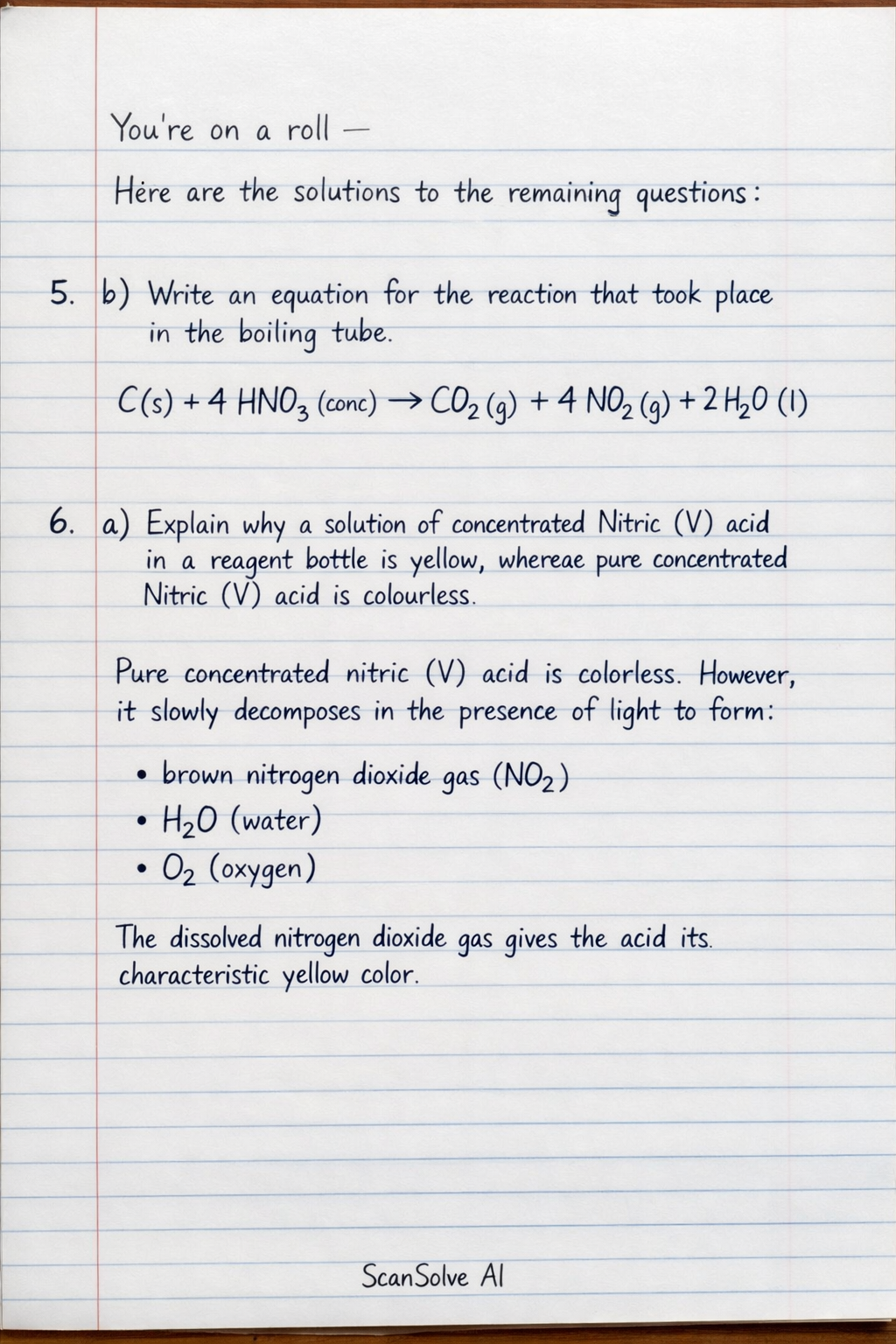
Here are the solutions to the remaining questions:
-
In an experiment to study the properties of concentrated Nitric (V) acid, a mixture of the acid and wood charcoal was heated in a boiling tube. b) Write an equation for the reaction that took place in the boiling tube.
-
a) Explain why a solution of concentrated Nitric (V) acid in a reagent bottle is yellow, whereas pure concentrated Nitric (V) acid is colourless. Pure concentrated nitric (V) acid is colorless. However, it slowly decomposes in the presence of light to form brown nitrogen dioxide gas (), water, and oxygen. The dissolved nitrogen dioxide gas gives the acid its characteristic yellow color.
b) Explain the observation made when acidified Iron (II) chloride solution is warmed with concentrated acid.
Observation: The green solution turns yellow-brown. Brown fumes may also be observed.
Explanation: Concentrated nitric (V) acid is a strong oxidizing agent. It oxidizes the green iron (II) ions () in the iron (II) chloride solution to yellow-brown iron (III) ions (). The nitric acid itself is reduced, often forming brown nitrogen dioxide gas. -
a) Water from a town in Kenya is suspected to contain chloride ions but not sulphate ions. Describe how the presence of the chloride ions in the water can be shown. To test for chloride ions: Add a few drops of dilute nitric acid to a sample of the water, followed by a few drops of silver nitrate solution. The formation of a white precipitate (silver chloride) indicates the presence of chloride ions.
b) Heated iron can react with both chlorine gas and hydrogen chloride gas.
i) Write equations for the reactions.- Reaction with chlorine gas:
- Reaction with hydrogen chloride gas:
c) In an experiment, chlorine gas was passed into moist hydrogen sulphide in a boiling tube.
a) What observation was made in the boiling tube?
A yellow precipitate (of sulfur) was formed.b) What precaution should be taken in carrying out this experiment? Give a reason.
Precaution: The experiment should be carried out in a fume cupboard or a well-ventilated area.
Reason: Both chlorine gas () and hydrogen sulfide gas () are toxic and corrosive. -
a) State Boyle's Law. Boyle's Law states that for a fixed mass of gas at a constant temperature, the pressure is inversely proportional to its volume.
b) A sample of nitrogen gas occupying at atmospheres is compressed to atmospheres. Calculate the new volume of the gas. Assume the temperature remains constant.
The question is incomplete as the initial and final pressure values are missing. Assuming the initial pressure is and the final pressure is :
Given:
(assumed)
(assumed)
Using Boyle's Law, :The new volume of the gas is .
c) A sample of oxygen gas occupies a volume of at a pressure of . What will be the pressure if the same sample occupies a volume of ? Assume the temperature remains constant.
Given:
Using Boyle's Law, :The new pressure will be .
-
A Form Three student carried out an experiment and obtained the following data and recorded as in the table below; answer the questions that follow. a) Complete the table above. For Boyle's Law, . From the given data: So, the constant is 300.
Now, complete the table:
- For : .
- For : .
- For : .
The completed table is:
Pressure 1/Pressure Volume 5 0.20 60 10 0.10 30 15 0.0667 20 20
Still stuck on this one?
Ask a follow-up, and the answer starts from this question.
More Chemistry Questions
Handwritten Step-by-Step Solution
Get this as a handwritten image on WhatsApp — like a tutor wrote it for you.
Try on WhatsApp