
We read your photo as:
Calculate the concentration of a nitric (V) acid solution prepared by adding distilled water to 20 cm3 of the stock acid solution to make 250 cm3 of solution. State any two differences between a lumin
ScanSolve AI Answer
Step-by-step solution
3 stepsHere are the solutions to the questions:
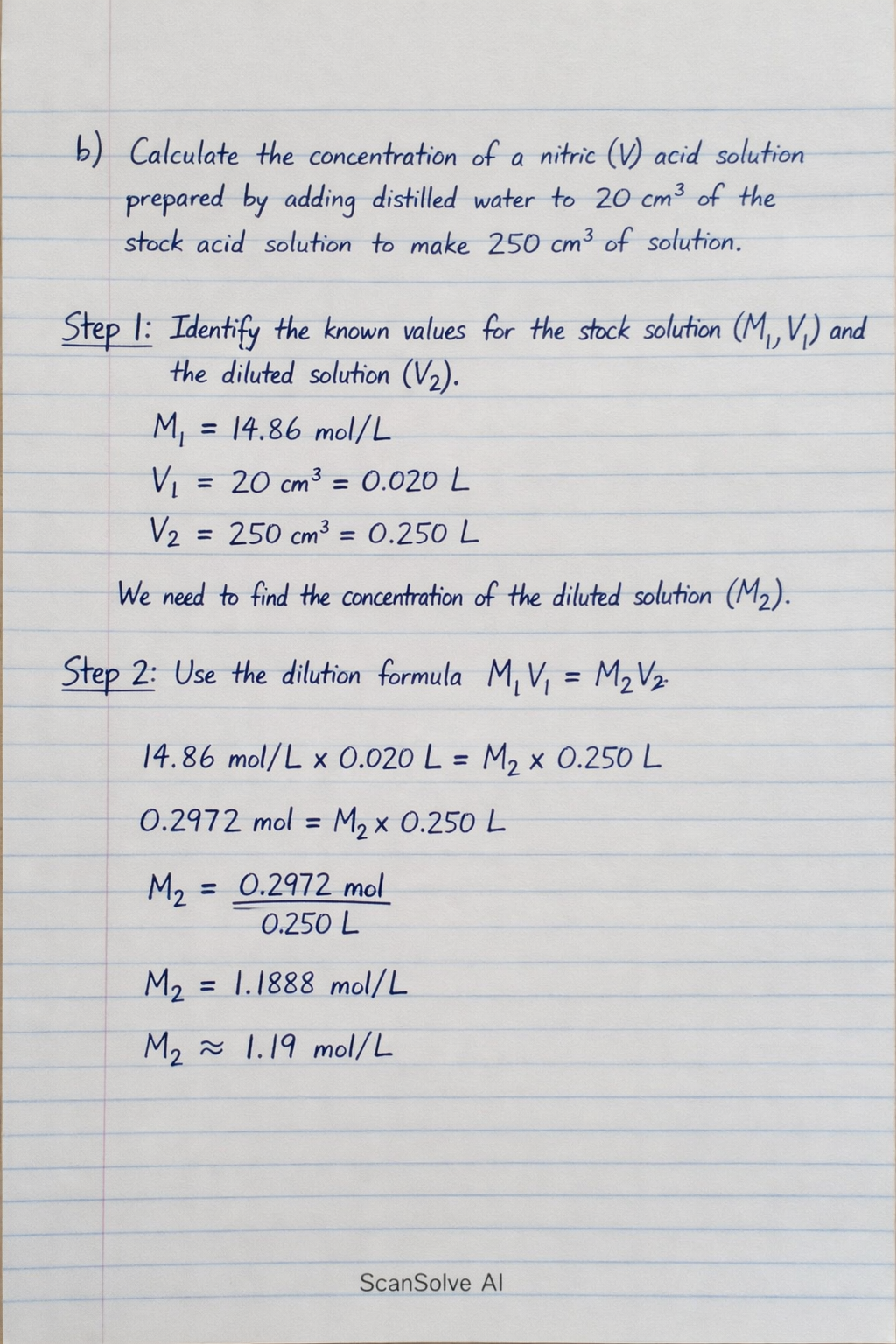
b) Calculate the concentration of a nitric (V) acid solution prepared by adding distilled water to 20 cm of the stock acid solution to make 250 cm of solution.
Identify the known values for the stock solution () and the diluted solution ().
From the previous problem, the concentration of the stock nitric acid solution () is .
Volume of stock solution () =
Final volume of diluted solution () =
We need to find the concentration of the diluted solution ().Use the dilution formula .
Solve for .
Rounding to three significant figures:
The concentration of the diluted nitric acid solution is .a) State any two differences between a luminous flame and a non-luminous flame.
- A luminous flame produces light and soot, while a non-luminous flame produces little to no light and no soot.
- A luminous flame results from incomplete combustion due to an insufficient oxygen supply, whereas a non-luminous flame results from complete combustion due to a sufficient oxygen supply.
b) A luminous flame produces bright yellow light. Explain this observation.
A luminous flame produces bright yellow light due to incomplete combustion. This occurs when there is an insufficient supply of oxygen, leading to the formation of tiny, unburnt carbon particles. These carbon particles are heated to incandescence (glow brightly due to high temperature) and emit yellow light.- The setup below is a boiling tube inverted over a basin of chlorine water.
a) State two observations that would be made when the setup is exposed to sunlight.
- Gas bubbles would be produced, and the water level in the inverted boiling tube would drop.
- The pale yellow-green color of the chlorine water would fade or disappear.
Still stuck on this one?
Ask a follow-up, and the answer starts from this question.
More Chemistry Questions
Handwritten Step-by-Step Solution
Get this as a handwritten image on WhatsApp — like a tutor wrote it for you.
Try on WhatsApp