
We read your photo as:
Name the compound HO-CH2-C≡C-CH2-C≡CH according to IUPAC nomenclature rules.
ScanSolve AI Answer
Answer
Step-by-step solution
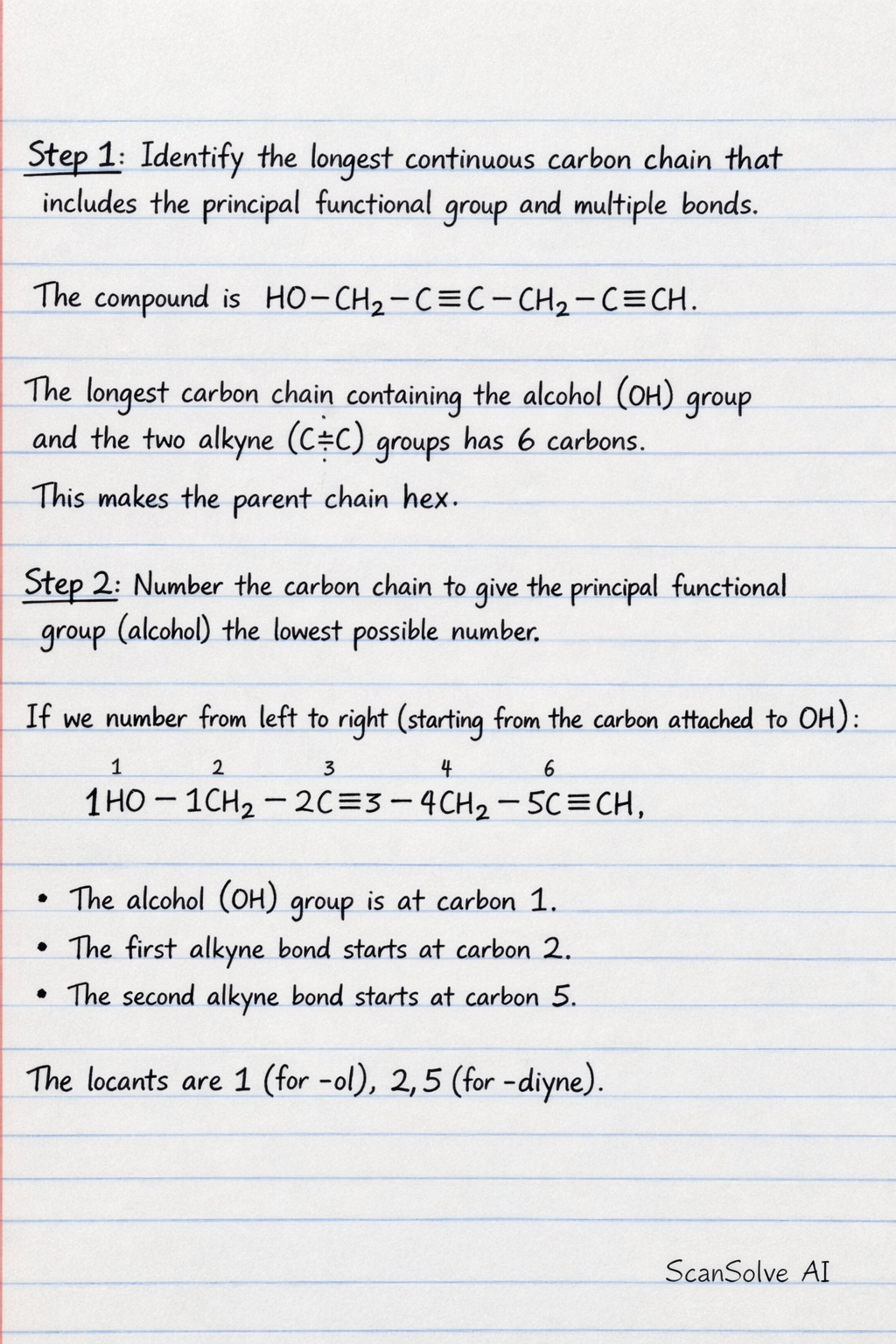
3 stepsIdentify the longest continuous carbon chain that includes the principal functional group and multiple bonds.
The compound is .
The longest carbon chain containing the alcohol () group and the two alkyne () groups has 6 carbons.
This makes the parent chain hex.Number the carbon chain to give the principal functional group (alcohol) the lowest possible number.
If we number from left to right (starting from the carbon attached to ):
- The alcohol () group is at carbon 1.
- The first alkyne bond starts at carbon 2.
- The second alkyne bond starts at carbon 5. The locants are 1 (for -ol), 2, 5 (for -diyne).
If we number from right to left:
- The alcohol () group is at carbon 6.
- The first alkyne bond starts at carbon 1.
- The second alkyne bond starts at carbon 4. The locants are 6 (for -ol), 1, 4 (for -diyne).
According to IUPAC rules, the principal functional group (alcohol) takes precedence in numbering. Therefore, numbering from left to right is correct, as it assigns the lowest possible number (1) to the carbon bearing the group.
Name the compound by combining the parent chain, multiple bond locants and suffixes, and the principal functional group locant and suffix.
- Parent chain: hex- (for 6 carbons)
- Two alkyne groups at positions 2 and 5: -2,5-diyne
- Alcohol group at position 1: -1-ol
Combine these parts. The "e" from "diyne" is dropped before the "ol" suffix.
The name of the compound is:
Try one yourself
A new problem that tests the same skill.
Still stuck on this one?
Ask a follow-up, and the answer starts from this question.
More Chemistry Questions
Handwritten Step-by-Step Solution
Get this as a handwritten image on WhatsApp — like a tutor wrote it for you.
Try on WhatsApp