
We read your photo as:
Name the following organic compounds: 1. 4-propylheptane 2. 1-bromo-3-chloro-2-fluorobutane
ScanSolve AI Answer
Step-by-step solution
8 stepsHere are the solutions based on the image provided:
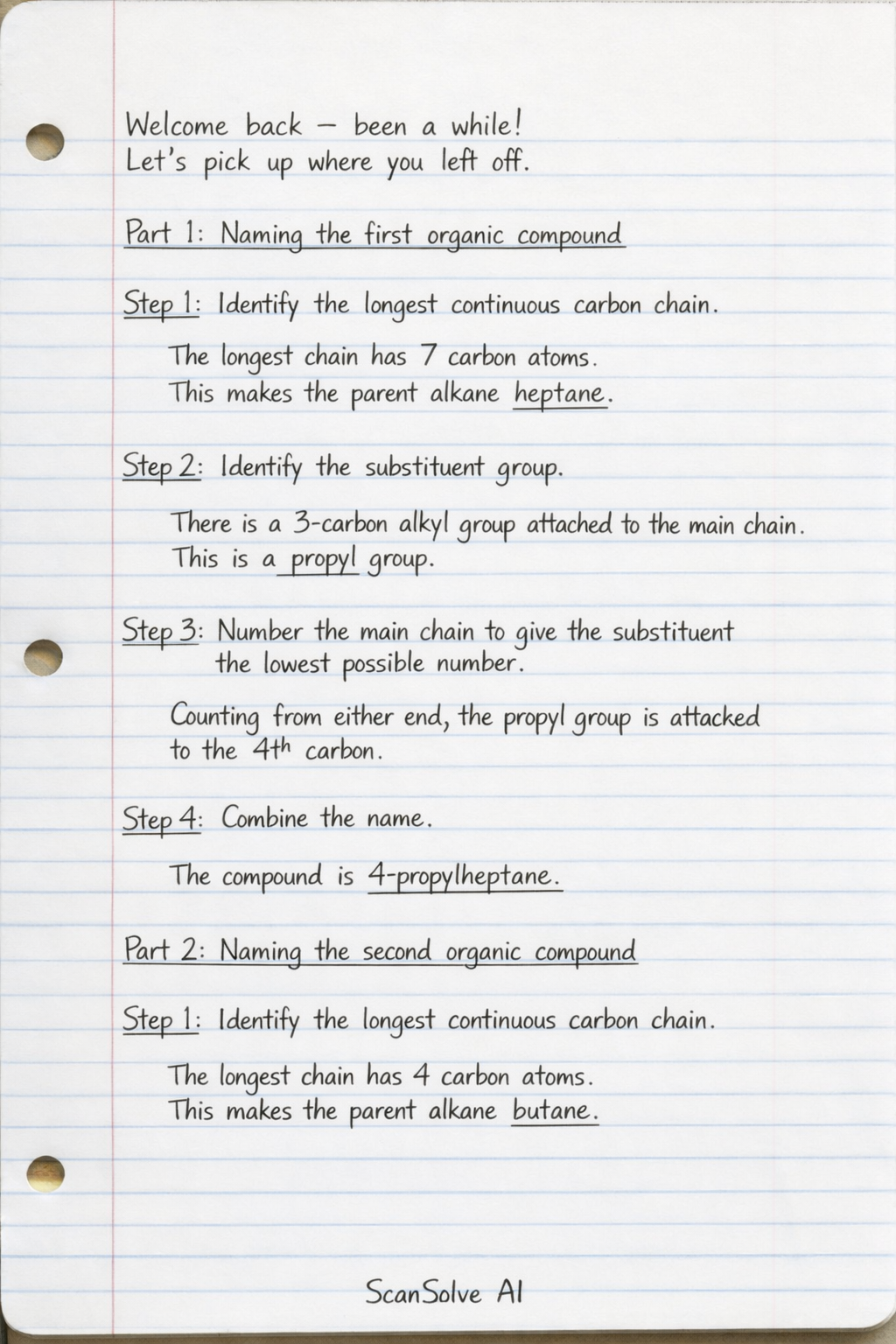
Part 1· 4 steps
Naming the first organic compound
Identify the longest continuous carbon chain.
The longest chain has 7 carbon atoms. This makes the parent alkane heptane.
Identify the substituent group.
There is a 3-carbon alkyl group attached to the main chain. This is a propyl group.
Number the main chain to give the substituent the lowest possible number.
Counting from either end, the propyl group is attached to the 4th carbon.
Combine the name.
The compound is 4-propylheptane.
Part 2· 4 steps
Naming the second organic compound
Identify the longest continuous carbon chain.
The longest chain has 4 carbon atoms. This makes the parent alkane butane.
Identify and number the substituents.
The substituents are bromo (), fluoro (), and chloro ().
Numbering the chain from left to right gives substituents at positions 1 (bromo), 2 (fluoro), and 3 (chloro).
Numbering from right to left gives substituents at positions 2 (chloro), 3 (fluoro), and 4 (bromo).
The set of locants (1, 2, 3) is lower than (2, 3, 4), so we number from left to right.List the substituents in alphabetical order.
Bromo comes before chloro, which comes before fluoro.
Combine the name with locants and alphabetical order.
The compound is 1-bromo-3-chloro-2-fluorobutane.
Part 3
Explanation of prefixes for multiple substituents
When the same substituent appears more than once in a molecule, a prefix is used to indicate its number. These prefixes are di- for two, tri- for three, tetra- for four, and so on. The position of each identical substituent is indicated by a number, and these numbers are separated by commas. For example, if there are two methyl groups at positions 2 and 3, it would be named 2,3-dimethyl.
Still stuck on this one?
Ask a follow-up, and the answer starts from this question.
More Chemistry Questions
Handwritten Step-by-Step Solution
Get this as a handwritten image on WhatsApp — like a tutor wrote it for you.
Try on WhatsApp