

This chemistry question involves key chemical concepts and calculations. The detailed solution below walks through each step, from identifying the reaction type to computing the final answer.
ScanSolve AI Answer
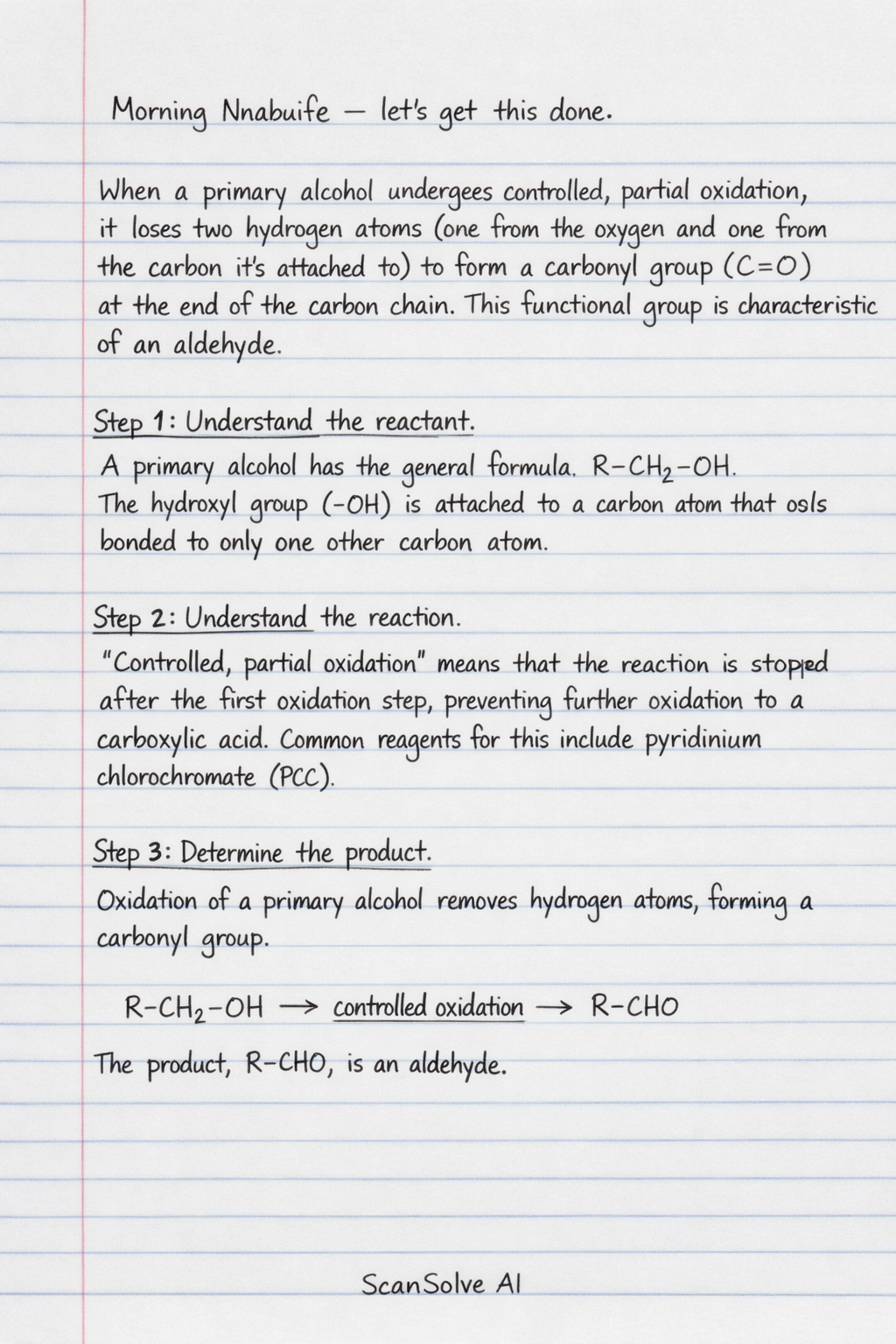
When a primary alcohol undergoes controlled, partial oxidation, it loses two hydrogen atoms (one from the oxygen and one from the carbon it's attached to) to form a carbonyl group (C=O) at the end of the carbon chain. This functional group is characteristic of an aldehyde. Step 1: Understand the reactant. A primary alcohol has the general formula R-CH_2-OH . The hydroxyl group (-OH) is attached to a carbon atom that is bonded to only one other carbon atom. Step 2: Understand the reaction. Controlled, partial oxidation means that the reaction is stopped after the first oxidation step, preventing further oxidation to a carboxylic acid. Common reagents for this include pyridinium chlorochromate (PCC). Step 3: Determine the product. Oxidation of a primary alcohol removes hydrogen atoms, forming a carbonyl group. R-CH_2-OH controlled oxidation R-CHO The product, R-CHO, is an aldehyde. Step 4: Compare with the given options. A. Ester: Formed from a carboxylic acid and an alcohol. B. Ketone: Formed from the oxidation of a secondary* alcohol. C. Aldehyde: Formed from the controlled oxidation of a primary* alcohol. D. Ether: Formed by dehydration of alcohols or Williamson ether synthesis. The correct answer is C. The final answer is C. Aldehyde.